

Over the decades, Volkswagen has managed to position parts sharing as one of its most powerful money-saving methods. With the need to cut costs in mind, VW created the Modularer Querbaukasten, or MQB, vehicle architecture. Audi, SEAT, and Škoda all use the platform alongside Volkswagen, but each brand has its own, unique styling that sets the models apart, despite their shared bones.
According to Volkswagen itself, the MQB strategy drastically reduced development costs, as well as production timeframes. One-time expenses also dropped, as tooling investments were not nearly as widespread. While this all sounds great, there’s a huge downside to sharing a platform: shared defects. At present, roughly four million VW, Audi, Škoda, and SEAT models are suffering through a recall campaign due to a corrosion-prone steering rack fastener. The fix is easy, but the issue is widespread, and VW’s current sales stagnation doesn’t help.
MQB Was One Of VW’s Greatest Engineering And Financial Tricks
2025 Volkswagen Golf GTI from the front three-quarter angleJoel Stocksdale
The short and skinny of the MQB platform: it is a modular vehicle architecture introduced by VW in 2012 and still in production today. It uses standardized dimensions across multiple iterations, making it easy to produce in large quantities. According to the German automaker, MQB “harmonizes” things, such as track width and wheelbase length. It also retains similar wheel sizes and even seating positions within the cabin. At the same time, the MQB platform can be stretched or shortened to fit a huge number of vehicles.
The scope of the MQB’s usefulness expands outside simple passenger cars. It can also be used by commercial vehicles, allowing VW to spread its engineering investment across huge production volumes, instead of developing every car independently. For context, designing, engineering, and producing an all-new car model can cost anywhere from $1 billion to $6 billion. Now you can see why VW wanted to save a few euros with the MQB architecture.
Since 2012, about 45 million vehicles have been produced on the MQB platform, which makes up roughly a third of the brand’s total production volume over that same timeframe. Just a single component found within an MQB vehicle saves VW money, as the cost of making it can be spread across multiple brands and models. That cost can then be spread across 45 million models without, in some cases, so much as a minor alteration.
Volkswagen has made sure to differentiate its MQB users, too. If you look at something like a Mk8 Volkswagen Golf and the Euro-market Mk4 Škoda Octavia, you wouldn’t be able to see the similarities at a glance. Even inside, both models look drastically different, and use different electronic interfaces and so on. However, both models utilize virtually the exact same iteration of the MQB platform.
For Volkswagen, creating the MQB platform created a significant financial advantage, but it also opened the brand up to disastrous issues if something goes wrong. As it turns out, something did.
A Steering Bolt Showed What Happens When A Single Shared Component Fails
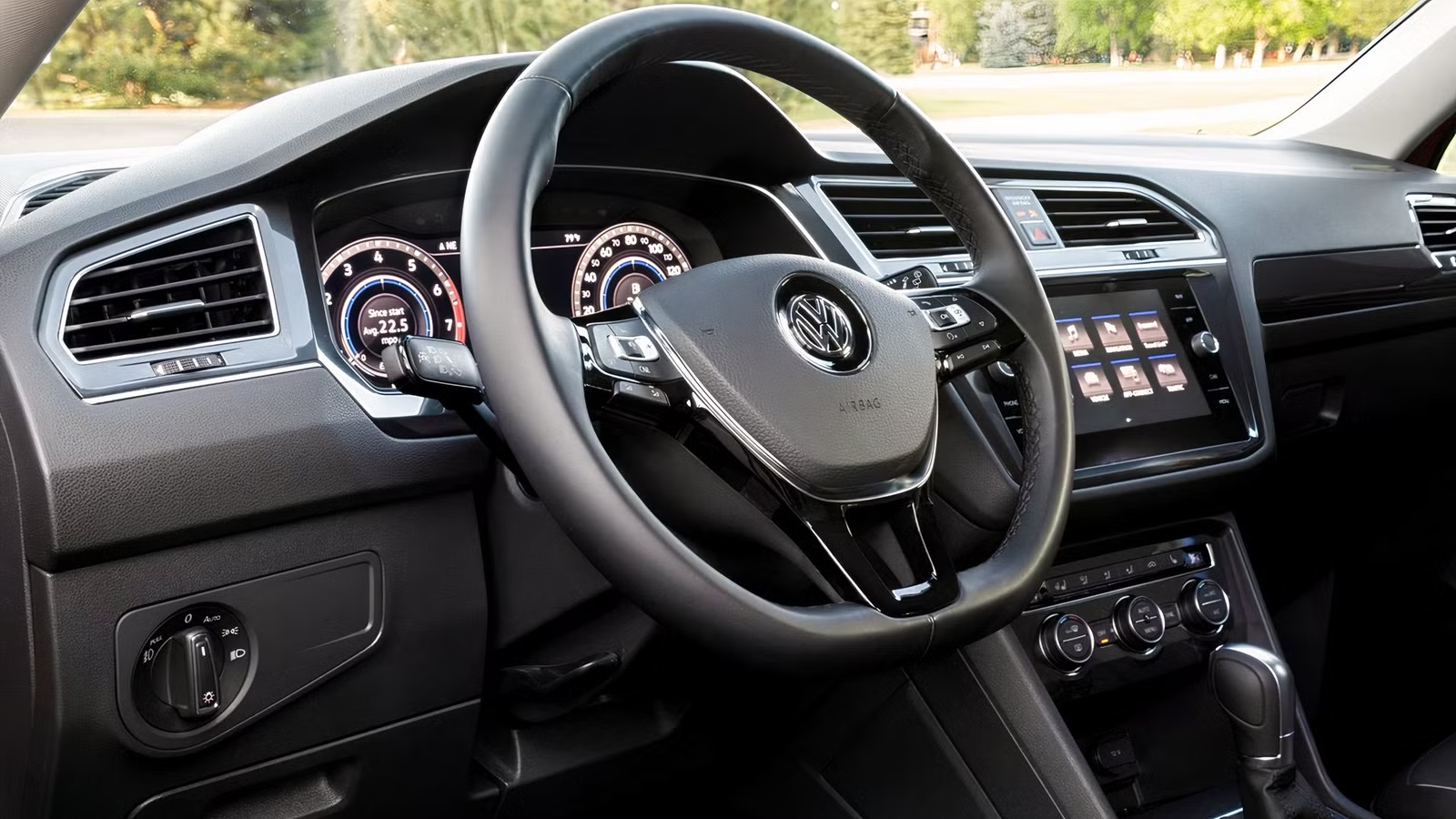
2026 Volkswagen Jetta SEL. Cabin. Interior. Steering wheelVolkswagen
We now know that having a highly standardized platform can be great for the bottom line. The failure of a single bolt in the MQB’s steering system, though, has proven to be heavy-hitting due to the sheer number of vehicles using the architecture currently on the road. The steering bolt in question tends to corrode when exposed to moisture and road salt. If said corrosion reaches a certain point, the bolt can snap and compromise steering. One shared part, billions in losses.
The affected models include the Volkswagen Tiguan, Touran, Golf, and Caddy. The Audi Q3 has also been affected, along with some additional Škoda and SEAT models. In total, it is estimated that over 4 million vehicles were equipped with the corrosion-prone steering bolt. Initially, that number sat at around 2.8 to 2.9 million models, but it was soon found that both Škoda and SEAT models were affected, too, through internal VW reports.
2014 Seat Leon Cupra Exterior Finished In White Surrounded By Shipping Containers Seat
What Volkswagen has suffered is something unique to mass-market production strategies. Not only is that steering bolt a safety issue, but it is also found in a litany of cars spanning widely different price points and market niches. The Audi Q3, for example, is not marketed with the same starting price as something like a base VW Golf. Because of the MQB platform, though, the very same issue affecting the cheapest MQB model can harm those on the higher end of the scale, too.
It’s not that Volkswagen was totally blindsided by the steering bolt recall, though. Its own risk assessment disclosures foresaw a problem like this one. In those disclosures, the German automaker sounded the alarm that quality issues involving shared components can affect a huge number of models, which could in turn hurt the reputations of several brands all at the same time, and for the same reason.
As of this writing, no crashes, deaths, or injuries have been reported in connection with the rusty steering bolt. However, considering the affected system is the steering, the need to repair the issue is quite severe.
The Timing Couldn’t Be Worse
2027 VW Atlas Cross Sport grilleVolkswagen
Volkswagen hasn’t had a very good year. The brand recently reported just a roughly 1% increase in operating return on all sales completed this year. For context, 4% to 5.5% was forecasted. Making things worse, news of this disappointing financial performance came mere days prior to the announcement of the steering bolt issue. And it is not just Volkswagen that is having trouble under the corporate umbrella, either.
Porsche has also recently found itself in financial difficulty. Its fiscal outlook has started to deteriorate, and roughly 6 billion euros has been spent by Volkswagen in an effort to right what are called impairments. Essentially, Porsche’s assets have declined in value, and that 6-billion-euro figure is needed to ensure those assets are properly accounted for. In total, Volkswagen has disclosed 10 to 11.5 billion euros in one-time charges, most of which were caused by Porsche.
There are even more factors at play in Volkswagen’s current misfortunes, such as weak Chinese demand. Volkswagen, Porsche, and Audi are all suffering from varying levels of profit loss, and restructuring expenses are running high as the group’s entire corporate structure is being overhauled in an effort to reduce costs.
The steering bolt fix itself is, luckily, not that expensive. It’s a bolt after all, not something like an entirely new engine. The problem begins when you consider the fact that roughly four million vehicles are going to need that bolt replaced. Technicians installing the bolt will need to be compensated by VW, and shipping that many bolts to dealers and shops will carry a significant cost.
The Sharing-Parts Strategy Isn’t Dead, But Volkswagen Has Learned Its Biggest Limitation
Nissan Hex Bolt 81-46816-1GNissan
Let’s be clear: the MQB platform is not a failure by any stretch. VW’s platform strategy is still central to the brand’s financial structure. In fact, the MQB architecture will be used as a rubric for a few new platforms, such as the MEB, PPE, and the work-in-progress SSP. Currently, almost half of all Volkswagen passenger car and light truck plants are operating as multi-brand sites. That just goes to show how deep platform sharing runs in the VW family.
This steering bolt recall does not mean Volkswagen should, or will, abandon platform sharing and revert to traditional development methods, such as designing every car independently. If it did that, the brand would be willingly throwing away tons of learned innovation, profitability, and time. Volkswagen’s biggest lesson in all of this appears to be something referred to as “risk concentration.”
2027 Audi Q3Audi
Risk concentration simply refers to how much risk any one component or decision carries, based on probabilities. Volkswagen’s bolt issue shows that each and every part involved in a shared platform needs to be heavily scrutinized before final designs are approved. While VW has been saving significant money by using the same parts — such as the steering bolt — across several brands and models, it also opened itself up to considerably more potential backlash.
A shared component does not care whether a Škoda badge or an Audi badge sits on the hood of whatever it is installed in — it can still fail all the same.
Sources: Volkswagen, Reuters, Reuters.
