

It’s 2026, and this isn’t my first launch control start in a powerful electric vehicle. The first in a vehicle with 1,139 max horsepower, to be sure, but I brace myself and don’t think twice about telling my drive partner to drop the hammer. As he does, I have just enough strength in my thumb to start the stopwatch on my iPhone as lateral forces shove me back into the seat. And, maybe, just quick enough reflexes to stop the timer again as the digital speedo blurs past 60 miles per hour.
Base Trim Engine
Electric
Base Trim Transmission
Single-speed Automatic
Base Trim Drivetrain
All-Wheel Drive
Base Trim Horsepower
1139 hp
Base Trim Torque
1106 lb-ft
0-60 MPH
2.4 seconds
Pros & Cons
- Mind-bending acceleration
- Shockingly agile handling for its size
- Huge range of driving personalities
- At $163k, the buying audience is limited?Do you work in oil?
- A serious case of ?EV Face?
- You?d better like screens
The stopwatch reads 2.51 seconds. It is, for lack of a better term, ludicrous. But Porsche’s own spec sheet lists a factory 0-60 time of 2.4 seconds for this 2026 Cayenne Turbo Electric; considering what I just felt and the number looking back on me, after our first hard pull on an abandoned stretch of public, un-prepped road, I tend to believe it.
Mind-meltingly rapid EVs aren’t exactly novel, of course. But this Cayenne’s quickness, in concert with its exemplary performance across a wide range of driving activities, makes it one of the most impressive electrics I’ve driven. Full stop.
What Is It? All-In On Electric Utility
In addition to being an accelerative sledgehammer, the Cayenne Electric is Porsche’s third full BEV vehicle after the Taycan and the Macan Electric. Built to be the EV-powered companion to the brand’s mega-successful luxury performance mid-size SUV, the Cayenne Electric is meant to do everything from off-roading to autobahn burning, well and quickly.
The Turbo version is the top trim level (no forced induction needed), with a maximum of 1,139 hp, and 1,106 pound-feet of torque delivered from two electric motors – one on each axle. The Cayenne Turbo Electric can still manage 303 miles of maximum range, too, if the correct tires are fitted.
Porsche also sells the Cayenne Electric with a base (435 hp) and S (657 hp) powertrain, and all variants can be had with the standard SUV body style or as a Cayenne Coupe that’s essentially a fastback shape. I only drove the Turbo model around the mountains of Colorado, so drive notes of the lower trims and coupe shapes will have to come at a later date.
Exterior Design: Not All Angles Are Equal
Porsche launched the OG Cayenne in 2002 and while modernization in design is necessary, the 2026 model looks best from the rear. Out back the continuous lighting element spans the beltline in a thin, sleek line, emphasizing the slightly flared rear wheel arches and pounce-ready stance. On the Turbo model, you also get the very cool active aeroblades on either side of the bumper – kind of deployable horizontal fins that clean up the drag at speed and look achingly high-tech.
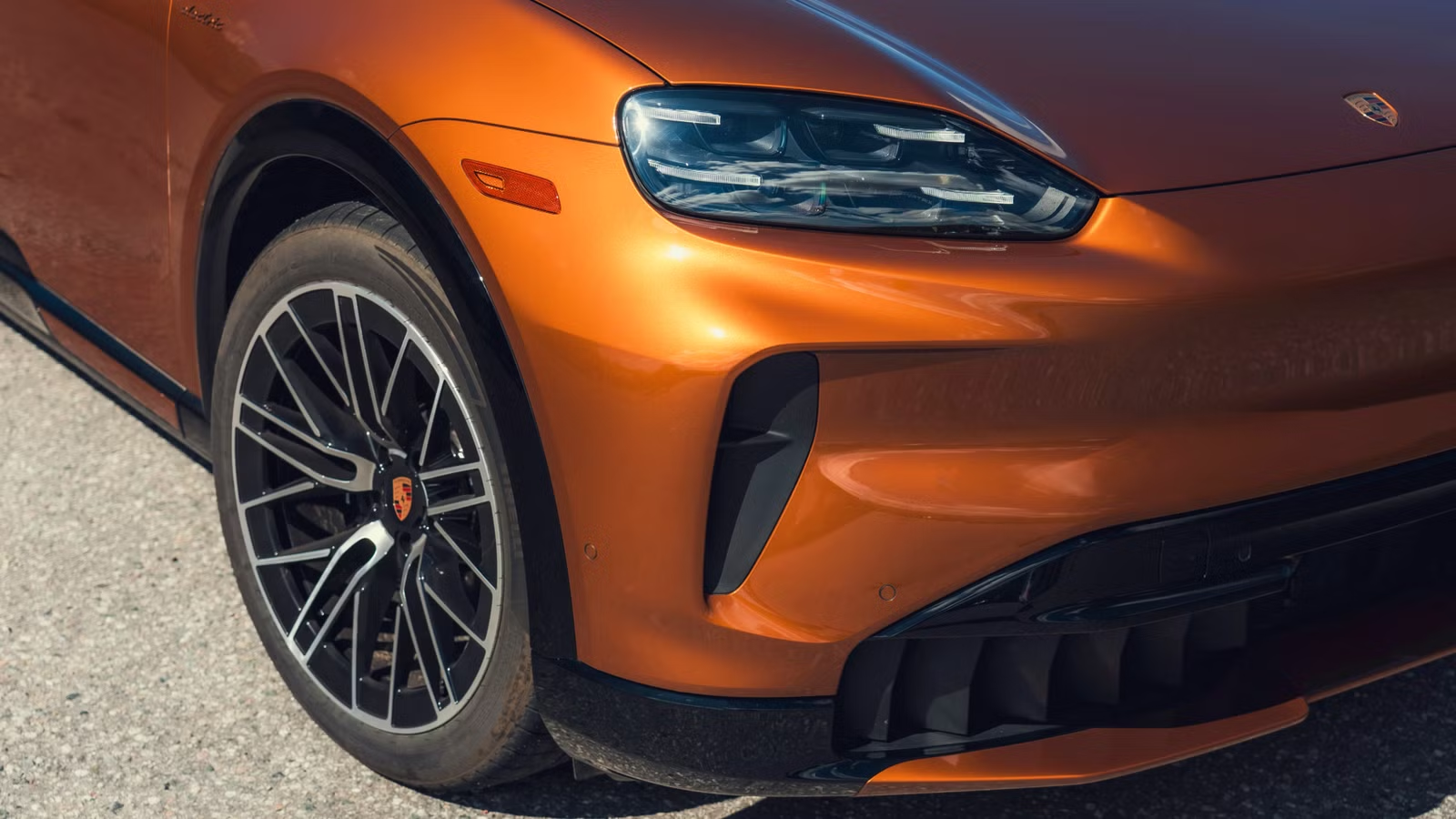
Meanwhile, I prefer the front fascia of the ICE Cayenne to the robot face of the Electric. Without the grille, and with some movable shutters on the lower valence, the view is just blocky and heavy to my eye. Though, as always, the Porsche headlights are killer jewelry.
With an overall height of 65.9 inches and 22-in wheels pushed out to the corners, the Cayenne certainly looks fast from most other angles, even in the parking lot.
Interior Design: Lots Of Pixels, Plenty Of Porsche
Strengths
Weaknesses
- Great seats, trim, and space for people
- Exterior lighting elements are rad
- Excellent rear end proportions with cool detailing
- Blocky-looking EV front end
- Optional passenger display is probably overkill for most use cases
- With color options so rich, don’t settle for black and gray
The Turbo Electric is the crown jewel of the Cayenne line, and the amount of screen real estate lavished on this top trim drives that point home. Porsche’s unique “Flow Display” bends the glass from the central screen down towards the armrest, creating a nice way to separate function buttons without another piece of glass. The driver sees an all-digital instrument cluster, and the optional 14.9-in passenger display gives anyone sitting shotgun the option to view media, listen via their own Bluetooth headphones, help with route planning, or what have you.
I’ve heard from many friends that they’re effectively over-screened everywhere these days, but I understand that this kind of highly polished suite of displays is de rigueur for six-figure luxury automobiles.
The heated and cooled front seats are exceptionally comfortable, and still supportive during whatever high-g-force event you feel like dialing up in this superpowered SUV. At 6-foot-5 I can testify that there’s ample room for the heads, knees, and legs of even very large drivers, and plenty of space in the second row even when I’m in my preferred seating position (something that little brother Macan Electric can’t boast).
Apart from all the pixels in the cabin, the styling is demure with a techy flair that you’d expect from Porsche and in the segment. If we can figure out how to backfill the software, this is a space that will still look cool in 20 years, no doubt.
Powertrain and Driving: Chassis Is Up To The Job
Strengths
Weaknesses
- All. That. Power.
- World-class chassis tuning
- Drive mode delta makes it feel like several kinds of vehicle in one
- Certainly not top of the Porsche food chain for steering feel
- Actual off-road chops are TBD (if that matters)
- Range takes a back seat to performance in the Turbo model
I obviously led off with the power because, well, it’s remarkable. A week after the test drive my inner ear is still somewhat shook from that first hard pull using launch control. What a rocket.
But the truth is that the more impressive feat is how light the Cayenne Electric is on its proverbial feet. I drove some 230 miles in the mountains around Aspen, including some seriously fun switchbacks, big long valley sweepers, and at high speeds over gravel. The Cayenne’s ability to conform to its environment and to a driving style is remarkable.
2026 Porsche Cayenne Turbo Electric Powertrain Specifications
Powertrain
Dual Electric Motors
Transmission
Single Speed
Drivetrain
All-Wheel Drive
Power
1,139 hp (with launch control)
Torque
1,106 lb-ft
0-60
2.4 seconds
Top Speed
162 mph
Range
303 miles (with correct tires)
Porsche has thrown all of its considerable chassis-building know-how at this model, and it shows. Air suspension and active dampers are standard on all levels, while Porsche’s active ride control is a worthwhile option on the S and Turbo models.
The net of having all of those, along with the variety of selectable drive modes to access them, is that the SUV feels glued to the road and stiff as hell in Sport Plus, with snappy steering response helped out at lower speeds by the optional rear steer feature (up to five degrees). Meanwhile, Comfort mode dramatically filters any chop coming from the road surface, and even helps to iron out gravel roads at speeds that, well, you shouldn’t hit on gravel roads.
Porsches have always been good at this, but the delta between the most laid-back and the most bloodthirsty driving experiences is gigantic in the Cayenne Electric. Having eleven hundred horsepower and gut-shifting acceleration certainly widens the gap, but I’m eager to see how variable the base Electrics feel, as well.
Battery, Range, And EV Stuff
2026 Porsche Cayenne Turbo ElectricPorsche
The Turbo is certainly not the Cayenne Electric trim you buy if you’re primarily concerned with range – though as I pointed out earlier, it ain’t half bad. Just over 300 miles of range is going to do the job for most people on most days, and the fact that Porsche is nearly as obsessed with quick charging as with quick cornering helps a lot.
The 800-volt system will charge the SUV’s 113 kilowatt-hour battery pack at a maximum DC fast charging rate of 400 kilowatts. That means juicing up from 10% to80% in 16 minutes, or less, under ideal circumstances. The charging curve is impressive to achieve those speeds, with Porsche estimating rates from 350 kW to 400 kW from 10% to 50% state of charge, and sticking above 200 kW for almost the whole run up to 80%.
2026 Porsche Cayenne Turbo ElectricPorsche
The automaker has achieved these results thanks to better-than-ever thermal management of its revised battery pack, with a dual cooling system that cools and heats from the top and bottom of the pack. I was told that engineers have made the pack much easier to service in this instance, too.
Verdict and Pricing: There’s Really Nothing Quite Like It
2026 Porsche Cayenne Turbo ElectricPorsche
So what competes with an eleven-hundred-horsepower, $160K electric SUV? Not much, really. The $163,000 Cayenne Turbo Electric occupies a pretty rarefied bit of real estate, with the 1,070-hp Lucid Gravity GT-S and 1,025-hp Rivian R1S Quad both coming in roughly $35,000 to $40,000 cheaper. Neither, however, delivers quite the same combination of outright speed, ride quality, steering feel, luxury, and chassis composure that Porsche has packed into this thing.
Since the Cayenne has only two rows of seating, Lucid’s Air Sapphire might be a better choice for a head-to-head comparison, but that performance sedan – while still quicker and faster than the Porsche – goes for $249,000.
For now, the Cayenne Turbo Electric owns the ultra EV space, in an SUV form factor, outright. And that feels correct after a day of dicing up the best roads in Colorado and having my brain smushed into the back of its case with launch control. Porsche’s newest SUV might also be its most singular electric expression – at least for now.
