

They say that imitation is the sincerest form of flattery, but what do you call it when you build a whole brand on imitation? Well, “Toyota” would be a good name for it.
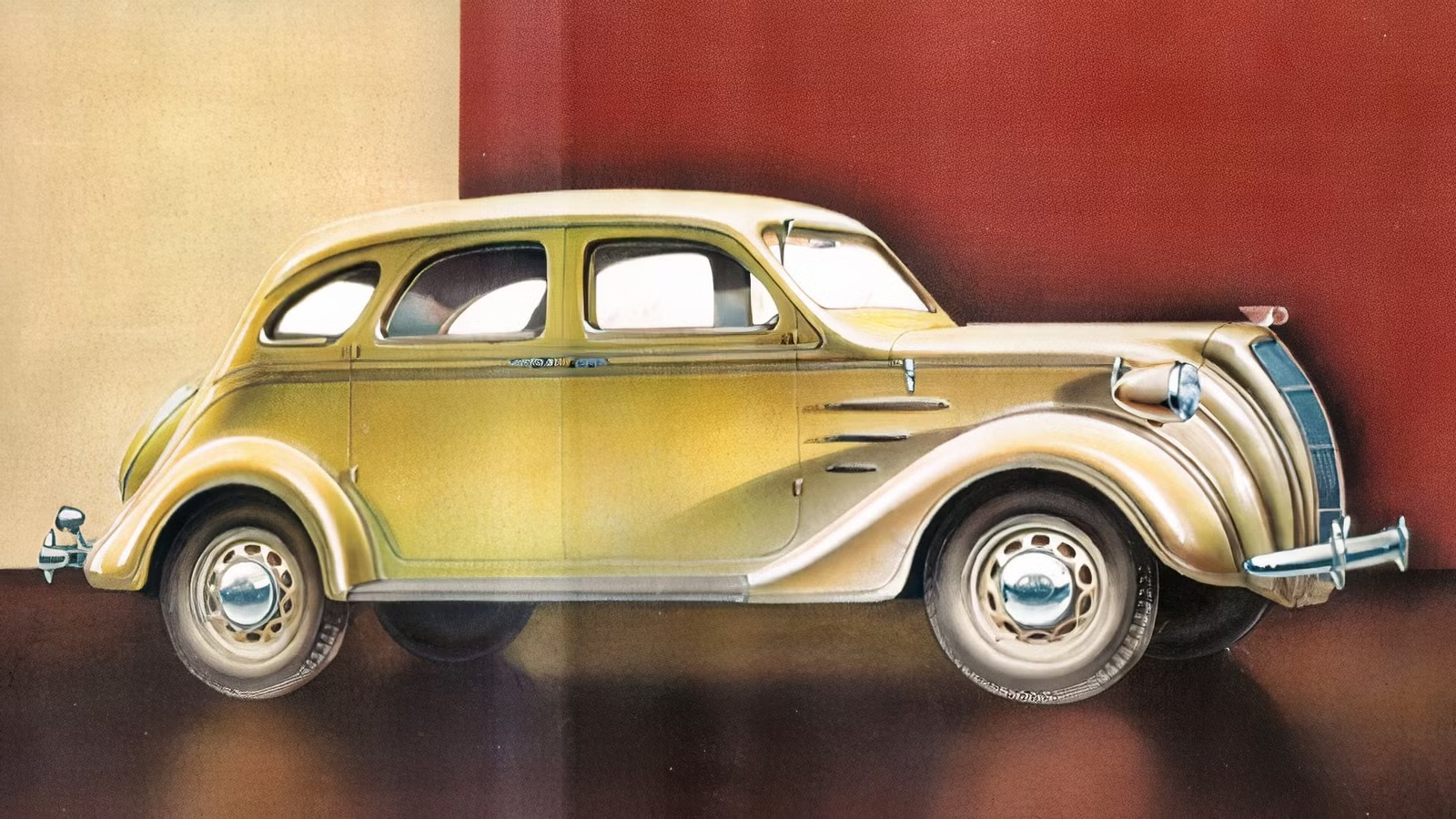
The Toyota AA, the car that put Toyota on the map all the way back in 1936, was a shameless copycat, borrowing bits and pieces of the 1933 Chevy Master and the 1934 Chrysler DeSoto Airflow. Here’s how some creative remixing gave us the world’s biggest carmaker.
The Swipe That Built A Brand
1936 Toyota AA Replica
Toyota didn’t come into a ready-made automotive scene in Japan. Cars were hardly a new invention by 1936, but most roads in Japan were unpaved, with the people largely relying on railways for long-haul transportation. A few car companies already existed, including Nissan predecessor DAT Automobile Manufacturing Co., but there was no real car culture to speak of. Japanese automakers didn’t have their own identity yet, so it wasn’t just Toyota borrowing from the West; everyone was doing it.
The passenger car that helped Toyota make a name for itself, the 1936 Toyota AA, was a full-size sedan with a 3.4-liter straight-six engine and a three-speed manual transmission. It had a front-engine, rear-wheel drive, and was also available as a convertible called the Toyota AB.
Toyota Borrowed From Everyone To Build The AA
Toyota AAToyota
The AA’s body primarily took inspiration from the Chrysler Airflow. There was a metal body on a ladder frame, a single-pane windshield, and rear-hinged doors in the second row, all traits it shared with the Chrysler.
Under the hood, there was an inline-six engine that was a direct copy of the legendary Chevrolet Stovebolt. Chevy introduced the powerplant in 1929, and variants remained in production through the early 1960s. Toyota specifically copied the 1933 version that displaced 207 cubic inches (3.4 liters). Toyota branded the powerplant as the Type A, and the unit produced around 62 hp – very close to the Chevy’s claimed 65 hp.
1936 Toyota AA
Engine
3.4-Liter NA 6-Cylinder
Power
62 hp
Transmission
3-Speed Manual
Toyota had considered copying the Ford flathead V8, Japan’s favorite engine at the time, but found the straight-six easier and cheaper to reproduce. Although, just to make sure Toyota was swiping from every one of the Big Three, the team reverse-engineered elements of the chassis and electronics from Ford.
Toyota built 1,404 AA sedans from 1936 to 1943 before retiring the AA for the AC, and the brand built 353 convertibles by 1942. That might not sound like a lot, but remember, the Japanese market was hardly driving at all then. Toyota was carving the Japanese auto industry out of solid rock around this time. Many Japanese drivers still opted for American cars in the mid-1930s, and Toyota won them over by undercutting imports by about 400 yen, selling the AA at 3,350 yen.
The Toyota AA Wouldn’t Be The Brand’s Last Swipe
1955 Toyota Land Cruiser J55 55 SeriesToyota
The Toyota AA was the remix that launched the brand. Then, 16 years later, another swipe kept Toyota relevant in the second half of the 20th century and became the brand’s first hit in the United States. We’re talking about the Land Cruiser.
As the story goes, the Land Cruiser was based directly on a captured Army Jeep. In reality, that’s skipping a step or two. What happened was Japan captured a Willys MB in the Philippines in 1941. The military sent the car to Toyota and asked the automaker to produce a similar vehicle.
The resulting Type 4 Compact Cargo-Truck saw relatively limited battlefield use and did not directly evolve into the Land Cruiser, or “Toyota Jeep.” But it served as a trial-by-error test run that informed the post-war Land Cruiser, making it more of a “loosely inspired by” swipe this time, even if the Land Cruiser was initially sold under the Jeep name until the Willys-Overland claimed the trademark in 1954.
We tend to remember the Oil Crisis as the reason Toyota was able to plant its flag in the US, but by 1970 the brand was selling as many as 8,000 Land Cruisers in a single year in the US. There’s something poetic about a stolen Jeep allowing Japanese automakers to make a good impression on American drivers.
1998 Chevrolet Prizm front 3/4Toyota
Look at the modern automotive landscape, and it’s clear that the tables have turned. Toyota is no longer the copycat, but the brand that other automakers go to for good ideas and top talent.
Most famously, you can look at the Malaise Era as a point in time when Japan truly led the way. Without the success of small Toyotas like the Corolla and the Corona, it might have taken Chrysler even longer to catch up with its K-Car line, building small cars like the Dodge Aries and the Plymouth Reliant in hopes of competing with Toyota.
General Motors practiced a philosophy of “if you can’t beat’em, join’em” in the 1980s and 1990s, rebadging the Corolla as the 1985 Chevy Nova, and slapping Geo and Chevy badges on the car into the early 2000s. Remember the Chevy Prizm (pictured above)? That was just a Corolla wearing a Bowtie.
Chrysler has also famously pulled talent from Toyota, recruiting Jim Press, Toyota’s top North American executive, back in 2007 and putting him to work on sales, marketing, and product strategy after 37 years with Toyota.
Toyota Now Sells Around 11.3 Million Cars A Year
2026 Toyota rav4 front grille detailToyota
To get an idea of how things are going for Toyota 90 years after it Frankensteined some Chrysler, Chevy, and Ford parts into a Japanese sedan, let’s take a look at the top-selling vehicles in the US last year.
- Ford F-Series
- Chevrolet Silverado
- Toyota RAV4
- Honda CR-V
- Ram Pickup
- GMC Sierra
- Chevrolet Equinox
- Toyota Camry
- Tesla Model Y
- Toyota Tacoma
Toyota appears three times on this list, more than any other brand, and it’s represented in every segment, including an SUV, a sedan, and a pickup. Worldwide, the RAV4 was the best-selling vehicle overall, with just over a million sales in 2025.
Meanwhile, Chrysler doesn’t show up on the US or global top-10 lists, and Chevrolet doesn’t even produce sedans anymore, having dropped out of the four-door car game after retiring the Malibu.
From Copycat To Benchmark
1936 Toyota AA brochure illustrationToyota
After nearly a century on the market, Toyota has become not just a success story, but the success story in the automotive world. Toyota sells more cars than any other automaker, collecting wins in every segment from full-size pickups to budget-friendly compact cars and luxury SUVs. The name has become synonymous with reliability, and the term “gold standard” only serves to undersell Toyota’s stature in the industry.
Toyota has actually slipped a few rungs on the reliability ladder, according to the latest JD Power roundup, but that doesn’t seem to be affecting the brand’s reputation at all. Once you reach this level of reputability, it takes a whole string of disasters to knock the crown off your head, and Toyota’s stock with customers remains high in spite of a few hiccups with the Toyota Tundra and the Tacoma in recent years.
Let this be a lesson to anyone out there who wants to start a business. Just because you don’t have any original ideas doesn’t mean you don’t have any good ones. Piggybacking on a successful product and putting your own spin on it is a proven strategy. It worked for Toyota more than once.
Sources: Toyota, JD Power.
