

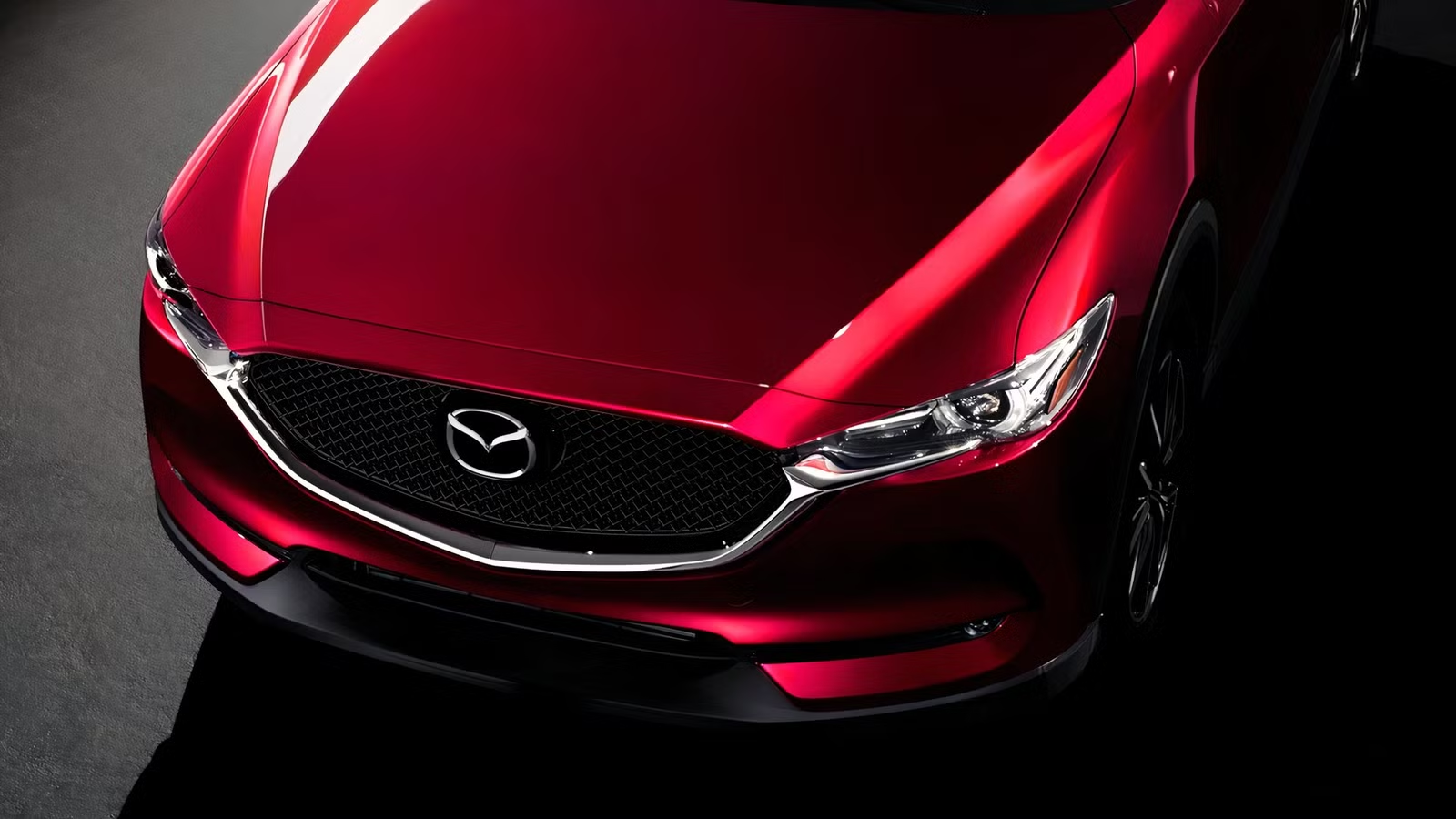
When it comes to diesel technology, you can’t fault Mazda for being persistent. For example, when it wanted to make the most of its groundbreaking Skyactiv engine technology, it spent the best part of a decade trying to make a version for the US market. Here, Mazda first promised its Skyactiv-D engine in the early 2010s, but it would be the end of the decade before it finally arrived on US shores in customer-ready form. But when it did arrive, the marketplace was entirely different, and although consumer demand became the official reason for the demise of Mazda’s plan, several other significant factors also came into the equation.
America’s Diesel Moment Looked Real For A While
2010 Volkswagen Passat Exterior TDI Engine Close-UpVolkswagen
In the late 2000s and early 2010s, diesel still had a plausible future in American passenger vehicles. Volkswagen had done a lot of the heavy lifting with its TDIs, and luxury brands were now toying with diesel SUVs. There was a lot to like about this technology, with its strong low RPM torque and fewer stops to fill up a tank. Hybrids were around but not yet dominating the efficiency conversation, and few people were paying much attention to EVs, especially from a mainstream SUV point of view.
In this environment, Mazda thought it was on to a winner in the US market. It was proudly sitting on its innovative Skyactiv engineering approach and initially planned to showcase this in the 2014 Mazda6. The company would debut the idea at the 2012 Los Angeles Auto Show, announcing that it would fit its Skyactiv-D 2.2-liter clean diesel engine into this passenger car. The new engine would deliver high torque, low internal friction, cleaner combustion, and a very low diesel compression ratio, and it would also come with a two-stage turbocharger. Mazda thought that it could use combustion itself to tackle the issue of high emissions, but the path ahead proved to be quite rocky.
The Certification Trap Was Bigger Than A Delay
2019 Mazda CX-5 Skyactiv-DMazda
Mazda was planning its Skyactiv experiment in a tough regulatory environment. After all, US light-duty emissions rules had made modern diesel increasingly hard for OEMs to execute cleanly and cheaply under the Tier 2 regulations. Here, the same emissions limits applied to cars, minivans, light trucks, and SUVs, regardless of fuel type. The Tier 2 Bin 5 rule also had an NOx limit of 0.07 g/mile, which was equal to the fleet-average NOx standard. That presented a very tough proposition for a diesel combustion system versus a gasoline engine, especially if fitted to a small-volume model that had little room for compromise.
Mazda clearly thought that its Skyactiv-D could meet strict standards without NOx aftertreatment. This would have been a particularly good selling point because urea injection and its related hardware added complexity, weight, cost, packaging demands, and ownership considerations. The Skyactiv-D technology featured a low compression ratio, which helped to reduce nitrogen oxides and soot, thereby avoiding the extra NOx aftertreatment that other manufacturers would use for more conventional diesel engines.
But for Mazda, theory was one thing and practice yet another. The company was forced to delay its North American diesel launch several times. By the time January 2014 rolled around, these plans were indefinitely postponed, and much of that came down to emissions testing and certification, particularly in California.
The bigger challenge for Mazda was that it didn’t simply have to pass a laboratory test. Instead, it had to maintain the right blend of fuel economy, durability, emissions compliance, and drivability for its consumers. The company wanted people to love its Skyactiv-D technology. And while clean diesel calibration would have been fine, it couldn’t come at the expense of response and feel, key selling points for Mazda’s marketers.
Eventually, the tech did reach the U.S. market, but by then, the original NOx aftertreatment idea had disappeared. Mazda had adopted exhaust aftertreatment with a selective catalytic reduction system using diesel exhaust fluid to reduce NOx. And even if Skyactiv-D had taken hold in the US, it certainly wasn’t the simpler version that Mazda had once hoped for.
The One-Year Wonder Finally Reached The CX-5
2019 Mazda CX-5 Skyactiv-D front 3/4Mazda
2019 Mazda CX-5 Signature Skyactiv-D AWD Specifications
Engine
2.2-liter Skyactiv-D sequential turbocharged inline-four diesel
Transmission
Six-speed automatic
Drivetrain
i-Activ AWD
Power
168 hp
Torque
290 lb-ft
!!!MODEL TAG!!! Listing Carousel 2019 Mazda CX-5 Signature AWD
Mazda had initially planned to showcase its diesel tech in the Mazda6, but it had entirely changed course by the time the technology finally landed. Mazda had instead decided to fit the engine into its CX-5 Signature AWD, which debuted at the 2019 New York International Auto Show. The company intended to put the new CX-5 on sale right away, as buyers had started to move strongly towards SUVs by that point, so the move looked practical and logical on paper.
Aboard the US CX-5 Signature AWD, Mazda used its 2.2-liter turbocharged inline-four, with the Skyactiv-D unit producing 168 hp at 4,000 rpm and 290 lb-ft of torque at 2,000 rpm. The vehicle came with all-wheel drive and a six-speed automatic transmission, with EPA fuel economy figures showing 27 mpg city, 30 mpg highway, and 28 mpg combined. Consumers could buy the CX-5 for $41,000 before destination fees, and it came with plenty of nice features such as ventilated front seats, Nappa leather, Apple CarPlay and Android Auto, and a heads-up display.
Mazda had finally reached the marketplace, but crucially, it had failed to produce an obvious knockout argument. For example, the diesel CX-5 needed 9.0 seconds to reach 60 mph, which made it considerably slower than both the turbocharged and naturally aspirated 2.5-liter versions from the same family. It may have offered relaxed torque delivery and a certain level of refinement rather than outright acceleration, but it was also the most expensive version of the lineup. Perhaps most importantly, Mazda had also failed to deliver the huge fuel economy headlines that many diesel-curious buyers were looking for.
Demand Was Only Part Of The Cancellation Story
2019 Mazda CX-5 Signature. Cabin. InteriorMazda USA
After less than a year, Mazda took a close look at consumer demand and decided that its Skyactiv-D diesel engine simply wouldn’t work in the US market. It would, instead, continue to advance such technology elsewhere around the world as part of its broader multi-solution powertrain strategy. But while Mazda stood behind its demand-based decision for Americans, there were plenty of other reasons why diesel was far more difficult. By the time the company had finally reached its goals, the Volkswagen diesel scandal had certainly changed the public mood. Also, new crossovers were proliferating, and they came equipped with efficient gasoline engines and improving hybrid systems.
Related
Why Mazda’s “Holy Grail” Combustion Engine Flopped
Touted as the savior of the combustion engine just 8 years ago, Skyactiv-X never reached the heights we were promised.
Mazda certainly didn’t help its case by offering something that only came as a single high-trim AWD model and that cost more than gas-powered alternatives while accelerating more slowly. Perhaps more tellingly, other OEMs were justifying diesel through the lens of full-size SUVs. GM offered its 3.0-liter Duramax turbo diesel in the Chevrolet Tahoe and GMC Yukon, perhaps better supporting the full-size SUV mission of towing confidence, torque, and long-haul range.
Skyactiv-D Didn’t Die, But Just Left America
2019 Mazda CX-5 With Skyactiv-D 2.2 Diesel Engine
Mazda
It would be wrong to say that Mazda’s Skyactiv-D turned out to be failed technology, and it still remains a meaningful part of the company’s lineup overseas. For example, Mazda continues to list these diesel variants for its CX-80 in Japan, and in the UK, it fits a 3.3-liter inline-six e-Skyactiv-D diesel into the CX-60.
Related
Why Engineers Still Admire Mazda’s 15-Year-Old SkyActiv Technology
The craftsmanship of Mazda’s award-winning engineers speak far louder to brainiacs than any generic spec sheet can.
Ultimately, Skyactiv-D showed that diesel’s future would depend heavily on elements like local regulations, buyer habits, fuel pricing, vehicle type, and taxation. In the US, diesel passenger vehicles were running into issues around reputation, fuel pricing, and regulatory headwinds. And all of these issues probably created too many commercial handicaps for Mazda as compared to some market structures overseas.
Mazda took almost a decade to finally offer its Skyactiv-D to U.S. consumers, and by then the market had firmly moved on. The original plan involved a lighter, cleaner, and simpler diesel solution for North America. But by the time the 2019 CX-5 diesel finally arrived, it turned out to be slower than the gas turbo, more expensive, and less dramatic with its EPA figures than buyers seemed to want. Mazda officially cited US consumer demand as the reason for the demise of Skyactiv-D, but the truth is that the original, elegant idea eventually transformed into a much tougher retail proposition.
Sources: Mazda, Dieselnet, Chevrolet.
