

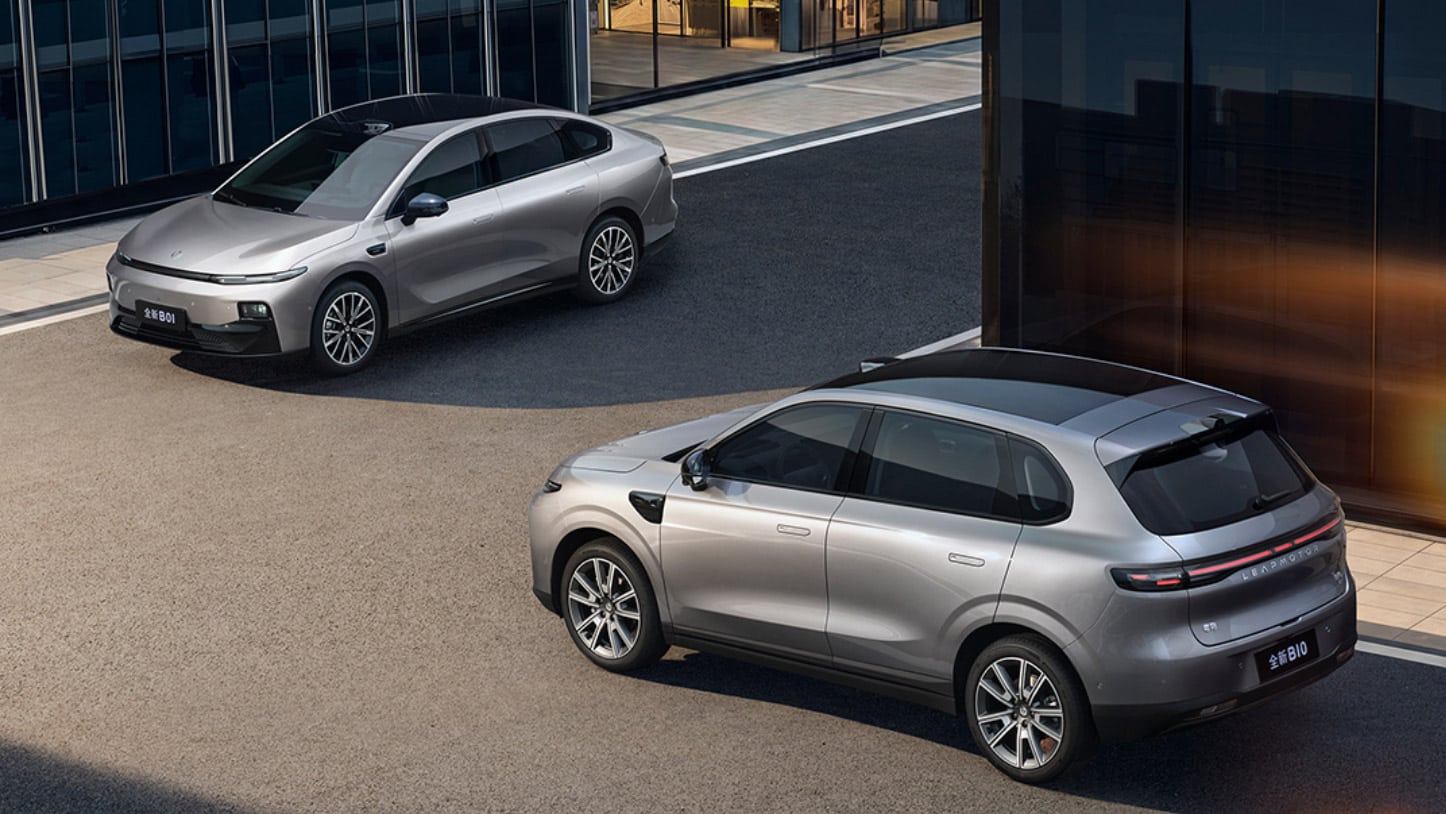
Credit: Leapmotor
- The refreshed B01 sedan starts at 95,800 yuan ($14,150), while the B10 SUV starts at 99,800 yuan.
- The long-range versions of both models adopt a full-domain 800-volt platform, as Leapmotor looks to support its annual delivery target.
Leapmotor (HKEX: 9863) has launched refreshed versions of the B01 sedan and B10 SUV (sport utility vehicle), further updating its mass-market electric vehicle lineup and extending the rapid pace of product roll-outs it has maintained this year.
The refreshed B01 is priced from 95,800 yuan to 119,800 yuan, while the refreshed B10 is priced from 99,800 yuan to 125,800 yuan. Each model is offered in 5 variants, including 2 equipped with LiDAR.
The pricing puts most versions of the 2 models in heavily overlapping ranges. Leapmotor is seeking to have consumers choose mainly between the sedan and SUV body styles, rather than differentiating the products through a significant price gap.
Compared with the B01’s starting price of 89,800 yuan when it was launched in 2025, the refreshed model’s entry price has risen by 6,000 yuan.
The B10, meanwhile, retains the 99,800-yuan starting price it had at its 2025 launch, indicating that Leapmotor wants to preserve the competitiveness of one of its key models.
Both vehicles continue to be built on the Leap 3.5 technology architecture and are offered only as battery electric vehicle (BEV) models. That differs from Leapmotor’s strategy for most of its core products, which are available in both BEV and extended-range electric vehicle (EREV) versions.
The refreshed B01 offers CLTC ranges of 590 kilometers and 670 kilometers, while the refreshed B10 offers 540-kilometer and 610-kilometer options. The shorter-range versions of both models use 60.8-kWh lithium iron phosphate (LFP) batteries, while the longer-range versions have 69.7-kWh packs.
The 670-kilometer B01 and 610-kilometer B10 are equipped with a full-domain 800-volt high-voltage silicon-carbide fast-charging platform.
Under DC fast charging, the 2 vehicles can replenish their batteries from 30% to 80% in as little as about 16 minutes. The shorter-range versions require about 21 minutes.
The 800-volt technology was previously found mainly in higher-priced vehicles. Leapmotor’s decision to bring it to products priced at about 110,000 yuan to 130,000 yuan shows that competition in China’s EV market is shifting from straightforward price cuts toward a broader contest involving charging speed, range and smart features.
The B01 is a compact electric sedan measuring 4,770 millimeters in length, 1,880 millimeters in width and 1,490 millimeters in height, with a wheelbase of 2,735 millimeters.
Inside, the B01 features a 17.3-inch 3K central display and offers a 50-inch augmented-reality head-up display, or AR-HUD.
The LiDAR versions feature the equivalent of a 128-channel LiDAR sensor, 27 sensing components and a Qualcomm 8650 assisted-driving chip. The system supports navigation-assisted driving on urban roads and highways, as well as in parking facilities, helping Leapmotor bring more advanced driver-assistance features to the roughly 100,000-yuan sedan market.
The refreshed B10 retains its positioning as a compact SUV, measuring 4,515 millimeters in length, 1,885 millimeters in width and 1,655 millimeters in height. It shares the B01’s 2,735-millimeter wheelbase.
It offers a 55-inch AR-HUD, dual zero-gravity front seats, a seat-to-bed function and a 1.83-square-meter panoramic glass roof.
The B10 is more important to Leapmotor’s sales performance. The model delivered 13,464 units in June, up 7.27% from May and accounting for 14.42% of the company’s monthly deliveries, according to data compiled by CnEVPost.
B10 deliveries totaled 53,317 units in the first half, bringing cumulative deliveries to 145,828 units as of the end of June.
Leapmotor B10 Monthly Deliveries 2025-2026
Month
2025
2026
January
5,208
February
4,405
March
3,298
7,484
April
6,648
10,204
May
10,115
12,552
June
14,316
13,464
July
8,676
August
9,150
September
11,781
October
9,662
November
11,015
December
7,850
Leapmotor B10 monthly deliveries
2025
2026
Sales of the B01, by contrast, remain below their levels shortly after the model’s launch. It delivered 3,497 units in June, down 12.49% from May and accounting for just 3.75% of the company’s monthly total.
Its monthly deliveries peaked at 13,697 units in October 2025 before falling sharply.
Cumulative B01 deliveries reached 89,360 units as of the end of June, including 21,466 units in the first half of this year.
Leapmotor B01 Monthly Deliveries 2025-2026
Month
2025
2026
January
2,099
February
2,425
March
4,011
April
5,438
May
3,996
June
1,581
3,497
July
8,576
August
10,171
September
12,653
October
13,697
November
13,401
December
7,815
Leapmotor B01 monthly deliveries
2025
2026
The launch of the 2 models comes as Leapmotor seeks to carry its strong company-wide growth into the second half.
The company delivered 93,376 vehicles globally in June, up 94.51% year-on-year and setting a new monthly record. First-half deliveries rose 60.82% to 356,487 units.
Leapmotor has set a target of delivering 1 million vehicles in 2026. That means it still needs to deliver 643,513 units in the second half, requiring average monthly deliveries of about 107,253 units, above its current monthly record.
The company is accelerating product updates in an effort to narrow that gap.
Leapmotor launched refreshed versions of the C10, C11 and C16 in June and launched the D99, its first MPV (multi-purpose vehicle).
The simultaneous updates to the B01 and B10 extend its product offensive further into the higher-volume compact-vehicle market.
For Leapmotor, which is backed by Stellantis NV (NYSE: STLA), the refreshed B-series is about more than adding features. The company needs to demonstrate that technologies including the 800-volt platform and LiDAR can generate sufficient incremental demand amid intense price competition in China, rather than merely increasing product costs.
The Leapmotor A05s is the second A-series model after the A10, offering roof-mounted LiDAR.
($1 = 6.7688 yuan)
