

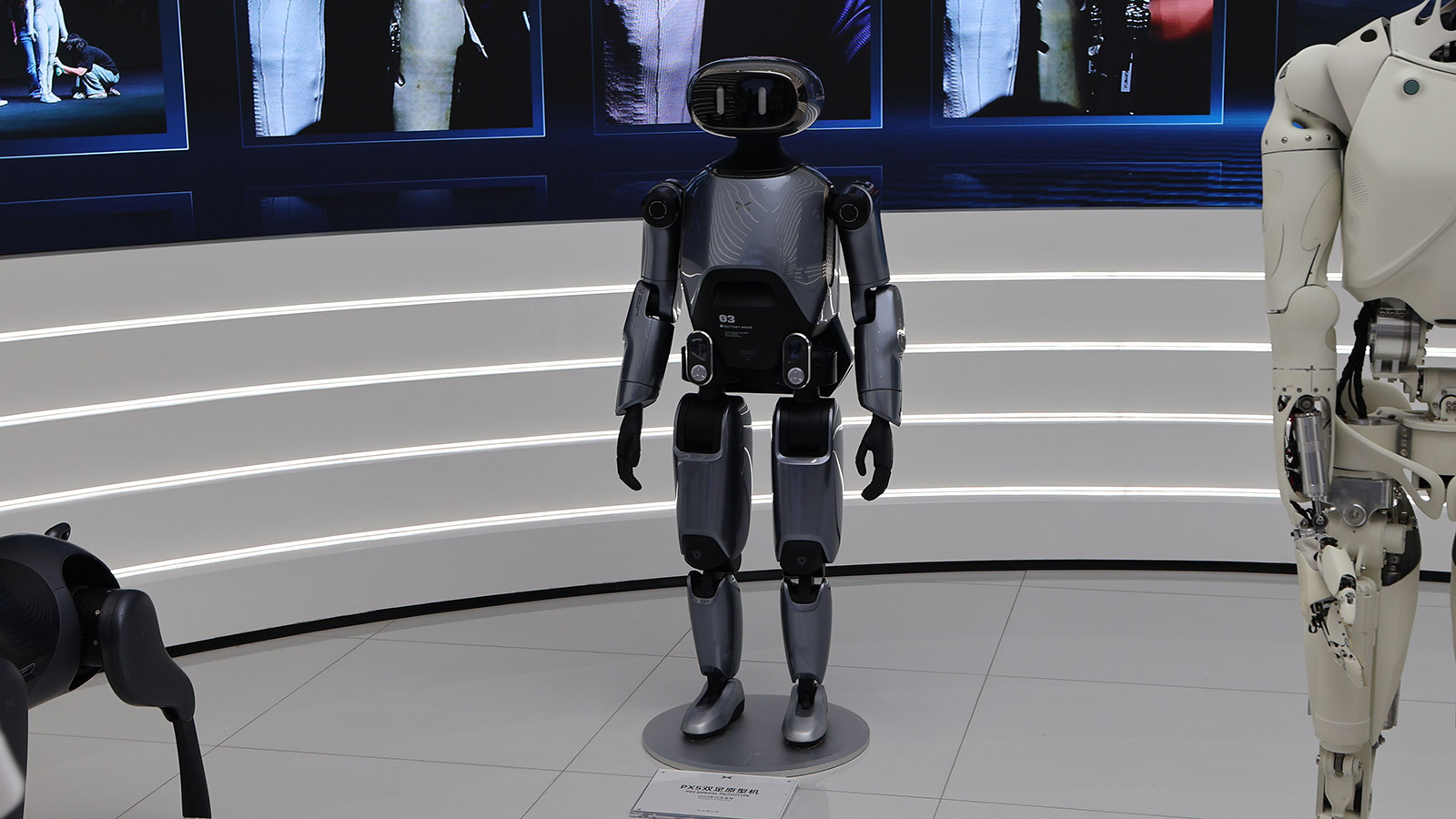
An Xpeng humanoid robot on display at the company’s headquarters in Guangzhou in April 2026. Credit: CnEVPost
- Leapmotor believes that as an NEV maker with in-house R&D capabilities, it is well positioned to develop embodied robots.
- The company has developed plans for a robotics business.
Leapmotor (HKEX: 9863) confirmed plans to enter the embodied robotics sector, saying it will formally announce details of the business in the near future.
Vice president and CFO Li Tengfei said during an interim earnings call on Monday that the company had developed plans for the robotics business. He did not disclose the product form, development progress or investment size.
Li said Leapmotor, as a new energy vehicle (NEV) maker with full-stack in-house R&D capabilities, is among the companies best positioned to develop embodied robots.
Business registration records have already offered clues about the move. Huzhou Lingsheng Precision Manufacturing Co Ltd, a Leapmotor subsidiary, was established in late July, with a business scope that includes industrial robot manufacturing, intelligent robot development and auto parts production.
Wu Cun, Leapmotor’s senior vice president and head of its electric-drive product line, serves as the company’s legal representative. Leapmotor has not said what role the new subsidiary will play in its robotics business.
The disclosure of the robot plans comes as Leapmotor has posted profits for 3 consecutive half-year periods. Revenue in the first half rose 57.2% year-on-year to 38.11 billion yuan ($5.62 billion), while net profit increased about 600% to 210 million yuan from 30 million yuan.
However, rising raw material prices and changes in its product mix are squeezing profitability. Leapmotor’s gross margin fell to 11.7% in the first half from 14.1% a year earlier.
Li said achieving the full-year net profit target of 5 billion yuan set at the beginning of the year would be “very difficult.” Management now expects full-year net profit of about 3 billion yuan, an overall gross margin of 13%-14%, and a vehicle gross margin of 10%-11%.
Leapmotor’s global sales rose 60.8% to about 356,400 vehicles in the first half. Exports surged 372.6% to about 96,200 vehicles, accounting for 27% of total sales.
Management expects overseas sales to reach 200,000 vehicles in 2026, above its previous target range of 100,000 to 150,000. The overseas sales target for 2027 is 350,000 to 400,000 vehicles.
The Spanish plant used by Leapmotor in partnership with Stellantis is scheduled to begin production of the B10 in October. Leapmotor expects sales of locally produced vehicles overseas to reach about 50,000 in 2027, but said localized production may provide only a limited near-term boost to margins.
The company also plans to hold a technology launch event on September 16, where it will unveil a new world model for assisted driving as well as technology advancements in batteries and electric-drive systems.
Li said the assisted-driving product based on the new architecture would deliver a “leapfrog improvement” over the existing system. Leapmotor also plans to launch more new models in 2027 across its B, C and D series.
Nio plans to make a strategic investment in the physical AI and embodied intelligence company founded by Ren and collaborate with it.
($1 = 6.7852 yuan)
