

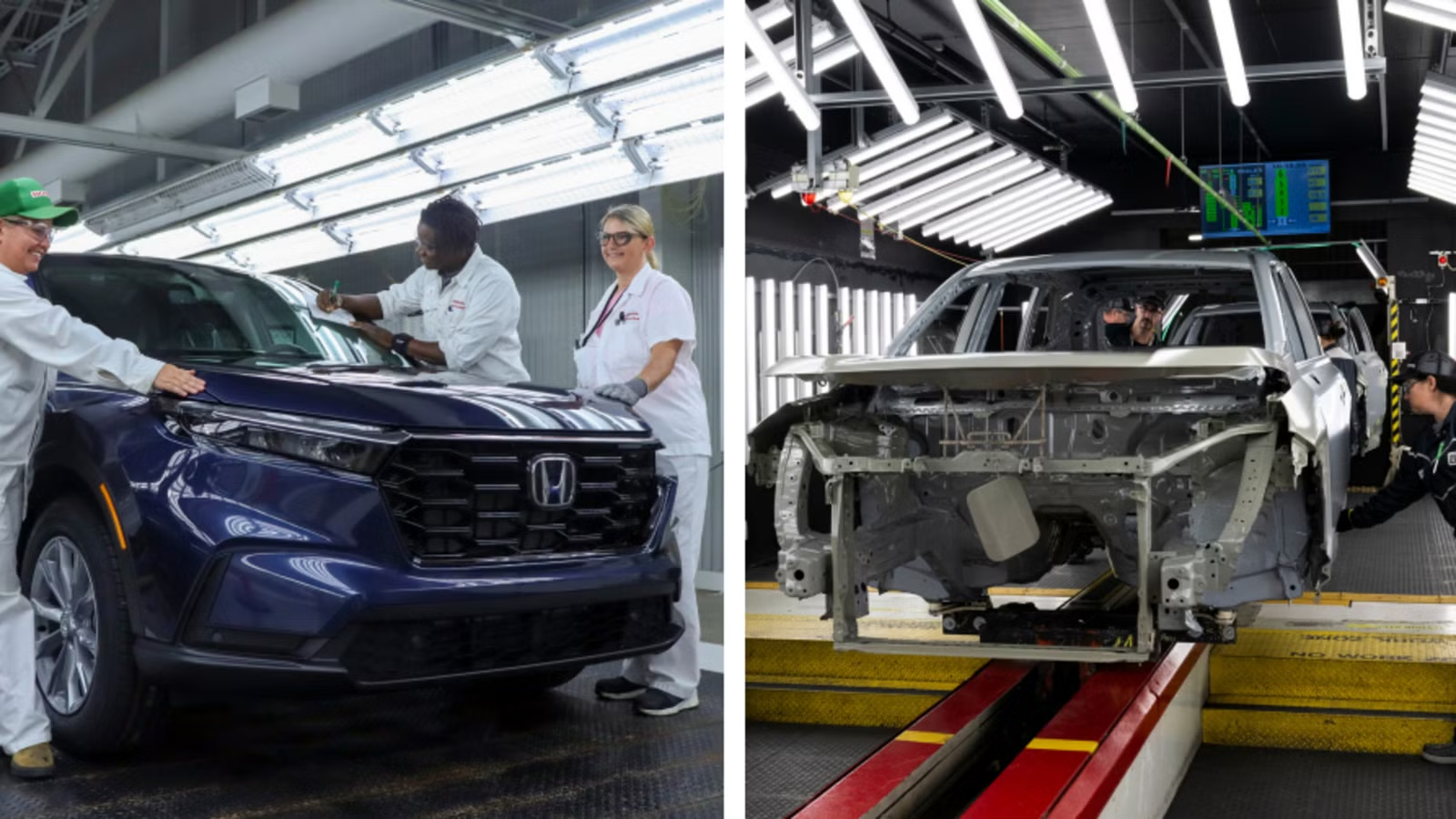
This didn’t get a lot of attention when it happened this past spring. Toyota and Honda, despite their intense rivalry that spans more than 50 years in Japan and elsewhere, found a good reason to join forces as an association dedicated to “strengthening Canada’s manufacturing competitiveness” and protecting Canadian jobs.
The two automakers announced on April 15 they were forming the Pacific Manufacturing Association of Canada, including Japan-based automotive component suppliers with operations in Canada. For reasons that might be obvious, there’s a bit more spotlight on all this right now.
Hopes Are Dashed For A New USMCA
Prime Minister Carney, President Trump, Minister JolyPrime Minister of Canada’s Office
The stated goal was to “provide a collective platform for coordinated engagement” with federal and provincial governments. The language may have sounded overly bureaucratic and perhaps unnecessary at the time, until Canada’s relationship with its No.1 trading partner, the US, deteriorated rapidly.
Every automaker in North America is lobbying hard for a new US-Mexico-Canada free-trade agreement, but those talks have completely broken down. Canada isn’t backing down from Trump’s threats, even as he tries to rename Lake Ontario and as Trump threatens to slap 50% US tariffs on vehicles assembled in Canada.
Will The New Partnership Prove Its Worth?
Dodge Challenger Production At Brampton Assembly PlantStellantis
Toyota and Honda are relatively new to auto manufacturing in Ontario. Honda opened a plant in 1986 in Alliston to build the Accord, while Toyota’s first plant in Cambridge started rolling out Corolla sedans in 1988. It’s many years for sure, but it’s not a century of building cars like Detroit’s legacy companies.
Back then, Detroit automakers were heavily invested in Canada. Ford went north of the border in 1904; Chevrolet’s were built in Oshawa in 1915, and Chrysler crossed the Detroit River to convert the former Maxwell-Chalmers facility to full-scale vehicle production in 1925. After decades of dominance in Ontario, Detroit’s presence began to wane in places like Brampton, Oakville, Oshawa, and Ingersoll, and by 2015, the Detroit brands accounted for only 56% of Canadian vehicle production. Meanwhile, Toyota and Honda continued growing their operations.
2026 Toyota RAV4 Produced in Cambridge, Ontario, CanadaToyota
With Gloves Off, Automakers Just Want To Be Heard
In 2023, Honda and Toyota combined to produce about 912,000 vehicles in Canada, while Ford, Stellantis, and GM combined for more than 500,000 vehicles in the region. Last year, Honda and Toyota assembled more than 75% of all the vehicles manufactured in Canada and employed more than 60% of the country’s vehicle assembly plant workers. So the Japanese automakers have earned a place at the table as Canada figures out how to deal with the US.
This is where automotive executives must choose every word very carefully, lest they be tagged as favoring one side over the other as the gloves come off in the US-Canada slugfest. Obviously, Honda and Toyota aren’t siding with Canada because their US operations are vital and much more extensive than those in Ontario.
2023 Honda CR-V assembled in Alliston, Ontario, CanadaHonda
Can’t Afford To Choose Sides
Same with Ford, Stellantis, and General Motors. Yes, they are American automakers, which puts them in an even more difficult position because their president wants them only investing in new American plants, with no regard for an industry that has been completely global for decades. Everything can’t be built in the US, despite what Trump says, and that’s why Detroit automakers have been entrenched in Canada for more than 100 years.
What all these automakers want (and this includes all the German, Korean, Swedish, and other Japanese transplants now building cars in the US) is to be heard and understood as to what it takes for them on the policy front to thrive and create jobs. So that dialogue happens in the US, Canada, and Mexico. Honda and Toyota are probably wanting more discussions with Canada because the White House has made its intentions clear with threats and tariffs, which hurt not only the auto industry but the consumers who buy cars.
2026 Toyota RAV4 Produced in Cambridge, Ontario, CanadaToyota
‘US Has Always Been Canada’s Best Ally’
In June, two months after Toyota and Honda formed PMAC, Honda Canada’s president and CEO, Dave Jamieson, spoke at a summit hosted by Canada’s Automotive Parts Manufacturers’ Association. Rather than sounding like he was siding with Canada against the US, Jamieson focused on facts. He said 76% of Hondas built in Alliston are shipped to the US and now suffering from cross-border trade dynamics that make future investments very difficult.
“If Canadian products are to remain competitive, we need to restore clarity and maintain stable, predictable access to the US market.”
–Dave Jamieson, President and CEO of Honda Canada
Jamieson recognizes the US has always been Canada’s best ally. “And we want it to continue to be our best trading partner,” he said. “Without that framework, the economic case for large-scale automotive manufacturing in Canada becomes far more difficult to justify and sustain.”
2023 Honda CR-V assembled in Alliston, Ontario, CanadaHonda
The decisions made in the next few months or years, Jamieson said, will determine whether Canada “remains competitive and a global leader in automotive manufacturing, or becomes a market into which others simply sell. We’ve already seen this scenario played out in other regions of the world – it is not a scare tactic, rather a potential reality.”
CarBuzz Insight – Why This Matters:
With trade talks between Canada and the US growing more vitriolic, we probably have to go back to the War of 1812 to find a time when there was this much acrimony between neighbors that have peacefully co-existed for the better part of two centuries. The auto industry is in the front row as this battle unfolds, and none of them has the latitude to publicly choose sides. But Toyota and Honda, just wanting to be heard, might be making some headway north of the border.
