

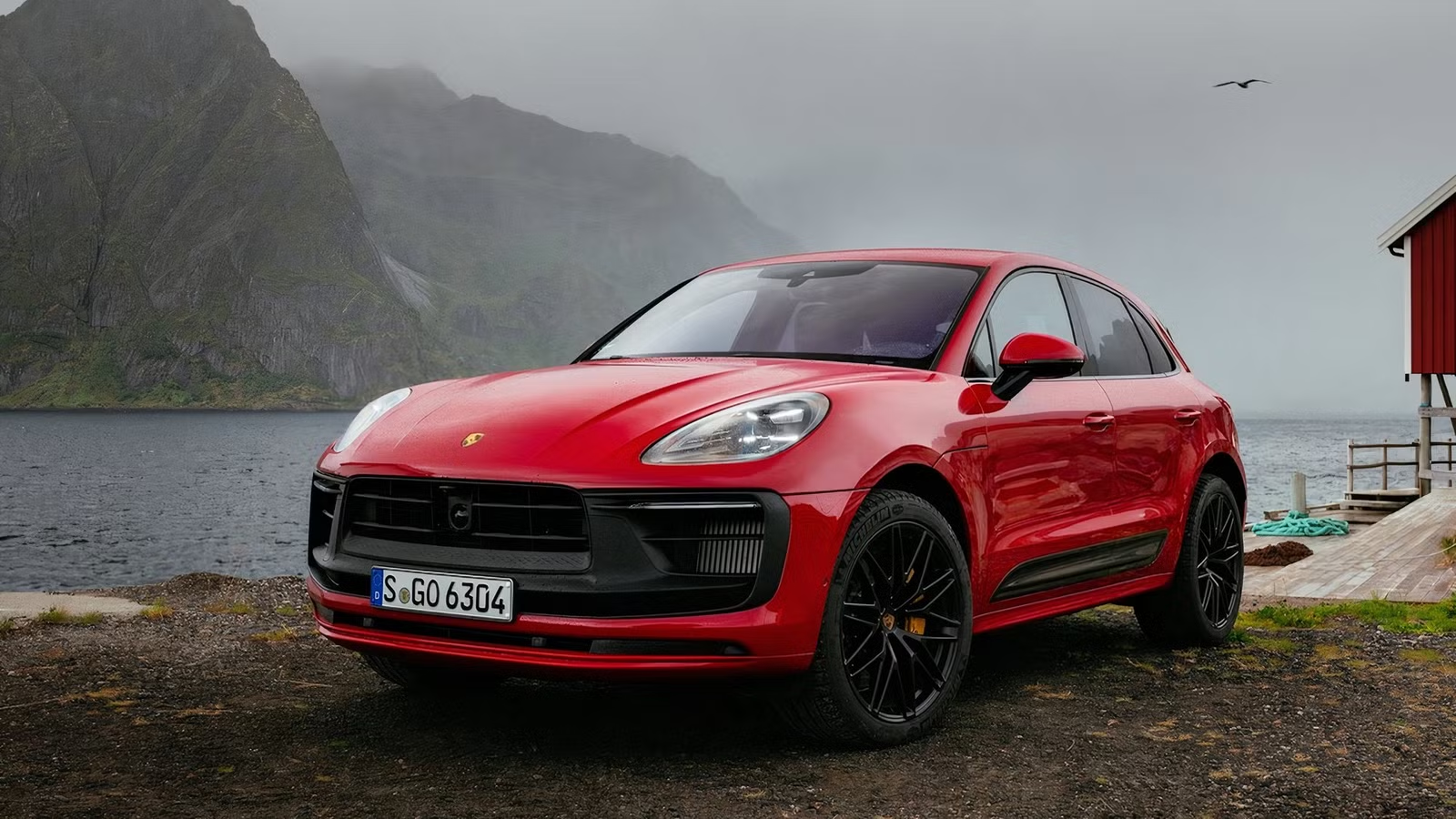
If you’re considering cutting a cheque on a new or slightly used Porsche this year, you might be wondering how the brand’s rigorous (and pricey) engineering standards pan out for shoppers in terms of real-life dependability.
If you’re wondering whether the premium you’ll pay for that Cayenne, Panamera or Macan translates into a more reliable ownership experience than key competitors, you’re in the right place. Below, we’re digging through the past five years of dependability data from JD Power to see how Porsche stacks up against BMW and Mercedes-Benz in terms of recent dependability, quality, and residual value trends. By the bottom of the page, you’ll have three useful strategies to consider when shopping in this universe.
How Does Porsche Dependability Compare to BMW and Mercedes Over The Past Five Years?
2027 Porsche 911 GT3 S/C hero shotPorsche
New car dependability is in a bit of upheaval these days, and this year has shown numerous shifts and trends worth understanding if you’ll be shopping for a new German luxury performance model anytime soon. That’s based on data from the annual JD Power Vehicle Dependability Study (VDS), which we’ll be citing below to ensure an apples-to-apples comparison.
How does the data stack up when broadly comparing entire brands? Across the past five consecutive JD Power Vehicle Dependability Study (VDS) iterations, Porsche, BMW, and Mercedes‑Benz results tell three different stories. Porsche consistently leads the trio, BMW steadily maintains the mid-pack position, and Mercedes-Benz repeatedly posts the highest number of Problems Per 100 Vehicles (PP100) among the three.
2026 Mercedes-Benz GLC-Class SUV Front ViewMercedes-Benz
Across this same five-year span, Lexus was the top premium brand twice, and the top premium and overall brand three times. Translation? Lexus doesn’t just lead the premium segment; it often leads the entire industry.
Here’s the five-year play-by-play showing how our German trio stacks up. You can use this information when considering a new or nearly new second-hand model.
2022: Porsche Leads, BMW Outruns The Average, Mercedes Just Misses
2020 BMW X3 MBMW
Specifically, Porsche scored 162 PP100 for 2022, with BMW trailing at 187 and Mercedes-Benz rated at 195 PP100. For context, the most dependable mainstream brand that year was Kia, with 145 PP100. The top premium brand for dependability was Genesis, with 155 PP100, beating out all three German competitors in the process.
The industry average score in 2022 was 192 PP100, meaning both Porsche and BMW delivered fewer-than-average problems, while Mercedes-Benz came in with a “just worse than average” PP100 score. The brand with the highest PP100 rating at the absolute bottom of the 2022 chart was Land Rover, posting a troubled score of 284 PP100.
2023: Porsche Drops, BMW Peaks, Lexus Dominates
2025 mercedes-benz-cle-cabrioletMercedes-Benz
In 2023, Porsche had its weakest year with 208 PP100. Still, it outperformed Mercedes-Benz by a considerable margin. With a score of 184 PP100, 2023 was BMW’s most dependable year of the five we’re focusing on here.
For context, the most dependable overall brand in 2023 was Lexus, with 133 PP100. Toyota led the mainstream brands with a 168 PP100 score. Sinking to the bottom of the rankings for 2023, Land Rover again registered the highest overall problem rating with 273 PP100.
2024: Porsche Bounces Back, BMW Hits Average, Mercedes Makes Slight Improvements
2026 Range Rover SV Ultra front 3/4Land Rover
For 2024, Porsche bounced back from its dip the previous year, landing at 175 PP100. Lexus and Toyota remained at the top of the Luxury and Mainstream dependability charts, respectively, and their gap widened. That same year, BMW’s score of 190 PP100 was slightly worse than Porsche’s, and coincidentally landed right on the industry average. Mercedes-Benz once again trailed at 218 PP100, a slight improvement from the previous year.
The worst-performing nameplate of the 2024 study was Chrysler, at 310 PP100.
2022 Chrysler Pacifica Pinnacle Exterior Finished In Red With Skyscrapers In BackgroundStellantis Media
Selected Vehicle Dependability Study Data (JD Power)
Study Year
2022
2023
2024
2025
2026
Top-Scoring Brand
(Lowest PP100)
Kia (145)
Lexus (133)
Lexus (135)
Lexus (140)
Lexus (151)
Porsche
162
(1st in Trio)
208
(2nd in Trio)
175
(1st in Trio)
186
(1st in Trio)
182
(1st in Trio)
BMW
187
(2nd in Trio)
184
(1st in Trio)
190
(2nd in Trio)
189
(2nd in Trio)
198
(2nd in Trio)
INDUSTRY AVERAGE
192
186
190
202
204
Mercedes-Benz
195
(3rd in Trio)
240
(3rd in Trio)
218
(3rd in Trio)
243
(3rd in Trio)
235
(3rd in Trio)
Lowest-Scoring Brand
(Highest PP100)
Land Rover
(284)
Land Rover
(273)
Chrysler
(310)
Volkswagen
(285)
Volkswagen
(301)
2025: Mercedes Bottoms Out, BMW Closes In On Porsche
2023 – 2025 Mercedes-AMG EQE V295 (1st Gen) SedanMercedes-Benz
The 2025 VDS had Porsche and BMW run nearly neck‑and‑neck, though both were comfortably below the industry average. Mercedes-Benz recorded their worst score of the five-year span, at 243 PP100. Buick and Lexus dominated their segments, with Buick even outperforming several premium brands. Anchoring the list with the most reported issues of 2025 was Volkswagen, at 285 PP100.
2026: Porsche Remains Strong, BMW Beats Average, Mercedes Relapses
For the 2026 VDS, Porsche landed at 182 PP100, with BMW at 198 and Mercedes-Benz at 235 for that first-second-third finish once again. Buick kicked Toyota out of the top position as the most dependable mainstream brand (160 PP100), and Lexus remains at the top of the charts with 151 PP100 as the most dependable premium brand. Reflecting a tough multi-year slide, Volkswagen remained at the very bottom of the 2026 chart at 301 PP100.
Related
Porsche’s Most Reliable Cayenne Is Currently Selling For New Honda CR-V Money
This premium model can now be had for the same price as a brand new CR-V. Should you opt for a used car and unlock a higher level of luxury?
Two Other Stories Hide In The Data
2025 BMW X3 in three different colors fron the frontBMW
Consider scoring volatility as well: across the five‑year span we’ve covered here, Porsche, BMW, and Mercedes-Benz all behaved differently where swings in scoring are concerned. Porsche experiences the widest swings, ranging from a low of 162 PP100 in 2022 to a spike of 208 PP100 in 2023 before settling back into the 175–186 range. Total scoring across the five years for Porsche fluctuates by as much as 46 PP100.
Mercedes-Benz CLA-ClassMercedes-Benz
Conversely, BMW is the most stable of the three, with scores tightly spaced within a range between 184 and 198 PP100 across the five years. That’s just 14 PP100 worth of fluctuation, making it the most predictable brand on your page. Mercedes‑Benz consistently racks up the highest PP100 scores in this trio, although with less year‑to‑year fluctuation than Porsche. Across the five-year span, Mercedes-Benz varies by 48 PP100, roughly the same as Porsche. That gives mid-pack BMW the most consistent performance of the trio by a considerable margin.
The BMW 3-Series was the brand’s bestselling sedan in 2025, but it lagged way behind the X3 and X5, BMW’s top-selling models.BMW
A look at the five-year average score for each brand in this trio helps further reveal the dependability hierarchy. Porsche’s five‑year average score is 183 PP100, with BMW following at 190 PP100 over the same period. Mercedes‑Benz comes in last, with a five‑year average score of 226.2 PP100. Put another way, shoppers buying a Porsche from this era can expect about 4% fewer problems than a comparable BMW, and about 19% fewer problems than a comparable Mercedes‑Benz.
Initial Quality Shows A Similar Hierarchy
Exterior view of the 2024 Porsche Cayenne TurboPorsche
So far, we’ve analyzed the dependability scores of our trio of automakers on a broad, brand-wide level. Now, we’ll run through the same trio again, instead looking at their Initial Quality Study (IQS) scoring for the same period. Where JD Power’s Vehicle Dependability Study (VDS) data focuses on owner survey results at three years of ownership, IQS data instead focuses on customer sentiment at just 90 days.
Think of VDS scoring as an indicator of how an automaker engineers its vehicles, and the IQS scoring as an indicator of how carefully it was assembled and prepared for its customer. With IQS data, we’re seeing more of the early-onset issues like software glitches, teething problems, fit and finish misses, and other initial defects, before time and mileage can drum up additional wear and tear.
Selected Initial Quality Study (IQS) Data (JD Power)
Study Year
2022
2023
2024
2025
Top-Scoring Brand
(Lowest PP100)
Buick (139)
Dodge (140)
Ram (148)
Lexus (166)
Porsche
200 (3rd in Trio)
167 (1st inTrio)
171 (1st inTrio)
188 (1st inTrio)
BMW
165 (1st in Trio)
192 (2nd in Trio)
206 (3rd in Trio)
196 (2nd in Trio)
INDUSTRY / STUDY AVERAGE
180
192
194
192
Mercedes-Benz
189 (2nd in Trio)
201 (3rd in Trio)
205 (2nd in Trio)
210 (3rd in Trio)
Lowest-Scoring
Brand (Highest PP100)
Chrysler (265)
Chrysler / Volvo (250)
Dodge (300)
Audi (269)
On initial quality over this four-year span, the data shows Porsche fluctuating by as much as 33 PP100, Mercedes fluctuating by as much as 21 PP100, and BMW fluctuating by up to 41 PP100. Translation? On initial quality, the most consistent performer is Mercedes-Benz, with Porsche and BMW trailing, respectively.
Here’s How Depreciation and Maintenance Costs Factor In
A static shot of the 2025 Porsche Macan from the front-right sidePorsche
Let’s zero in on data from three specific competitor models to help provide additional context. We’ll use 2023 model year units of the Porsche Macan, Mercedes-Benz GLC, and BMW X3 for this illustration.
According to data from iSeeCars.com, a Porsche Macan will hit 13.7 percent depreciation in three years, and 40.1 percent depreciation after five. It outperforms all luxury compact SUVs in both metrics, especially three-year depreciation. In fact, the Macan’s three- and five-year depreciation metrics outperform the average rating for all SUVs (25.3 percent) and all cars (23.9 percent) in general. Based on five-year predictions, shoppers should budget an extra $1,300 annually for maintenance.
The BMW X3 will hit 26 percent depreciation after three years, and 49.6 percent depreciation after five, according to the same data. Among all luxury compact SUVs, SUVs, and cars in general, an X3 shows roughly average depreciation over three- and five-year predictions. CarEdge.com data shows the X3 with an average annual maintenance cost of about $1,182 during the first five years of its life.
An interior shot of the 2025 Porsche MacanPorsche
We’ll use CarEdge.com data for the Mercedes GLC, which shows 39.3 percent depreciation after three years, and 48 percent depreciation after five. Annual maintenance costs are $955 on average for each of the first five years of ownership.
What’s The Best Strategy For Your Dollars?
Here’s a recap to help you make the best purchase decision possible between the BMW X3, Porsche Macan, and Mercedes GLC. Let’s start with the Macan. It’ll hit just 13.7% depreciation in three years, significantly outperforming its competitors. Still, it’s got the highest maintenance costs on your page, though not by much.
2026 Mercedes-Benz GLC-Class SUV DashboardMercedes-Benz
The GLC suffers a 39.3% depreciation hit after three years, meaning used buyers can find massive discounts compared to buying new. With the lowest predicted maintenance costs of the trio for the first five years, this is a cost-conscious choice in the second-hand space.
The X3 shows roughly average depreciation over three- and five-year predictions, and its average annual maintenance cost sits right in the middle at $1,182 during the first five years.
Translation? Choose the Porsche Macan if your primary goal is avoiding steep depreciation, and you plan to sell the car before out-of-warranty maintenance costs stack up. Choose the Mercedes-Benz GLC if you plan to buy used (benefiting from that sharp three-year depreciation drop) and want the lowest annual maintenance bills possible. Finally, the BMW X3 is likely the strongest draw for shoppers prioritizing a surprise-free ownership experience when it comes to both depreciation and upkeep costs.
A static shot of the 2025 Porsche Macan from the rear-right sidePorsche
So, do Porsche’s rigorous, premium-priced engineering standards actually translate into a better real-life ownership experience? Based on the data, that’s a “yes”, but with a catch. Buy a new Macan and hold it through that critical three- to five-year window, and its top-tier dependability and retention ratings give you precisely what you paid for: a solid machine that protects your equity better than key competitors.
2025 BMW X3 driving front corner in blueBMW
The caveat? It’s a pay-to-play game. That Macan will likely reward you with fewer initial defects, better long-term reliability, and lower depreciation, but then you are paying a premium up front, and a (smaller) premium for maintenance. Time your ownership experience correctly, and the Macan can actually be the financially smart move here: allowing owners to reap the benefits of top-tier dependability and excellent value retention before higher out-of-warranty costs and depreciation levels start to factor in.
Sources: JD Power, iSeeCars.com, CarEdge.com, KBB, EPA
