

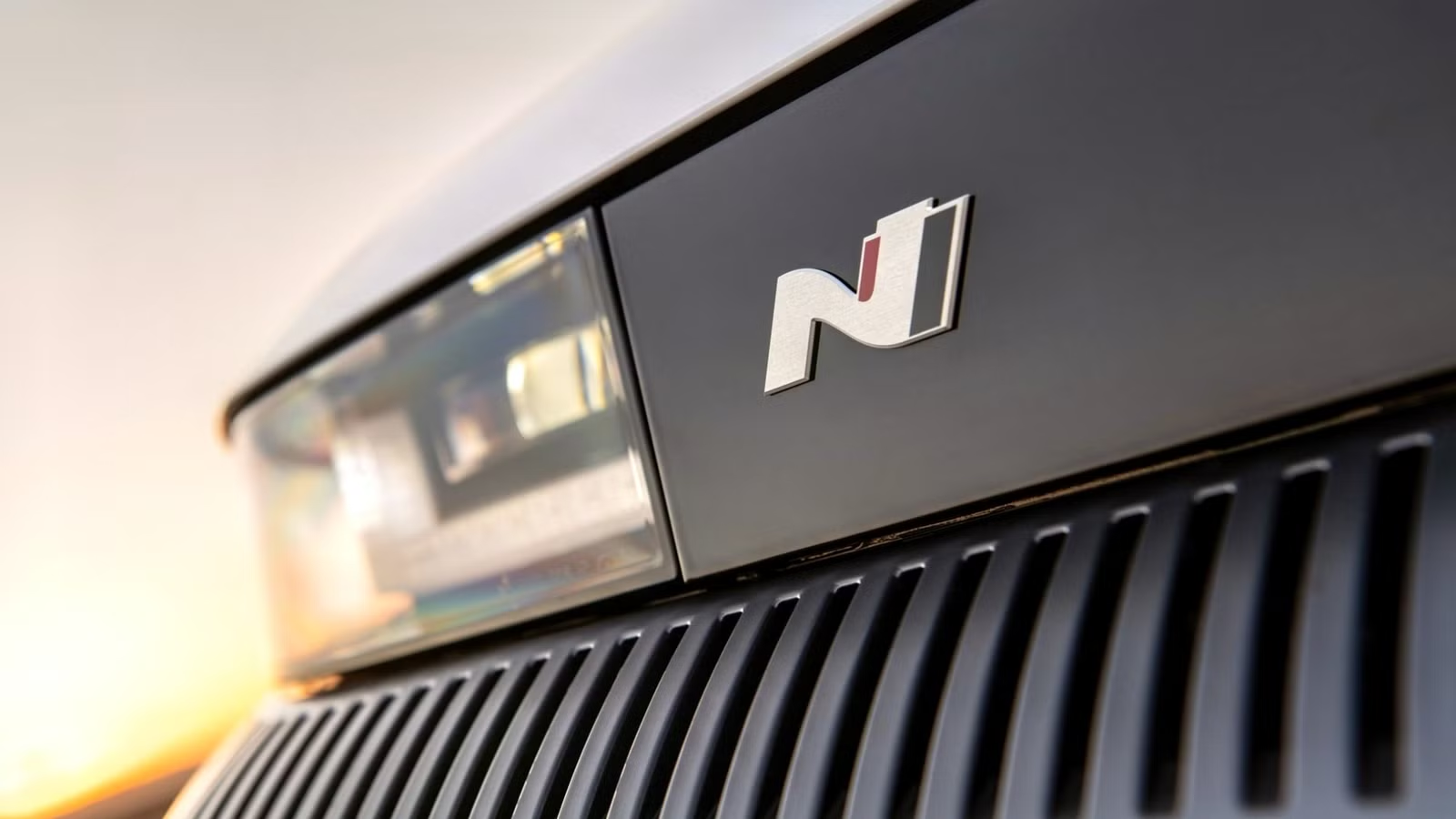
Huge outputs used to be reserved for only the most expensive sports and supercars, while SUVs focused primarily on practicality or off-road preparedness, depending on their individual target audiences. However, electrification has enabled SUVs and crossovers to blur the lines between segments a little, bringing high-horsepower machines to the mass market at easily digestible prices.
Leading the charge in 2026 is a Hyundai that packs a 600+ horsepower punch in a practical, sub-$60,000 package.
Hyundai Makes The Cheapest 600-hp Crossover In The US
Not all that long ago, 600 hp was an output reserved exclusively for the upper echelons of the supercar club, with only the most prestigious offerings from brands like Ferrari, Lamborghini, and Aston Martin able to tick that box. Such releases would often require buyers to part with upward of $200,000 in order to take one home, but in 2026, Hyundai will sell you a 600-horse crossover for just under $60,000.
The car in question is, of course, the Ioniq 5 N, and with an MSRP of $59,900 – that’s prior to any dealer or destination fees – it is the cheapest 600-hp crossover on sale in the US right now. To put that price tag into perspective, the average price paid for a new car in the US, as of August 2026, is $50,089. For around $10,000 more, instead of just an average crossover, Americans could be driving home in something with more power than a Ferrari Portofino. And what makes that so much more impressive is that the Ioniq 5 N is still a sensible crossover, ideal for school drop-off, grocery hauls, and family road trips.
While the Hyundai has earned plenty of praise in recent years, it’s not alone in the high-power, high-value crossover segment, and in fact, an American competitor sits hot on its heels with a very similar output and a sticker price only a few hundred dollars higher.
Chevy Isn’t Far Behind
2025 Chevrolet Blazer EV SS from the front three-quarter angleChevrolet
The car that held the crown for cheapest 600-horse crossover only last year was this: the Chevrolet Blazer EV SS. Chevy asks $60,700 before destination and dealer costs for the 2027 model year, and so it loses out to the Hyundai by a mere $800 – hardly a deal-breaker when it comes to $60,000 crossovers.
Providing motivation for the Blazer is a dual-motor setup powered by a 102 kWh battery, which sends 615 hp and 650 lb-ft of torque to all four wheels. The EV SS tips the scales at 5,730 lbs – heavy, but par for the course for a vehicle like this – and a maximum range of 303 miles is quoted. As for performance, the Chevy darts from 0–60 mph in just 3.4 seconds, it’ll have a quarter-mile covered in a shade under 12 seconds, and top speed comes in at a respectable 131 mph.
While it is not a low-slung sports car, the Blazer EV SS does have a sleeker silhouette than the Ioniq 5 N. Its tall rear fenders with minimal glass above lend the body almost coupe-like proportions. Traditionally beautiful it is not, but the more adventurous styling might just act as the decider for some when it comes to choosing between these two.The Blazer nearly matches the Ioniq 5 N on paper – but raw specs don’t always tell the full story. So what actually separates them when you dig into the details?
How The Ioniq 5 N Outruns Its More Powerful Rival
2025 Hyundai Ioniq 5 N driving front 3/4Hyundai
A similar setup provides propulsion for the Hyundai, too, with a pair of motors sending power to all four wheels. It makes use of a smaller, 84 kWh battery, and range peaks at 221 miles. Output is slightly less in the 5 N, with peak power arriving at 601 hp and 568 lb-ft of torque. It’s worth mentioning at this point that neither the Hyundai nor the Chevy deliver this level of power all the time.
In the Hyundai’s case, it has what’s called “N Grin Boost” mode, while the Blazer calls it “WOW” mode. In the 5 N, hitting the N Grin Boost button on the steering wheel injects an extra 40 hp for 10 seconds, while in the Blazer’s case, WOW mode is a standing mode – similar to a traditional “Sport” mode – accessed via the infotainment system. It sees the output soar from 500 to 650 hp.
With all 641 hp engaged, the 4,861-lb Ioniq 5 N manages to reach 60 mph from a standstill in just 3.2 seconds, while a quarter mile takes around 11.5 seconds, and its top speed sits at an electronically limited 161 mph. So, despite ceding a few horsepower to the Blazer, it is actually both faster and quicker. The range is a little lackluster in comparison, but in reality, 221 miles is probably more than enough for most as a daily driver.
Supercar Power, Family Hauler Space: The Ioniq 5 N’s Most Underrated Stats
Hyundai Ioniq 5 interior.Hyundai
The truly impressive thing about the Hyundai Ioniq 5 N is that it isn’t just a ballistic missile with an affordable sticker – it’s a well-engineered all-rounder, with exceptional practicality, a wealth of useful features, and a host of additions that make it an excellent daily driver. Stated head room is 39.8 inches in the front and 38.7 inches in the rear, while leg-room stats reveal 41.7 inches in the front and 39.4 inches in the rear. Cargo capacity behind the first row is an impressive 58.5 cubic feet, while there’s 26.3 cu ft behind the second row.
That’s a genuinely spacious car, capable of carrying a large haul of groceries, sports equipment, or whatever else in the trunk, and more than capable of transporting a cabin full of adults over a long distance in perfect comfort. That’s exactly what anyone would expect from a crossover like this, but such practical space is rarely available in a 600-hp performance car, so these are still figures worth celebrating.
As for the Ioniq 5 N’s standard equipment list, it’s just as impressive. Here are some highlights that come as standard with the current model year:
None of these are groundbreaking pieces of technology on their own, but together, they form a considered and comprehensive package that ensures the 5 N works as much more than just a 0–60 mph party piece. You could take 300 hp away, and the 5 N would still be a well-equipped, smart-looking, and perfectly justifiable buy, thanks to the impressive standard specification.
The $200,000 Benchmark That A $60k Hyundai Just Shattered
Hyundai Ioniq 5 N Drift ModeIan Wright/CarBuzz/Valnet
Electric cars are not perfect, and they certainly do have their pitfalls. While the technology surrounding charging speeds and efficiency is constantly improving, it’s still not as convenient as filling up a tank with gas, and other sticking points include high insurance and repair costs, range reduction in extreme weather, and recycling and replacement limitations and costs.
However, one thing electrification has done remarkably well is make horsepower more accessible. Just 10 years ago, the cheapest SUV with 600 horsepower at its disposal was probably something like a Bentley Bentayga W12, which commanded north of $200,000. Other high-end choices, like the X5 M and Range Rover SVR, fell short of the 600-horsepower benchmark and still demanded notably more than the Ioniq 5 N, even before factoring in inflation.
Of course, the 5 N doesn’t snarl or bark like an 8- or 12-cylinder SUV, but it does feature a drift optimization mode – courtesy of its torque distribution system – and it even includes simulated engine and gear-shift sounds, so it’s not as if the EV is entirely devoid of sensory involvement. Hyundai’s N division still works hard to inject emotion into its models, and while some struggle to look past the fact that EVs still aren’t as characterful as gas-powered models, it is impossible to ignore how much more accessible sky-high horsepower has become, now that electrification is hitting its stride.
Base Trim Engine
EV
Base Trim Transmission
Automatic
Base Trim Drivetrain
All-Wheel Drive
Base Trim Horsepower
601 HP
Base Trim Torque
545 lb.-ft.
Base Trim Fuel Economy Equivalent (city/highway/combined)
84/72/78 mpge
Base Trim Battery Type
Lithium ion (Li-ion)
Infotainment & Features
9 /10
Sources: Chevrolet, Hyundai, Kelley Blue Book.
