

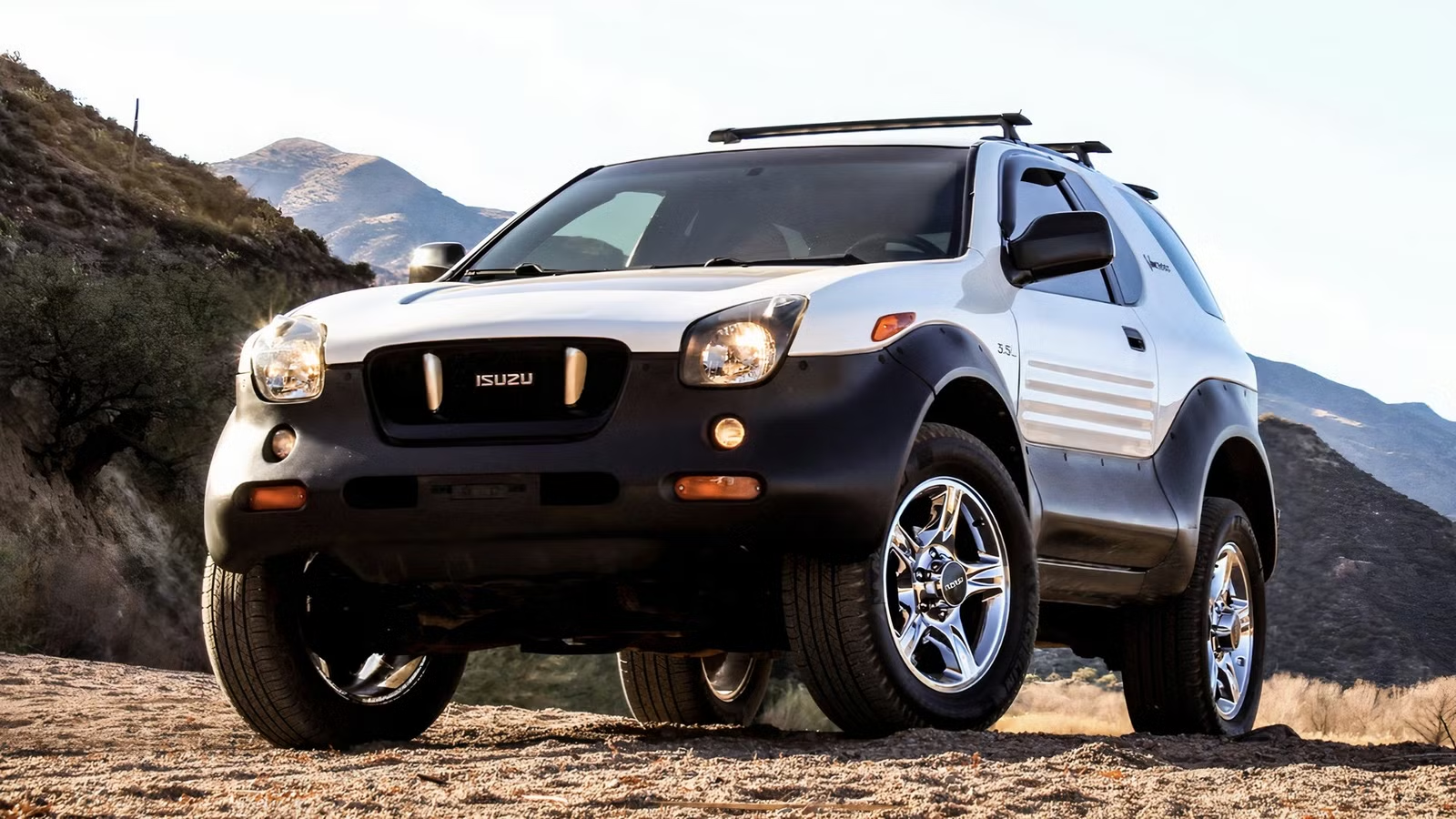
Concept cars can be rather misleading, since they usually display out-there designs and engineering concepts that have the tendency to never make it to the road. The production vehicles that actually result from these concepts usually end up being much more conservative so that they can work in a variety of markets and conditions, or because they’re easier and cheaper to produce than the original concept offerings. Isuzu went against this trend in the late 1990s though, as its small off-road concept SUV ended up being sold practically unchanged.
The VehiCROSS Went From Concept To Production Very Quickly
1999 Isuzu Vehicross Ironman front 3/4Bring A Trailer
In the 1990s, Isuzu was known for producing large and rugged body-on-frame SUVs, but it wanted to sample from different areas of the market. There were few such SUVs that were small enough to be classed as compact, with the likes of the Honda CR-V and Toyota RAV4 both using unibody designs that ensured they were more refined on the road, but not quite as durable. Wanting to make a splash, Isuzu debuted the VehiCROSS concept at the 1993 Tokyo International Auto Show, and it certainly achieved its goal. The small V6-powered SUV looked unlike anything else, thanks to its aggressive styling that was full of body overhangs that made it look supremely tough.
Its grille was designed to look like it had a sharp set of teeth, while indents along the doors further heightened the vibe of this being a little SUV you’d pay dearly for if you underestimated it. Like most concepts, interested onlookers assumed it would never reach production, and moved on with their lives.
Just four years later though, the public could buy one for themselves. First reaching Japan in 1997, the VehiCROSS was launched in the US market for the 1999 model year. The finished article was also pretty much identical to the concept, which was also unheard of in the automotive industry.
The key to these elements was Isuzu electing to use ceramic body-stamping dies, which could be produced much cheaper than traditional cast iron dies, and in a matter of weeks rather than months. This allowed Isuzu to make the needed changes and get the dies produced much more quickly than would normally be expected, while using a large number of parts from pre-existing models built by the brand also reduced lead times and costs considerably. The thing is, if Isuzu had used the normal manufacturing method, the VehiCROSS would have been too expensive to produce due to its unique design.
Isuzu’s Manufacturing Approach Sealed The VehiCROSS’ Fate
1999 Isuzu VehiCross Orange/Black Rear Angled ViewIsuzu
The thing is, while opting to use ceramic dies allowed Isuzu to cut construction costs by enough to put the VehiCROSS into production, they also led to its eventual demise. The reason ceramic dies aren’t used over steel is that they’re much less durable, which leads to them breaking down and being unusable within just a few years. This was exactly what played out with the VehiCROSS, and its 2001 axing wasn’t down to low sales or changing priorities, it was simply that the tooling used to produce the car had deteriorated too much.
In the end, just 5,958 examples of the SUV were produced before the tooling became unusable, with 4,153 of these being sold in the US. Not wanting to spend the money to reproduce the tooling to keep production of the machine going for another short period, or to invest in much more expensive and time-consuming cast-iron dies, Isuzu elected to let the VehiCROSS pass on, alongside the tooling that created it in the first place.
The VehiCROSS Was Very Effective As An Off-Roader
Engine shot of a Isuzu VehiCROSSBring A Trailer
Aside from looking different from every other off-roader out there, the VehiCROSS was also praised for how it backed up its unique design with genuine substance. Underneath its striking looks was a tough body-on-frame chassis borrowed from the Trooper mid-size SUV, while its 3.5-liter naturally aspirated V6 was also taken from its larger sibling. With 215 horsepower and 230 lb-ft of torque distributed across all four wheels, the VehiCROSS had more than enough power to keep moving along the rough terrain it was designed to conquer.
It helped that its four-wheel drive system was also advanced for the time, with its torque-on-demand design meaning it could adapt to a range of conditions and terrain with ease. The system’s computer could monitor 12 different data points, including throttle position, brake position, and all four wheel speeds, and then actively balance the level of torque between the front and rear axles to ensure maximum traction could be achieved. Isuzu even included a special display within the instrument cluster that showed how much grunt was being sent to the front or rear in real time, which was a unique feature for the time.
And then we get to the suspension. While its independent double-wishbone front and rear multi-link setup was very effective in its own right, the real standout feature was its shock absorbers. They were extruded aluminum monotube components that came with external heat chambers, technology that was usually only found in motocross bikes and other off-road racing vehicles of the time. The external heat chambers meant the shocks were practically impossible to overheat, so there was no loss of performance, no matter how long you were attacking a demanding trail.
The VehiCROSS really had it all: a durable chassis, a dependable and powerful engine, an advanced 4WD system, and a suspension setup fit for a top-flight off-road racer. It was a potent recipe, though no other manufacturer has ever elected to make their own version.
The VehiCROSS Didn’t Make Financial Sense
2001 Isuzu VehicrossCars And Bids
There are some good reasons for this. The primary one was cost, both from a production and a selling standpoint. The ceramic die production method at least made it viable for Isuzu to produce the VehiCROSS on a smaller scale, but using a more long-lasting cast iron approach would have tipped the scales too far the other way to make the machine viable as a mass production vehicle. After all, the VehiCROSS was expensive enough in its first iteration.
Thanks to its radical design inside and out, the SUV retailed for just over $30,000, which is the equivalent of just under $58,500 in today’s money. This was supremely expensive for a compact SUV, given you could hand over less than $20k to secure yourself a RAV4 or CR-V, which were excellent offerings in their own right. You could even purchase an SR5 variant of the mid-size Toyota 4Runner SUV for less than the cost of a VehiCROSS, which also boasted the durability that comes with a body-on-frame chassis.
Plus, the adventure SUV segment the VehiCROSS occupied was something of a dying breed at the time, since the Ford Bronco and Chevrolet K5 Blazer had already fallen by the wayside a few years before the Isuzu arrived in the US. Even the venerable Jeep Wrangler was struggling, so opting to build something of the sort seemed like financial suicide. The business case didn’t stack up, even before you factored in just how much money you’d have had to ask for a car running the level of technology the VehiCROSS was.
You Can Still Find VehiCROSSes For Cheap
1999 Isuzu VehiCross Ironman Edition Black/Red Interior Front CabinBring A Trailer
Being such a low-volume machine that looks the way it does, and is as effective at its primary job as it is, you’d think the VehiCROSS would have achieved collector status by now. Well, not so fast. The average value for a used machine currently stands at just $11,984, a small fraction of its original MSRP. There are very few cars that have been tucked away in a garage and still have delivery miles on them, with most used for their intended capability. Even a 28,000-mile car presented in excellent condition only managed to attract $21,000 when it was sold through Bring a Trailer, showing just how cheap they still are.
This is in contrast to similar cars like the Toyota FJ Cruiser, which have doubled in price when compared to their original MSRP. This can be explained partly by Isuzu not being as desirable a name as Toyota as far as classics are concerned, since machines from the latter have a bulletproof reputation for lasting forever. Sourcing parts for a car as rare as the VehiCROSS is also a nightmare, which compromises its value somewhat. The polarizing looks also don’t help it in this regard.
That’s not to say this won’t ever change, however, especially if younger generations go crazy for it. According to Hagerty, younger drivers accounted for around 60% of the registrations of VehiCROSSes back in 2020. As the car gets older and more machines embrace electric propulsion, overlooked vehicles like the VehiCROSS could easily come back to the fore and see a surge in value. There are no signs this will be happening anytime soon, so there are better options if you’re looking for a four-wheeled investment right now.
As an affordable, durable, and extremely effective off-roader though? The VehiCROSS will certainly turn heads, both for its looks and how well it tackles practically any challenging terrain.
Sources: Hagerty, Isuzu
