

We’ve all seen Facebook memes where some aspiring Einstein has the idea to put some sort of generator on an EV. The idea is it can charge the car using the road or the wind, but the idea falls apart immediately once you apply the laws of physics. It’s an idea that makes no sense, except that Hyundai might be about to try it.
Running With, Not Against The Wind
Hyundai Wind Power Patent DrawingsHyundai
CarBuzz has just uncovered a new patent from Hyundai and Kia for a vehicle wind power generation system. The idea is to make a car that can harvest energy using a generator mounted behind a grille in the front bumper. But don’t scroll away, because this one doesn’t look to circumvent Newton’s third law. It tries to take advantage.
Patent filings do not guarantee the use of such technology in future vehicles and are often used exclusively as a means of protecting intellectual property. Such a filing cannot be construed as confirmation of production intent.
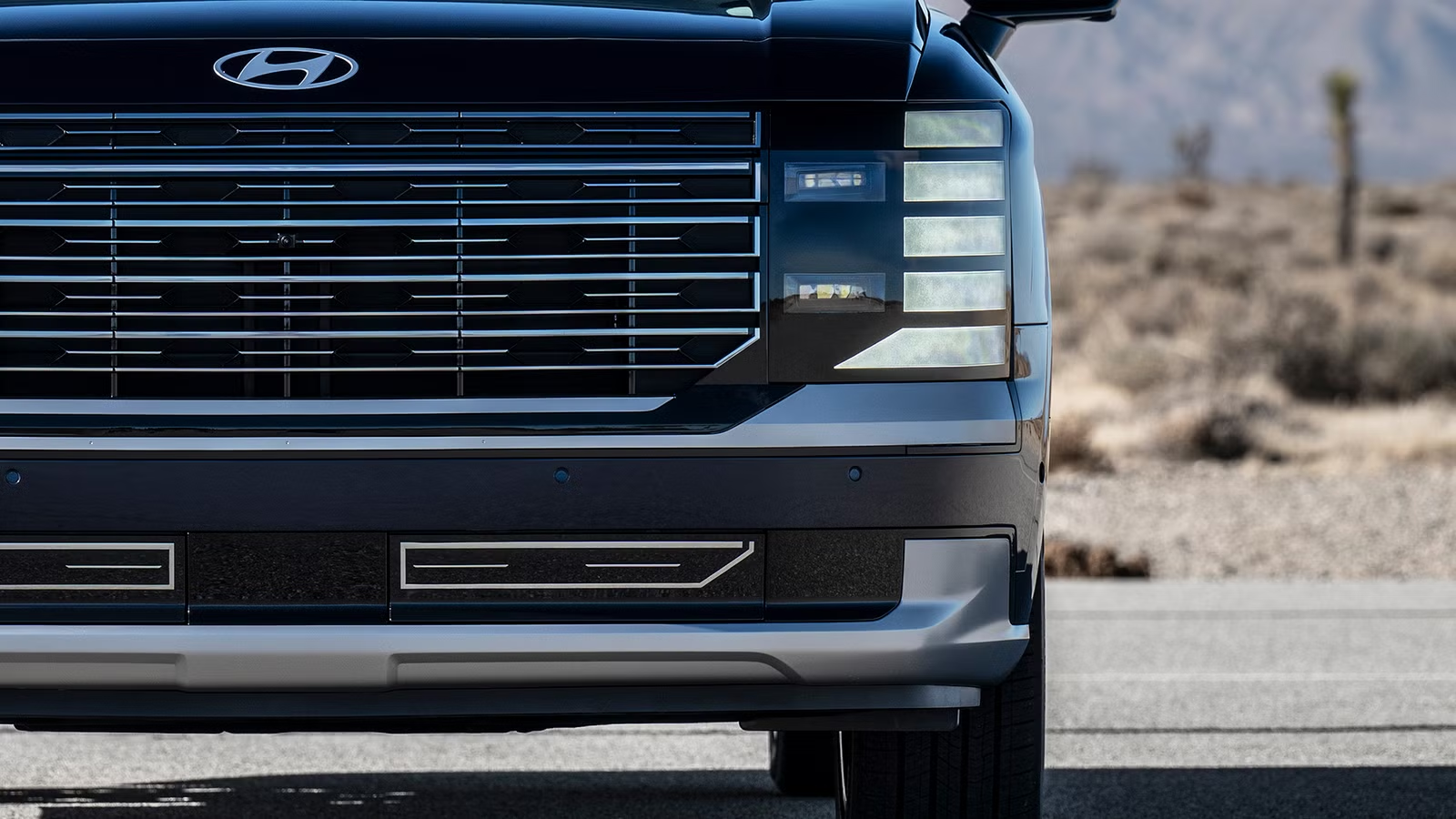
Hyundai’s invention puts the electric generator behind a set of movable flaps that are mounted in the grille. It’s in an air channel to make sure air is directed through the generator when the flaps are open, then exits out the bottom or rear of the vehicle.
Trying to generate electricity at higher speeds in an EV won’t work. The amount of power you take out to put in the battery is equal to the amount of extra power it takes to push the vehicle through that air. Except it’s actually worse than that, because you lose efficiency in power conversion, the motor and generator, and plenty of other places.
Related
Did Hyundai Just Create A ‘Nitrous’ System For Electric Cars?
Hyundai may have the equivalent of a tank of nawwws for EV owners who want one battery for range, and another for power.
At lower speeds, though, the equation changes. On the highway, most of the energy used is to push the vehicle through the air. At lower speeds, it’s tire rotation and the weight of the vehicle (and climate control systems) that use the most. Hyundai has calculated that it can get enough electricity from the generator system in that instance to be worthwhile.
This Idea Works Best With Gas And Hybrid, Not EV
Hyundai Wind Power Patent DrawingsHyundai
The system can capture power over and above what regenerative braking can when coasting or braking. It can even produce some electricity for the battery using the wind that flows through the system when the car is parked. The shutters close, improving aerodynamic efficiency when the math doesn’t work.
In a hybrid vehicle, the system has even more potential. The hybrid’s electric motor is far more efficient than the gas engine. The gas engine itself is most efficient at certain load and speed conditions. So the generator can be used to make power for the battery in a way that puts the gas engine into the best possible fuel economy window, then it can shut off both engine and generator for more electric driving.
Applied to a gas-only car, it can make electricity to charge the car’s battery and make power for the 12-volt systems. It would replace the alternator and run as needed, reducing fuel consumption. Instead of braking down a hill, you could just make some electricity from the air flow.
Related
Interesting Battery Patent From Hyundai Looks Perfect For ‘Mid-Engine’ Sports Car
Imagine the mid-engine balance in a sleek, low-roof EV.
It’s a wild idea, but the potential for extra efficiency is very intriguing. So is the idea of parking facing the right direction and getting a charge from the wind. The inventors don’t suggest how much power you might get, and small-scale generators aren’t exactly efficient. But that’s a problem for a different patent.
CarBuzz Insight – Why This Matters:
2025 Hyundai Tucson PHEV power gaugeHyundai
Ways to make EVs more efficient are important, but in this patent it’s the gas applications that are the most interesting. It shows that automakers like Hyundai and Kia are still investing in gas engine development, and that they are willing to go to extremes to make them more efficient.
Those extremes might never come close to EV efficiency, but they could be enough to keep gas cars on the road. Something that’s clearly important to many American vehicle shoppers. Plus, free energy is always nice.
Source: US Patent & Trademark Office
