

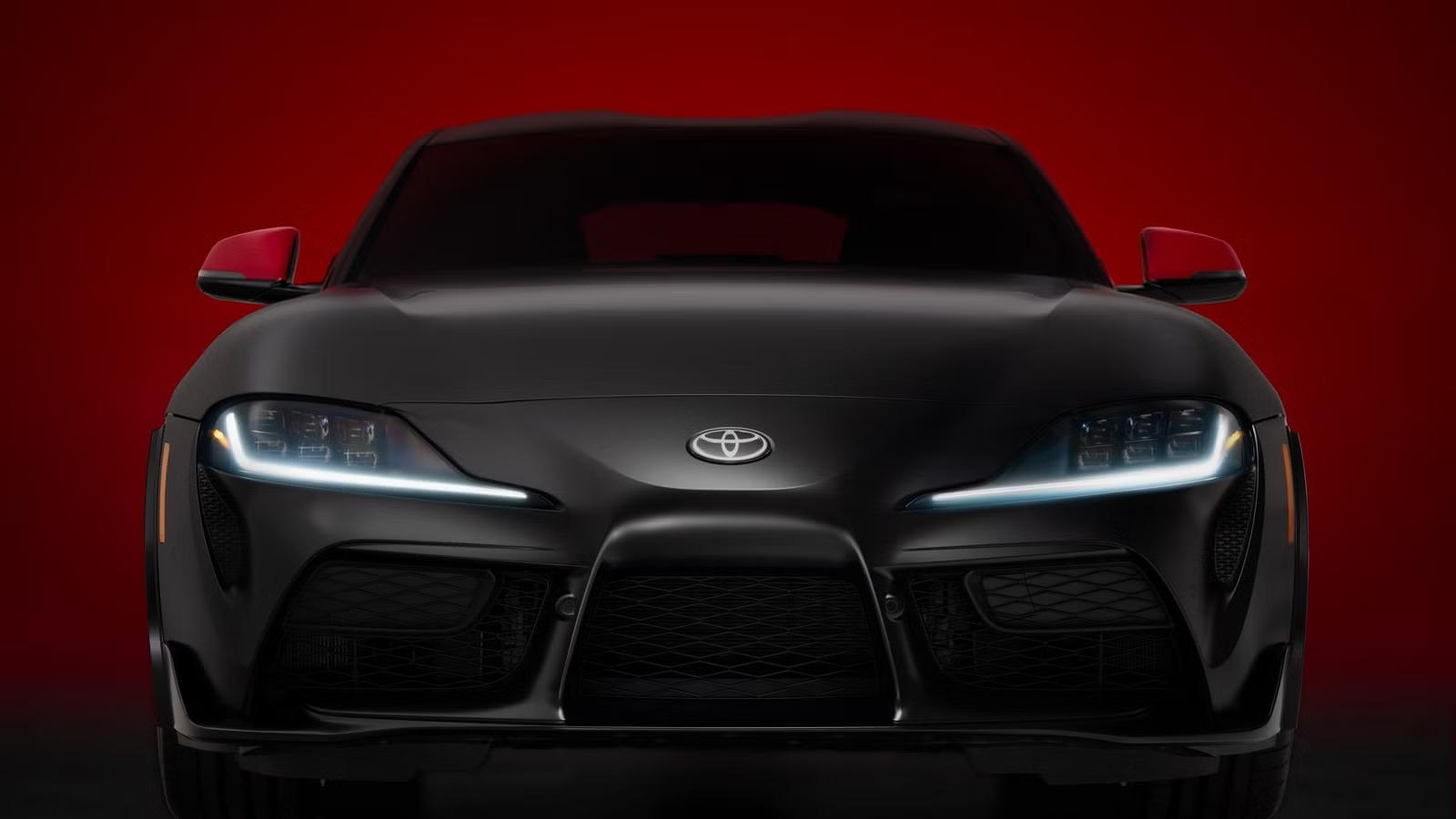
Ever since the Toyota Supra first hit the market in mid-1978, then called the Celica Supra, its recipe has been rather unchanged. Since then, the model has packed an inline-six engine mounted up front and rear-wheel drive around the back. With this simple formula, the Supra managed to become one of the most famous Japanese sports coupes ever produced.
However, things are quietly changing for the age-old model. Now, it seems Toyota is indirectly broadening the Supra’s horizons with two new powertrains, both of which are V8s: the Supercars Championship V8 racer and the incoming GR GT3 V8 hybrid. The broadening engine developments beg the question: is Toyota taking the Supra platform to new heights?
The Inline-Six Is Still Central To The Street Supra’s Equation
2026 Toyota GR Supra from the frontToyota
At present, the current, fifth-gen (A90) Toyota Supra is coming to its natural end. 2026 marks the A90’s final model year, and to celebrate, Toyota produced the A90 Final Edition. According to the Japanese automaker, only 300 examples of the special edition version were produced, with 150 destined for the Japanese market and the other 150 going to Europe. Production officially ended in March of this year, and the number of available units in the USA is extremely low.
2026 Toyota GR Supra from the rear three-quarter angleToyota
The Final Edition Supra is no slouch. Instead of the standard 382-horsepower and 368 pound-feet of torque output from its turbocharged, 3.0-liter straight-six, Toyota ratcheted it all the way up to 429 ponies and 420 pound feet of torque. Instead of sourcing a larger or different engine for the Final Edition, Toyota stuck with the six due to the engine type’s heritage under the hoods of Supras, along with the straight-six power plant’s inherent balance.
If we turn back the clock roughly 14 years, the A90 Supra has just entered into development, and the Final Edition is a long way off. At the time, Toyota had just signed an agreement with BMW to joint-build a sports car platform, which the A90 and the G29 BMW Z4 would be based on. The Supra was destined to utilize BMW’s 3.0-liter B58 straight-six engine, which Toyota relentlessly tested for power, reliability, and longevity in order to certify it for use.
2026 Toyota GR Supra from the front three-quarter angleToyota
While some joke that the A90 Supra was just “a BMW in a Toyota shirt,” in reality, it managed to remain largely faithful to the age-old Supra formula. Front-engined, rear-drive, and straight-six power have all been essential to the Supra’s heritage for the last 48 years, and Toyota seemed to spare nothing when it came to making sure BMW’s engineering and production was up to snuff.
Motorsport Abandoned The Inline-Six Without Looking Back
2026 Toyota GR Supra. Australian Supercars. Race car. Launch. Front, three-quartersToyota
These days, finding a straight-six in mainstream racing series is harder than it used to be, but there are still versions of the B58 racing out there. The weird thing is that they actually produce less power than you’ll find in the most powerful Supra, due to balance of performance regulations. After dumping BMW’s turbocharged four-cylinder option a few years ago, the Supra is currently racing with three engines globally, none of which are street legal.
Three Engines Reveal Three Completely Different Missions
2026 Toyota GR Supra. Australian Supercars. Race car. Motion. On-track. Front, three-quartersToyota
The versatility of the modern racing Supra platform is best demonstrated by the three vastly different powertrain architectures Toyota deploys across international motorsport sanctioning bodies. In customer racing programs like IMSA, SRO GT4, and Japan’s Super Taikyu series, the factory-backed GR Supra GT4 EVO utilizes a competition-prepped variation of the production 3.0-liter B58 turbocharged inline-six. Utilizing a single twin-scroll turbocharger, modified ECU mapping, and bespoke race manifolds, this engine produces between 430 and 500 horsepower depending on strict Balance of Performance (BoP) regulations. It maintains the road car’s fundamental mechanical identity, delivering linear torque curves, predictable throttle modulation, and endurance-tested durability for privateer teams racing around the globe.
Stepping up to elite professional series requires far more radical engineering departures from showroom reality. In Japan’s premier Super GT class, the GR Supra GT500 abandons the six-cylinder configuration entirely in favor of a specialized 2.0-liter turbocharged inline-four built under strict Nippon Race Engine (NRE) framework rules. Despite dropping two cylinders and a third of its displacement, this high-revving race motor utilizes extreme boost pressures, direct-injection mapping, and carbon-fiber packaging to churn out well over 600 horsepower. This engine is by far the most interesting, because we know Toyota likes to run engines on the track before putting them in production cars. This was the case with the 300-hp turbocharged 3-cylinder, and we know Toyota is working on a gnarly 4-cylinder performance engine.
Meanwhile, on straight-line drag strips, Toyota’s NHRA Funny Car Supra operates on an entirely separate level of mechanical madness. Carrying zero parts overlap with any production vehicle, it packs a massive 500-cubic-inch nitromethane-fueled supercharged V8. Generating an earth-shattering 11,000 horsepower, this purpose-built drag mill launches the carbon-bodied Supra shell past 330 mph in under four seconds—proving the emblem spans everything from refined road-car derivatives to hyper-specialized motorsport monsters.
What’s Next, Now That The Supra Is Dead?
Toyota GR GT PrototypeGabrielle Schmauderer/CarBuzz/Valnet
The big news is the GR GT, but it will be sold in limited numbers. The GR86 will soldier on for a while, but Joe Average will be happy to hear that the Celica is returning. Not to mention an all-new MR2 hiding in plain sight.
The Celica is not confirmed yet, but it is one of the worst-kept secrets in automotive history. Development prototypes and internal leaks point toward a high-output 2.0-liter turbocharged four-cylinder engine—derived from the GR Yaris—potentially paired with hybrid assistance to push power figures near 400 horsepower.
Related
Toyota GR Celica Edging Closer To Reality With New Camo Prototype
Big scoops, broad fenders, and a tall wing complete the new Celica’s rally car recipe.
Echoing the legendary GT-Four models of the 1990s, the new Celica is expected to feature a performance-tuned GR-FOUR all-wheel-drive system. Toyota is testing both a six-speed manual and a fast-shifting automatic transmission to satisfy purists and track drivers alike. By reviving the Celica alongside the Supra and GR86, Toyota continues its passionate commitment to enthusiast-focused sports cars.
Sources: Toyota, BMWBlog.com, LexusEnthusiast.com, Racecar-Engineering.com.
