
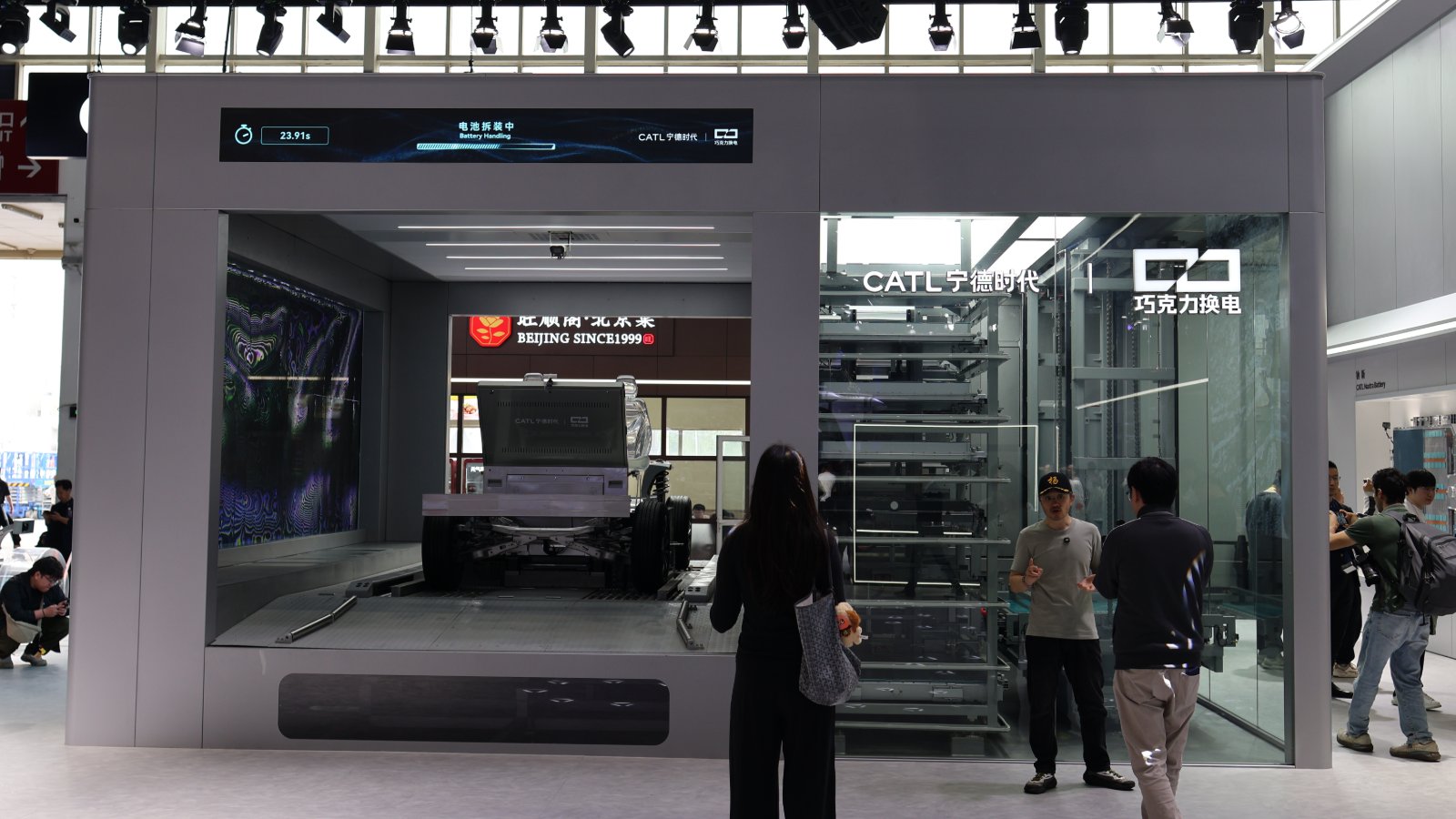
A CATL Choco battery swap station on display at the Beijing Auto Show in April 2026. Credit: CnEVPost
- The initial models are under development, with launches planned for next year.
- The first model will reportedly come from Dongfeng and Huawei’s Epicland brand, expanding vehicle coverage for the Choco swap network.
Huawei’s automotive technology company Yinwang, or Newcool, and CATL (HKEX: 3750) have tentatively set an initial lineup of 5 battery swap models for launch in 2027, according to a media report.
Newcool, CATL and the battery maker’s battery swap operator are developing the vehicles, LatePost reported on Tuesday, offering further details on the initial scope of their partnership.
Newcool reiterated the core provisions of the 3 parties’ strategic cooperation agreement to the outlet but declined to comment on the model count or launch plans. Those details have yet to be officially confirmed.
Cailian reported earlier today that the first model would come from Epicland, a brand jointly developed by Dongfeng and Huawei, with a launch planned for 2027. The specific model has not been disclosed.
The 2 reports add details on the product lineup and timeline to the newly announced battery swap partnership. The strategic cooperation framework agreement announced on October 19 did not identify specific models or launch dates.
Under the agreement, Newcool is joining CATL’s Choco swap ecosystem to help adapt partner models using Huawei’s Qiankun intelligent automotive solutions for compatibility with the battery swap network.
The partnership also includes Contemporary Amperex Energy Service Technology (CAES), CATL’s battery swap operator.
The 3 parties plan to integrate data and services across vehicles, battery swap stations and cloud systems, using real-time battery conditions and users’ travel patterns to anticipate energy needs and proactively arrange battery swaps.
Under the plan outlined in the earlier statement, vehicles would autonomously locate and enter stations, position themselves for a fully automated 99-second battery swap, and then drive away.
Additional partner models would help CATL expand the user base for its battery swap network. The business can generate recurring revenue from battery rentals and energy replenishment services, but requires sufficient vehicle volume to support investment in stations, battery inventories and operations.
CATL had built 2,520 battery swap stations across 200 Chinese cities as of September 29, according to information it previously released. Its long-term goal is to expand the network to 30,000 stations.
The company also plans to build 1,000 highway battery swap stations between 2026 and 2027, extending the network beyond cities to support long-distance travel.
Newcool took over Huawei’s former intelligent automotive solution business and supplies automakers with systems for smart driving, smart cockpits and vehicle control.
Aiva is discussing a battery swap solution with CATL, with its first production model, the ME7, set to debut by the end of 2026.
