

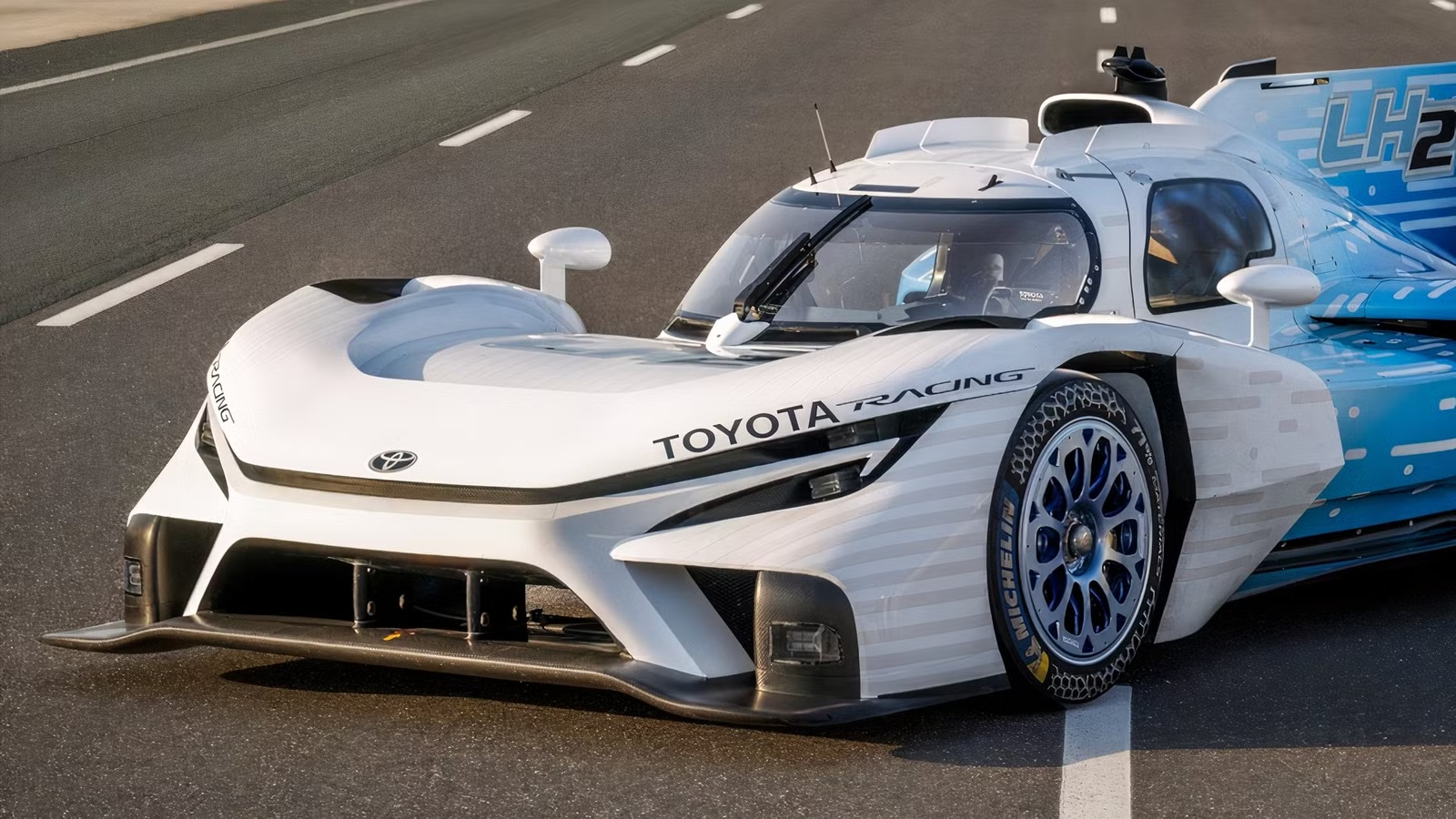
Fast-forward a few years and try to imagine the scene. It’s 2030, and screaming down the Mulsanne straight is a GT3 race car. The thing sounds like a gasoline-powered racer, but it’s actually using hydrogen to fuel it. That’s the sort of future Toyota is after; not hydrogen-powered fuel cells, but straight-up hydrogen-fueled internal combustion engines. The Japanese automaker is working on a 3.5-liter V6 that will hopefully do just that.
The engine, part of the brand’s joint H24EVO project shared with MissionH24, is targeting an output of 871 horsepower. In essence, Toyota is heavily invested in figuring out if internal combustion engines can still be viable if the fuel that goes into the mill’s intake changes. The H24EVO project was announced on September 26th, 2026, with an official reveal target planned for early 2028.
Don’t Give Up On Hydrogen Just Yet
Toyota H24EVO prototype finished in blue and whiteMissionH24
Up until recently, MissionH24’s H24EVO program was experimenting with hydrogen fuel cells, but decided to scrap the idea altogether in pursuit of a true hydrogen-fueled powertrain. Instead of abandoning hydrogen, MissionH24 simply switched tactics and changed the method by which the element would be burned. Other automakers have recently given up on hydrogen fuel cells, too, such as General Motors and its HYDROTEC platform.
In a typical hydrogen fuel cell car, hydrogen reacts chemically with oxygen, thereby producing electricity. From there, electricity drives electric motors attached to the vehicle’s drive wheels. The only emission to come out of the tailpipe is water vapor, effectively eliminating emissions concerns stemming from the vehicle itself. No conventional gasoline combustion and higher efficiency are major upsides, too.
However, throw endurance racing requirements at a hydrogen fuel cell, and things change dramatically. The reason is that fuel cells require more than just the cell itself. A fuel cell is actually a stack of fuel cells, which would need to be larger to accommodate more fuel for endurance purposes. That means the endurance racer would need more hydrogen storage. A large air supply, excellent cooling, a slew of electronics, and other high-voltage hardware would all need to be extensively refined to work in long-lasting, high-intensity situations.
It’s reported that MissionH24 found current fuel-cell hardware capabilities were not up to the task of delivering the sort of performance required for endurance racing without becoming way too heavy. By switching over to straight hydrogen fuel for an internal combustion engine, a lot of weight can be saved. For context, MissionH24 is targeting a maximum H24EVO weight of roughly 1,250 kg (2,576 pounds). Remember, every single pound of mass added to a racecar hurts acceleration, cornering, top speed, and tire load, so saving as much weight as possible is paramount.
Toyota’s role in this project relates to the 3.5-liter V6, which it is supplying for testing and, should things work out, eventual racing use. Not to mention, should MissionH24 be successful, straight hydrogen-fueled ICE engines would likely change the scope of future engines as a whole, and Toyota would be positioned near the forefront of that innovation.
Toyota’s 3.5-Liter V6 Can Turn Hydrogen Into Serious Power
Toyota H24EVO prototype finished in blue and whiteMissionH24
871 horsepower is respectable in the world of GT3 racers. Toyota’s 3.5-liter test mule supplied to MissionH24 will be paired with a hybrid system, as well. Rather than first determining whether using hydrogen to power an ICE engine would work at all, MissionH24 decided to set the 871-hp goal from the outset. The best part? The engine’s fundamental operation likely remains the same.
Toyota’s supplied 3.5-liter V6 doesn’t have to undergo all that much change to run on hydrogen. All the same basic components will remain, such as its cylinders, pistons, crankshaft, and air intake. This means its fundamental architecture will resemble what most engineers are already comfortable with. It will even use a standard mechanical transmission. In MissionH24’s previous fuel cell idea, things would be very much specialized under the hood, probably alienating most conventional engineers right off the bat.
BMW iX5 hydrogen tankBMW
Coupling the 3.5-liter hydrogen V6 with a standard hybrid drive also injects some helpful familiarity into the mix. The setup will likely behave exactly as typical hybrids do, with functions like energy recovery able to be utilized on the racetrack. It also allows for more power output than the 3.5-liter V6 could probably make on its own, thanks to electric-power assistance.
A major downside of using hydrogen fuel, even if it’s applied to conventional ICE engine operational metrics, is storage. The hydrogen used needs to be liquid, meaning it will be compressed and under pressure. At the same time, it needs to be cooled to remain in a liquid state. MissionH24 has already secured cryogenic tanks built by FORVIA for this purpose, but there are other issues to solve, as well.
Hydrogen engines need their fuel delivered at very specific temperatures and pressure, with far less room for error than in a gasoline engine. Building highly specialized pumps and other components for high-pressure delivery is proving to be a challenge for MissionH24. At the same time, all of this specialist gear needs to stay lightweight. The H24EVO is a race car, after all.
Hydrogen vs. Gasoline, Or Power-To-Weight vs. Everything Else?
Toyota H24EVO prototype finished in blue and whiteMissionH24
Efficiency isn’t enough on its own to win a race, especially not in an event like Le Mans. In reality, a winning racecar needs to exhibit the best combination of things like a lightweight structure, power output, reliability, and even repeatable performance. With an extremely low target weight of about 1,250 kilograms, that leaves little room for error anywhere else in the H24EVO’s design.
You can make a powertrain as efficient as you want, but if it requires loads of heavy supporting tech to work properly, you’ve already lost your edge on the track. MissionH24’s decision to use a standard engine and route hydrogen through it eliminates all the associated complexity that comes along with fuel cell technology. This way, both Toyota and MissionH24 can work on making the 3.5-liter V6 as lightweight and high-revving as possible, all while allowing race-day mechanics the ability to work on a familiar powertrain.
There are some issues with using hydrogen instead of gasoline that still need to be solved. The combustion characteristics of both fuels are different, requiring the engine to operate a little bit differently, too. As of now, it remains unclear what MissionH24 and Toyota are doing to alter the 3.5-liter V6’s combustion characteristics to suit liquid hydrogen’s requirements, but the finished product will not be a mirror image of a gasoline engine in its operating characteristics.
Once solved — if solved — the H24EVO’s true testing phase can begin. MissionH24 is aiming for a top speed of roughly 199 to 205 mph, which it will no doubt need to hit on the Mulsanne straight to remain competitive. An engine running at full tilt at that kind of speed absolutely needs the proper engineering to make sustained runs like that repeatable.
Success On The Racetrack Could Translate Into Success On The Road
Toyota liquid hydrogen techToyota
There’s a broader picture here if you take a step back. The H24EVO, should it be viable on the racetrack, means hydrogen-powered ICE engines could very well be utilized on the road. With that in mind, that would mean internal combustion is no longer tethered to fossil fuel use completely. If you can retain the core basics of a regular engine and simply route hydrogen through it, you would eliminate the need for complicated fuel cell development. However, the issues of hydrogen storage would still need to be solved in a mass-production-friendly way.
At this point in time, the H24EVO project aims for an official Le Mans demonstration in 2028, with a hopeful 2030 target for official racing entry. That’s less than four years from now. Until then, MissionH24 and Toyota will likely be hard at work figuring out how to solve things like liquid hydrogen fuel storage that’s both safe and lightweight.
Toyota’s joint program is one of the most significant of its kind at this point, although other brands may join in on the hydrogen fun in a similar capacity as time moves forward. Should the H24EVO continue to progress positively through its development, other titans of the industry may very well follow suit with hydrogen-fueled ICE engine technology.
Should things work out completely, the H24EVO may end up proving that you can keep the engine the same; you just swap the gas out for hydrogen.
Sources: Toyota, MissionH24, Ground News, FIA, JP.Motorsport.com.
