

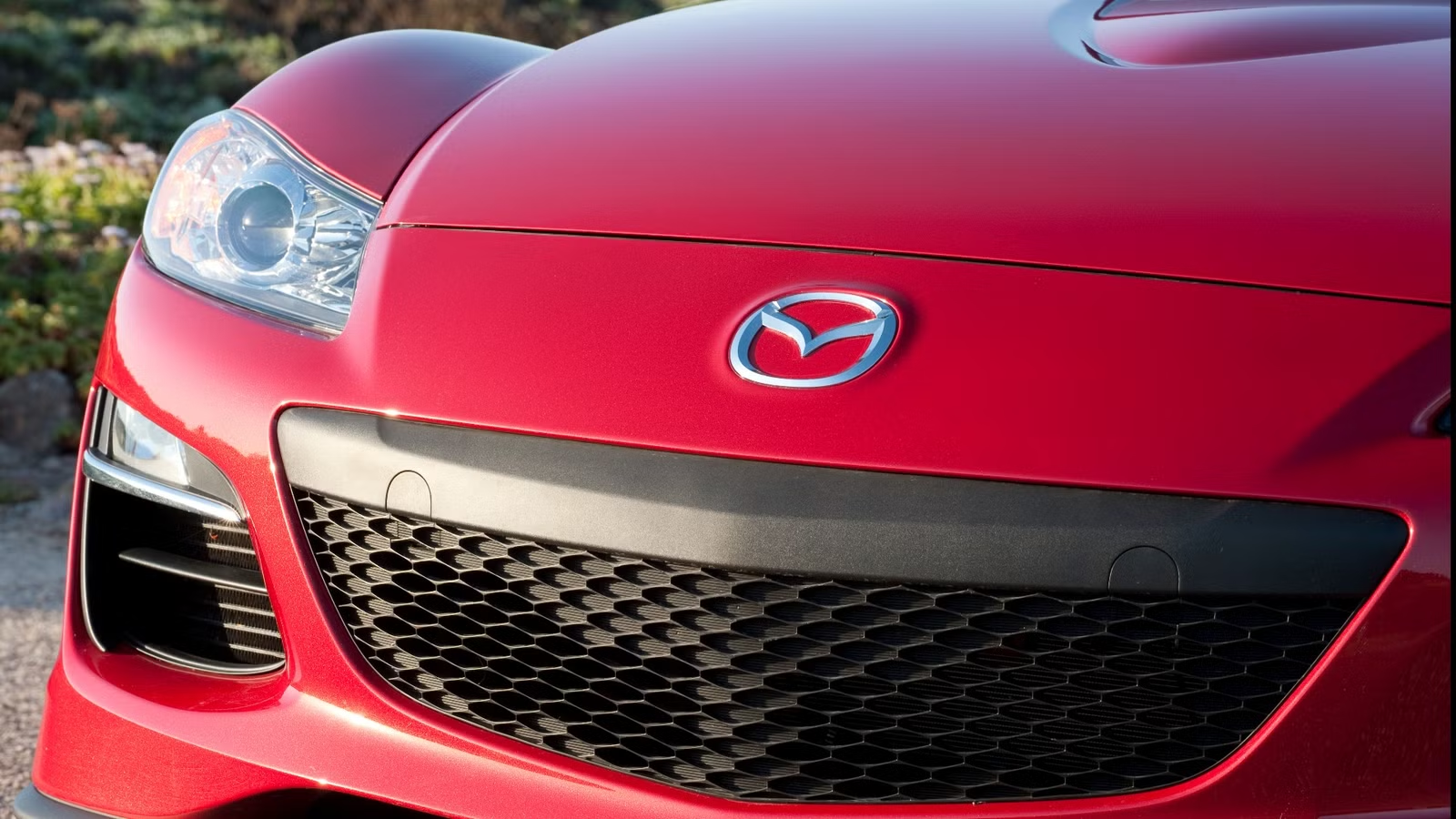
Following up a successful enthusiast car has never been easy for automakers. However, some have managed to do it. For example, Nissan has successfully created multiple generations of the GT-R, and Subaru has kept the WRX name competitive.
For Mazda, this moment came in the early 2000s, when they had to build on the rotary-engined success it enjoyed with the RX-7. The RX-8 may not have ever lived up to its predecessor, but that doesn’t mean it should be forgotten.
Plagued by reliability quirks, the RX-8’s value has steadily dropped for years, but we don’t think that can continue forever. If you want the unique experience of owning an internal combustion engine without reciprocating pistons, here’s why the lower entry price for an RX-8 is great.
Rotary Dreams Have Become Increasingly Expensive
Mazda RX-7 exterior frontMazda2011 Mazda RX-8 – front angleMazda
The most famous RX-7 generation is the third and final one, unveiled in 1991 and sold in Japan until 2002, although availability in the United States ran only from the 1993 through 1995 model years. The first two generations sold in great numbers, including 377,000 examples of just the first iteration, and accounted for most of the world’s RX-7 sales. The third gen never really became a sales hit because of the high base price. Mazda retired it after just three years in the US, but the automaker couldn’t have predicted how big a cultural hit it became.
Fueled by 1990s JDM modifying culture, the twin-turbo twin-rotor setup became famous for its distinct sound and smooth characteristics. The model also had a prominent role in the Fast and Furious films, giving it appeal to a younger generation of car enthusiasts. With that movie, along with countless other cultural references to this car, prices have crept up sharply.
2005-2008 Mazda RX-8 1.3L NA 13B Renesis Rotary EngineMazda
It’s hard to put an exact number on it with the number of trims and options available, but for a decent RX-7, you’re looking at around $40,000. A 1993 example went for a hard-to-swallow $148,000 in 2023 as it was pristine and unmodified. With the amount of aftermarket performance parts available for this vehicle, finding a clean example is becoming increasingly difficult. There’s currently a listing for $100,000 for a 5,000-mile RX-7 with a manual gearbox.
90s cars as a whole are becoming increasingly expensive. Those who had pictures of the RX-7 on their wall, watched Fast and Furious or Initial D, and saw these cars in dealerships when they were young might now have the means to buy them. The situation means dealers are jacking up the prices, especially with how picky buyers can be. The subpar reliability of this sports car also means a well-detailed service and maintenance book is worth its weight in gold.
The RX-8 Delivers A Rotary Experience Unlike Any Other
The RX-8 came out in 2003 at a much more reasonable price point and with a distinct character. The heavily revised Renesis twin-rotor rotary engine gave it engaging free-revving performance and a sound unlike other cars. Depending on the trim level and transmission choice, the RX-8 came with either a six-port or four-port engine, producing 192-228 horsepower. The ports refer to the number of intake inlets, which allow for more power.
Built on a chassis shared with a Miata, it delivered more power and an intoxicating noise that made the MX-5 seem lame by comparison. And its handling was as sharp as its soundtrack was visceral, reading driver inputs and telegraphing them into a dance between car and driver that amplified the engine’s revviness and responsiveness.
– Roger Biermann, Managing Editor, CarBuzz
Lower-power four-port engines were only available with an automatic transmission in the US market, whilst six-port engines had a slick six-speed manual gearbox. With a displacement of only 1.3 liters, this engine produced a measly 156 lb-ft of torque, meaning speed came from properly attacking the gears and gas. With such a tiny engine up front, the RX-8 was delightfully easy to steer, feeling as if it could change direction with just your thoughts.
The base pre-facelift model has a delightfully Japanese 2000s look, but the facelift version looks much more modern and grown-up. The R3 is maybe the most desirable edition to come from the facelift, featuring sports seats, suspension, and forged wheels. It’s also super rare, so good luck getting your hands on this flagship model.
Setting aside its famously iffy reliability, the RX-8 is a pleasant car to own and drive daily. The addition of tiny rear doors means adults can fit in the back, and the front seating position is nigh-on perfect. The 7.6 cubic feet of cargo space it offers in the back is also good compared to two-seat cars of the time. Overall, the high-revving, under-torqued engine means you have to wring out performance, making it an intense car to drive when you’re really on the ball.
Its Reputation Keeps Prices Surprisingly Low
The Mazda RX-8 is the company’s last rotary-powered production car, and was on sale until 2012.Mazda
The elephant in the room whenever someone talks about how good an RX-8 is to drive and own is how inherently fragile the engine is. Instead of pistons reciprocating up and down, a rotary engine relies on a spinning triangle inside a combustion chamber. Each side of the triangle acts similarly to a piston by compressing an air-fuel mixture before a spark plug ignites it. Each corner of the rotor has a seal against the inner wall of the chamber, but if these parts fail, then compression can leak into other areas of the engine. Think of a cracked head gasket leaking pressure into the cylinder next to it.
These rotor tips, called apex seals, wear against the internal housing, so they need constant lubrication. The engine is designed to burn a little oil to minimize wear, but that only means more open-hood time for the owner to feed this bottomless pit of oil known as the rotary engine. If heavy compression loss occurs, the powertrain requires a rebuild, which isn’t cheap. Later models featured more oil injectors, but the RX-8 has never shaken off this unreliable nature.
2005-2008 Mazda RX-8 Black/Tan Interior Driver AreaMazda
In addition, the starter motor on early models can be weak and should be upgraded to the later, stronger model. The Wankel engine’s higher emissions mean Mazda designed the ignition to flood the engine and the catalytic converter on cold starts to warm it up quicker. That means you should avoid turning off the engine until it has warmed up enough to clear out the fuel. Some owners have also complained about premature clutch wear.
You should go into the RX-8 with an open mind. Some owners have had a nightmare experience, while others have had a super reliable ownership experience. A pre-purchase inspection is crucial with this car, and especially a compression test. Other than the purchase price, be warned that the RX-8 gets poor fuel mileage at 16 miles per gallon city, 22 mpg highway, and 18 mpg combined for the 2004 model, regardless of transmission. It also consumes oil, by design. If you’re sold on the rotary engine, though, take the plunge with a late-model-year example after the 2008 model year refresh.
The RX-8 May Not Stay Cheap Forever
2003 Mazda RX-8 doors openMazda
The thrill of the RX-8’s driving experience won’t die out any time soon, meaning values could start to climb. If a third-gen RX-7 is too expensive, then many folks are going to look for less expensive options, and the RX-8 fits the bill. Plus, owners have found ways to make the engine last longer and have learned which oils work best. With so many turbocharged cars making power easy to access, this humble Mazda makes you work for it in a way few others do.
The Mazda RX-8 didn’t get much love for a long time, largely owing to its lowly performance and infamous reliability issues with the 13B Renesis engine. The fact that it had rear suicide doors, a carbon fiber driveshaft, and seating for kids in the back made it an anomaly for an affordable sports car, and one the world should remember.
Recent Listings Of The RX-8
2007 Mazda RX-8 Red Overhead Side View Driving w/ Sunroof OpenMazda
- An 11,000-mile RX-8 Grand Touring recently sold for $16,500
- A 47,000-mile RX-8 R3 recently sold for $18,500
- An 18,000-mile 2004 RX-8 Sport recently sold for $8,200
Market values vary widely, but we’d set aside $20,000 at this point for the purchase, inspection, and maintenance associated with the RX-8. That might be higher than you’d expect, but these cars are becoming rarer, and owners are holding onto them, hoping the rotary engine makes them even more appealing in the future. Mazda’s constant back-and-forth with the Wankel engine means you could also be looking at the last series-production car with wheels powered by the spinning tortilla chip.
Some listings also include engine-swapped examples, such as with LS V8s or General Motors LFX V6 engines. These eliminate the rotary’s issues, but the added weight and complexity of the donated engines mean some of the lightweight characteristics are lost, which is what makes the RX-8 shine. Unfortunately, we don’t have a crystal ball, but we think unmodified late RX-8s could be the next obsession for collectors.
Sources: Mazda, Pistonheads, Classic.com, Evo, BringATrailer
