

These days, the term ‘everyday supercar’ applies to many a performance model. From the modern-day Porsche 911 Turbo to the McLaren 750S, many thoroughbred supercars are designed to excel on-road as well as on the track. Back in the late 1980s, they were a distant dream. The Porsche 911 Turbo of the time was still too wayward to be considered an ‘everyday supercar’, while models like the Lamborghini Countach would make your life a living hell from the moment you opened the door.
But an unlikely champion emerged, one renowned for reliability and practicality rather than Ferrari-beating performance. THat champion was Honda, and the car that became the world’s first daily supercar was none other than the NSX in 1992. The goal was simple: a real supercar rival that was comfortable and reliable, but also a true performer.
The NSX Was Designed To Be Used On An Everyday Basis
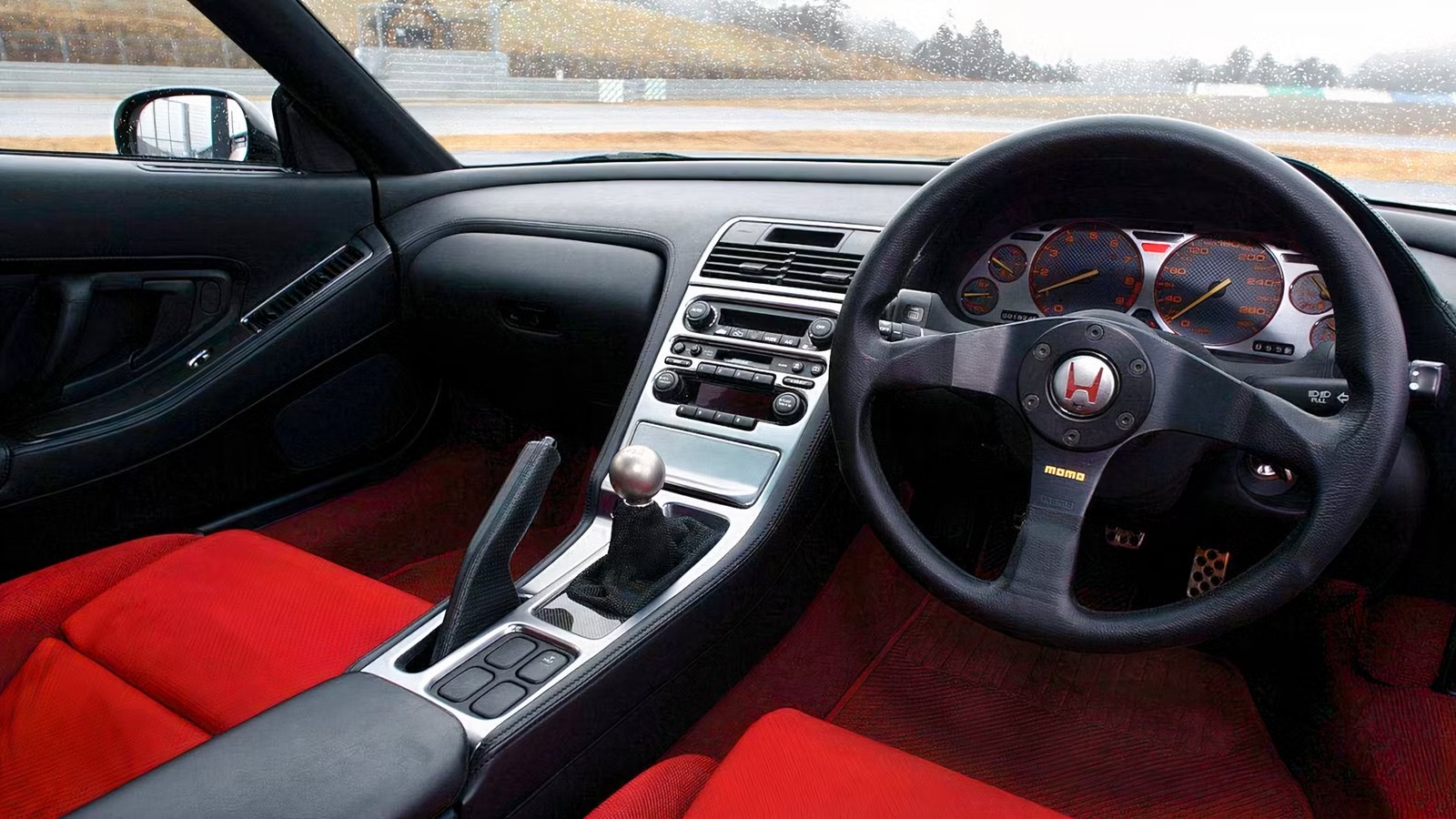
Interior view in the Acura NSX
Acura/Honda
While Honda’s engineers afforded the NSX the level of performance other supercars could achieve at the time, they also worked hard to ensure drivers felt comfortable when piloting it when their hair wasn’t on fire. A fighter-jet style canopy was developed to give drivers a 360-degree view of their surroundings, while the mid-engine layout meant that a decent-sized trunk was available and legroom was improved in the cabin.
The NSX’s seats were designed to be supportive as well as comfortable, and it came with a range of handy refinements as standard, such as climate control and a Bose audio system. The controls for these setups were also placed intelligently on the dashboard to make it as intuitive as possible for the NSXs occupants.
It Even Came With An Extensive Warranty
2003 Honda NSX-R. NSX Type RBroad Arrow Auctions
Of course, being a Honda, it came with a stout reliability record. The C Series V6 engine family is one of the brand’s most reliable, with units easily capable of covering 200,000 to 250,000 miles when properly looked after. The NSX was even sold with a three-year or 36,000-mile warranty when it was released in the US, allowing owners to give their new pride and joy a good go without having to worry about being left with hefty repair bills. That said, any crash damage wasn’t covered.
Given the NSXs C30 A power plant shared many similarities to the C-Series engines featured in its more mass-produced models, it could also be easily maintained by main Honda dealers and independent garages specializing in the brand’s hardware. This helped make it a great everyday supercar, as you didn’t have to sit around waiting for months for bespoke parts to be made should the worst happen – which it largely didn’t.
The NSX Was Born To Battle Honda’s European Rivals
Exterior view of the Acura NSXAcura/Honda
The idea of an everyday supercar was first floated within Honda around the mid-1980s, when the brand was playing around with different layouts it could utilize in its future products. One of these included cutting a tiny Honda City in half and slotting the engine behind the rear seats to power the rear wheels. From this came the idea of building a supercar, though Honda’s higher-ups pushed to ensure the finished product would show its European rivals who was boss.
1995-2001 Acura NSX Yellow Rear Angled ViewAcura/Honda
Honda commissioned Italian design house Pininfarina to design a concept car following a two-seat mid-engined configuration. Named the HP-X, it made its worldwide debut at the 1984 Turin Motor Show. It was well received, and Honda got stuck in a lengthy development process to ensure it could hit its lofty targets. The marque targeted cars such as the Ferrari 348 with its challenger, which was later christened the NSX.
And the NSX managed to beat the Ferrari in a few core areas. On the one hand, it was about half the price when new, and on the other, it was cheaper to maintain. While Ferrari 348 owners faced $8,000 annual maintenance costs (based on multiple owner reports) and Lamborghini Countach drivers couldn’t see out the back window to park at grocery stores, NSX owners enjoyed Honda Civic-level maintenance schedules and 360-degree visibility for daily errands. And years down the line, the NSX has seen its value increase significantly.
Sold Under Honda’s Luxury Brand In The US
1991 acura nsxAcura
Following a six-year development push, the finished product finally made its debut at the 1989 Chicago Motor Show. After more positive reaction from audiences worldwide, the NSX went on sale in Japan first in 1990, before then being introduced to US audiences by the end of the year. Unlike most of the world, the NSX was sold under Honda’s US-based luxury arm, Acura, stateside. This hinted that the NSX was destined to be no ordinary supercar.
The first-gen car was continually developed until it was finally retired in 2005, with a hybrid-powered second-generation Honda NSX making its bow in 2017.
Honda Used F1 Technology To Solve Supercar Reliability Problems
The 2003 Honda NSX-R, with just 10,000 miles on the clock, recently became the first NSX to officially sell for more than $1 million.Broad Arrow Auctions
The buzzword Honda stuck to when designing the NSX was ‘Balance’. The manufacturer tasked its engineers with developing a car that was not only light and responsive, but had a powerplant that would work seamlessly to make sure it threw up no nasty surprises when pushed. As a result, there were no wheelspin-inducing turbos here, the NSX got a high-revving 3.0-liter V6 that featured its iconic VTEC technology.
Like in the HP-X prototype years earlier, the engine was placed behind the rear seats and ahead of the rear axle to achieve superior weight distribution to improve chassis balance. The light all-aluminum V6 helped keep the overall weight down to just over 3,000 pounds, which was needed as the power plant wasn’t exactly a 500-hp powerhouse. It produced 270 hp and 210 lb-ft of torque which, when combined with its light frame, allowed it to sprint to 60 mph in under six seconds. It was exciting too, with manual-equipped cars being afforded a redline of 8,000 rpm.
The engine came mated to a five-speed manual gearbox as standard, though drivers after a more relaxing supercar experience could opt for a four-speed automatic unit instead.
The NSX Had F1-Inspired Tech Under The Skin
2002 Honda NSX Blue Front Angle DrivingHonda
Alongside the excitable V6, Honda’s engineers ensured the NSX could attack apexes better than its rivals. It was loaded with aluminum double-wishbone suspension that reduced weight and further influenced the NSX’s balanced handling characteristics. Speaking of saving weight, the NSX was the first production car to have its chassis and body made from aluminum, which Honda claimed to save 40% more weight than if they’d used traditional steel. Both of these advancements had been developed in Formula 1, which Honda took part in as an engine supplier at the time.
It stopped well too, with the NSX getting a revolutionary 4-channel ABS system. The setup could control all four wheels under heavy braking, ensuring it could quickly adapt to any wheel losing grip and put extra on other wheels with more grip. It was the first production car to ever feature such a system.
It also has another connection to Formula 1. Ayrton Senna is said to have played a role in the development of this car. He tested several prototypes and helped Honda create the supercar part of the car. There’s a famous video of Senna driving the wheels off an NSX, proving that it could do all the stuff a supercar should do. All while wearing a pair of white socks and brown loafers. If you haven’t seen it, please watch the video below. Many people said a car with a 270 hp V6 couldn’t be a supercar, but Senna proved otherwise…
The NSX’s Biggest Compliment
GMSV S1 LM parkedGordon Murray Special Vehicles
Perhaps the greatest testament to the NSX’s brilliance came from Gordon Murray, the designer of the McLaren F1. While benchmarking the world’s most elite cars, Murray found the Ferraris and Lamborghinis of the era lacking in ride quality and steering precision. Upon driving the NSX, he famously discarded his previous benchmarks, declaring the Honda the new yardstick for his hypercar. He even lobbied Honda to build the McLaren F1’s engine, and though they declined, the NSX’s drive-by-wire throttle and suspension geometry served as direct inspirations for the F1’s legendary road manners.
As the 21st century approached, the NSX underwent its most dramatic visual shift. The 2002 facelift retired the iconic pop-up headlights in favor of fixed HID units, a change driven by aerodynamic efficiency and weight reduction. These late-model cars featured a revised front air dam and a rear diffuser that lowered the coefficient of drag to 0.30.
First-Gen NSX Values Have Risen Significantly
Broad Arrow Auctions. 2003 Honda NSX-R. NSX Type RBroad Arrow Auctions
Due to the NSXs popularity and rise as a performance icon, you’ll struggle to get an affordable example in 2025. According to Hagerty’s Valuation Tool, even a slightly rundown fair condition example will set you back around $42,000, with a good condition specimen setting you back $62,000. Set your sights higher, and you could expect to shell out around $150,000 for one in mint condition.
1991-1998 Honda NSX NA1 Values
Concours
$144,000
Excellent
$107,000
Good
$63,100
Fair
$42,400
Classic.com Average Auction Sale Price
$74,989
Low-Mileage NSXs Can Sell For Over $200,000
Yellow 1992 Honda NSX-R back endHonda
These values are backed up by Classic.com, which collates a range of auction listings from around the world. The average auction sale price for NA1 NSXs, which are cars built between 1991 and 1998, is a hefty $74,989. Values of the ar have risen considerably over the past few years though, with the average value sitting as low as $55,000 in 2020, before rising consistently ever since to the current level.
Sources: Honda, Classic.com, Hagerty Valuation Tool
