

The Hennessey Venom F5 is coming up on the end of its lifespan, with half of the 99 cars built and delivered and the rest expected to be done sometime in 2028. So what’s next? How do you follow up on a car with up to 2,031 horsepower and, in the right spec, a gated manual gearbox? 2,500 hp? All-wheel drive? Hybrid? Electric? None of the above.
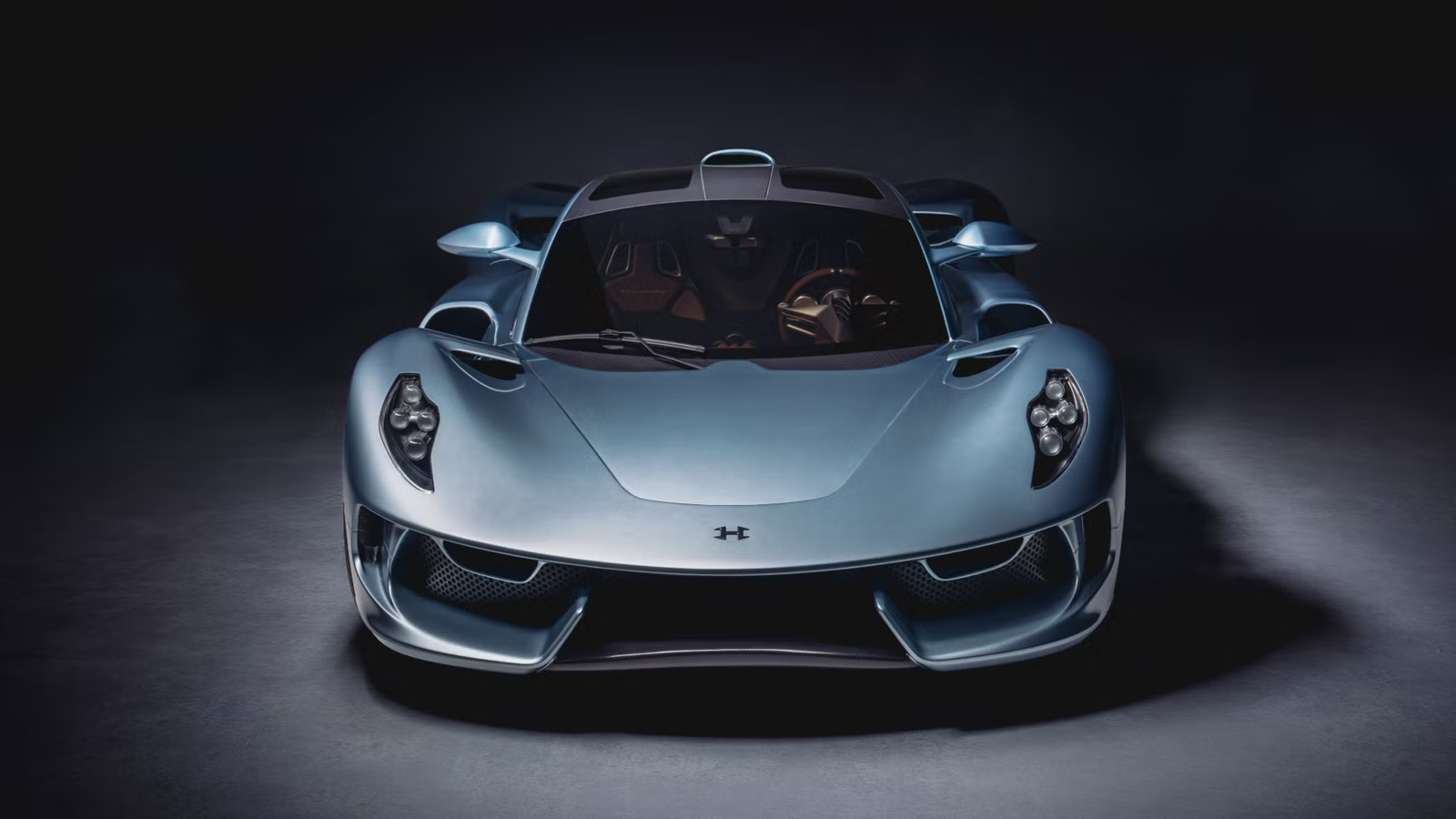
The car you see here is the Hennessey Blackbird, and it has the tough job of following up on the bonkers Venom F5 as Hennessey’s second-ever full production car. But it might surprise you to hear that there are no turbos, no electric motors, and no bold record-breaking top speed claims. This one is for the drivers, and it’s about as anti-Venom F5 as you can get.
The Anti-Venom Hypercar For Those Who Love To Drive
Hennessey Blackbird exteriorHennessey
We’ve heard rumors of the “American Carrera GT” John Hennessey was talking about, and this is it, in the metal, or rather carbon fiber. It doesn’t have a wild V10 like the Carrera GT did, but it’s still got something high-revving and naturally aspirated, with American flavor. The Hennessey Blackbird will be powered by a 6.2-liter naturally aspirated V8 co-developed with Ilmor Engineering that will produce somewhere in the region of 800–850 horsepower and rev beyond 9,000 rpm. That’s miles off of the Venom F5’s figures, but not without a record claim, as this will be the highest revving, most powerful naturally aspirated V8 ever, besting the 670 hp from the Corvette Z06’s 5.5-liter V8.
Despite less than four-figure horsepower outputs, this is still every bit a hypercar, focused on exotic components, design, and above all else, engagement. At the heart of that is a six-speed gated manual gearbox directing power to the rear wheels, which, as we learned from Hennessey Director of Design Nathan Malinick, is an authentic manual and not simulated like some other manufacturers.
With a bespoke carbon fiber chassis and carbon fiber bodywork (more on that in a moment), Hennessey is targeting a sub-3,000-pound curb weight. This should see it dash from zero to 60 mph in 2.5 seconds before topping out at 220 mph. Not slow.
Why Has Hennessey Built Something With So Little Power?
Hennessey Blackbird exteriorHennessey
Calling 800-850 hp ‘little’ sounds wrong, but in a world of 1,250-hp Corvettes, a Hennessey hypercar with only three-digit power outputs sounds wild. But Hennessey had good reason for this being so wildly different from the Venom GT and Venom F5 that came before. Simply put, it didn’t want to cannibalize its own product lineup, but there’s far more nuance to it than that.
Speaking to Malinick ahead of the Blackbird’s reveal, he admitted Hennessey buyers tend to have dozens of cars in their collections. But the Hennessey team thought, “If there was a scenario where you had a customer, and they only had two spots in their garage and one of the spots was filled with an F5, the next car would have to make sense for them both to exist there.”
“I think the expected thing for us would be like 3,000+ horsepower and 400 miles an hour and just more ridiculous numbers. But right off the bat, that kind of got eliminated as the path forward because it would sort of make the F5 irrelevant and do a disservice to our customers.”
– Nathan Malinick, Hennessey Director of Design
So for one, the Blackbird needed to be a different kind of car, and short of it being electric, an SUV, or some big family-style car like the now-delayed Project Deep Space, just throwing power and superlative speed at it wouldn’t be enough. But there was another driving force at play. “There’s such a movement and a desire for a return to a true material connection with the car, and having just a real honesty about the man and machine relationship,” explains Malinick.
Hennessey Blackbird exteriorHennessey
Hennessey wanted to build that car. The car a driver could engage with authentically, without electric motors, without all-wheel drive, without turbochargers, and without screens. This is not a numbers car. This is an experiential one. And it’s got the makings of an epic experience, too, starting with how it looks.
Why Does It Look Like That?
Hennessey Blackbird exteriorHennessey
There are a lot of details at play in the design of the Blackbird, many of which we’ll get onto in a follow-up story from our extensive chat with Malinick. But the important thing you need to know is that, free from the constraints of a 300-mph top speed dictating design, Malinick was able to set about designing a car that was truly beautiful — a hypercar that’s a feast for the eyes, not just a form-follows-function missile.
He looked back to the work of the Italian master designers — the likes of Giorgetto Giugiaro, Marcello Gandini, Giovanni Michelotti, and Sergio Scaglietti — and took influence from motorsport and aerospace to create a form worthy of bearing the Blackbird name. If you haven’t guessed it by now, the hypercar is named after the Lockheed SR-71 Blackbird, and there are a number of nods to it in the design of the car.
Close
On the dash, for example, you’ll see a speedform of the plane proudly displayed, and the vertical stabilizers at the rear of the car deploy automatically at 71 mph and are angled at 71 degrees. That last bit was serendipitous, a pure coincidence that just looked right to Malinick and his team. Beneath these winglets, the diamond quartet exhaust layout was inspired by the Bell X-1 supersonic rocket plane built in 1945.
That design repeats itself inside the cabin, where you’ll find air vents and instrumentation in a similar layout (including an analog clock, although the optional ‘Whiskey Compass’ you see here is from the SR-71’s cockpit), and four cupholders, of which the two outer ones are smaller and perfect for cans of Red Bull.
Hennessey Blackbird interiorHennessey
Back to the exterior for a moment, though. The motorsport influence is plain to see, with the side pods on the doors taking clear influence from Formula 1. Malinick says they’re placed to make use of incredibly highly charged airflow, and were remarkably difficult to make work. Even the subtlety in the front splitter, which rises in the center, was inspired by F1 cars, while the ‘shaker’ roof scoop, directly feeding the naturally aspirated engine, throws back to a variety of motorsport disciplines.
The high-mounted wing mirrors not only guide the air, but are also callbacks to classic Le Mans racers, and from certain angles, it’s easy to see shades of Porsche 917K in the form of the Hennessey Blackbird. And like classic Le Mans racers, there’s even a physical key to turn.
Close
But the coolest design feature might be one you don’t see in the supplied photo set. That’s because the Hennessey Blackbird has mighty gullwing doors, which are as stylish as they are practical, taking with them a big chunk of the side sill to ease ingress and egress.
“Why do gullwing doors?” Malinick asks, before providing the answer himself. “Number one, who doesn’t like the gullwing? It’s just the coolest door out there … seeing them drive slowly with the doors up is just a bit of theater and drama. Performance is cheap nowadays. People are more interested in how it makes you feel, or even how you’re perceived, and that’s part of the whole experience.”
A Screen-Free Interior In 2026, Hallelujah!
Looking at the interior, you’ll likely notice a few things. One is the abundance of leather instead of pure, focused carbon fiber. This is because the Blackbird is meant to be driven, and it’s why Hennessey considers this as close to an actual Grand Tourer as it’ll ever build. It’s meant to be the car in your collection you instinctively grab the key to because it’s easy to live with and cross thousands of miles with. The second is the absence of a screen.
That’s on purpose. Screens aren’t timeless, and it’s why you’re able to connect to your phone and listen to your own music, but without having all your functionality embedded in a screen. Instead, physical controls and instrumentation dominate, from the physical key to the climate control and the giant central tachometer. The only ‘screen’ is a rearview mirror using a camera, required for global homologation. And this will be globally homologated.
In case you haven’t noticed, the Hennessey Blackbird is a different kind of hypercar than any Hennessey before it. Malinick labels it as GT-adjacent, which is made clear by its practicality. The frunk, for example, can house two large carry-on suitcases. The interior has four cupholders and space to hang your cowboy hat, and there’s storage within the rear fenders for smaller duffel bags or 48 cans of cola.
CarBuzz Insight — Why It Matters
Hennessey Blackbird exteriorHennessey
Hennessey is a known purveyor of power above all else, so the fact that its sophomore hypercar (we consider the Venom GT more of an extreme tuner-build than a bespoke, ground-up vehicle) has swung so wildly away from this stereotype is glorious. In a world where four-figure supercars have become common, Hennessey is choosing to focus on the act of driving, giving us the analog experience in a world becoming increasingly more digital.
There’s something magical about being surprised by the unexpected, and the Hennessey Blackbird is as unexpected as it gets. Not only is it not driven by performance or speed like Hennesseys of the past, but it’s an American-designed hypercar that’s genuinely beautiful, mechanically magnificent, and marks the start of a completely new chapter for the Texan car company.
The Hennessey Blackbird will debut at The Quail, A Motorsports Gathering during Monterey Car Week on August 14. Production is limited to 71 units, priced from $2.5 million before taxes, and starts in 2029-2030. More than two thirds are already spoken for.
