

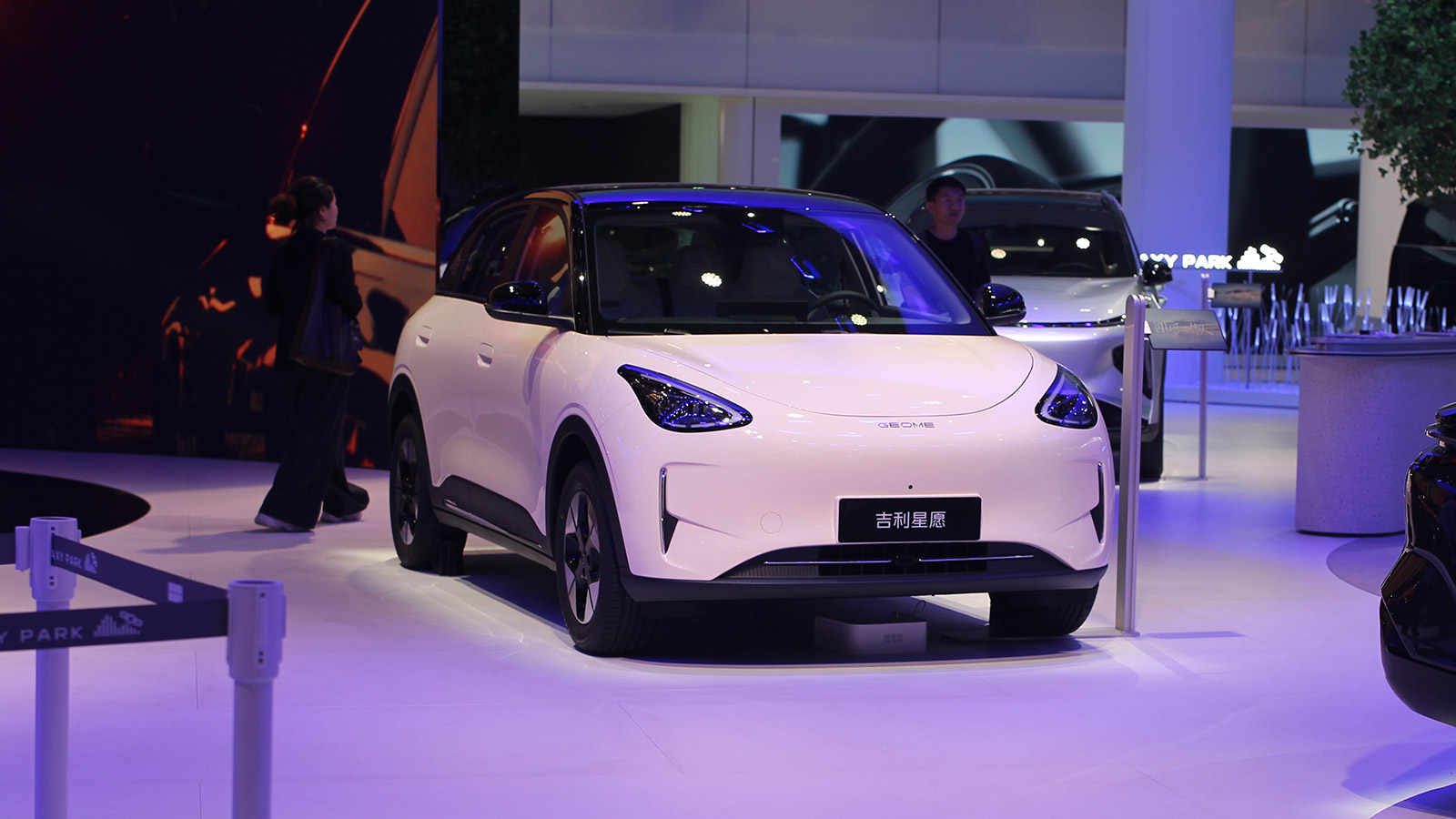
A Geely Xingyuan is displayed at the Shanghai Auto Show in April 2025. Credit: CnEVPost
- The Xingyuan sample vehicle’s wheelbase deviation exceeded the permitted 1% margin, while the Qin L DM-i’s fuel consumption was higher than its declared level.
- China launched a 1-year auto quality campaign a day before the notice, strengthening oversight of production conformity.
Geely Auto’s (HKEX: 0175) Xingyuan and BYD’s (HKEX: 1211) Qin L DM-i were cited as typical cases by China’s Ministry of Industry and Information Technology (MIIT) because their vehicle parameters did not match regulatory filings.
MIIT on Friday released the results of its 2025 new energy vehicle (NEV) production conformity inspections, publicly identifying problems involving 7 vehicle models.
The notice listed only vehicle identification codes without disclosing model names. Based on previous regulatory filings, the JL7001BEV71 all-electric sedan cited in the notice corresponds to Geely’s Xingyuan.
The difference between the sample vehicle’s wheelbase and the value filed in MIIT’s catalog exceeded the permitted 1% margin of error.
The vehicle was manufactured by Zhejiang Haoqing Automobile Manufacturing Co Ltd, a Geely manufacturing entity.
The other passenger vehicle cited was the BYD7153WT6HEV plug-in hybrid sedan. Based on previous regulatory filings, the code corresponds to the Qin L DM-i.
MIIT said the sample vehicle’s fuel consumption in charge-sustaining (CS) mode exceeded the company’s declared level. The notice did not disclose the actual fuel consumption, the size of the discrepancy or the specific variant involved.
Regulators also did not specify what measures were taken against Geely and BYD, respectively.
The remaining 5 models involved in the inspection were commercial vehicles. Their problems included missing manuals, discrepancies in vehicle parameters, and emergency windows and protective devices that failed to meet national standards.
MIIT said it had taken measures based on the severity of the problems, including ordering rectification, suspending or revoking the listings of affected products in its catalog, and suspending the electronic transmission of vehicle conformity certificates.
The Xingyuan is one of Geely’s best-selling models. The compact electric vehicle (EV) recorded retail sales of 465,775 units in China in 2025, making it the country’s top-selling vehicle that year, according to data compiled by CnEVPost.
Geely Xingyuan Monthly Retail Sales 2024-2026
Month
2024
2025
2026
January
28,146
29,007
February
28,588
27,362
March
32,481
30,953
April
36,119
34,727
May
38,715
38,751
June
40,891
33,359
July
44,274
32,306
August
46,057
September
48,080
October
15,130
44,239
November
20,038
42,038
December
16,491
36,147
Geely Xingyuan monthly retail sales
2024
2025
2026
By mid-July, cumulative sales of the Xingyuan had surpassed 800,000 units less than 2 years after its launch. The Qin L DM-i is a mass-market plug-in hybrid sedan from BYD.
A day before the notice, 4 Chinese government agencies launched a 1-year campaign to improve vehicle production conformity and quality.
The campaign will examine intelligent connected vehicle safety, companies’ research, development and manufacturing capabilities, and product conformity, upgrading previous annual inspections into a nationwide, cross-agency initiative.
MIIT has warned that some aggressive designs are being put into mass production without sufficient testing and that irrational competition is also increasing quality risks for automotive products.
The public identification of specific products shows that China’s oversight of vehicle quality and production conformity is shifting from policy directives toward more direct enforcement.
China will conduct nationwide inspections of intelligent connected vehicle safety, R&D and production capabilities, and product conformity.
