

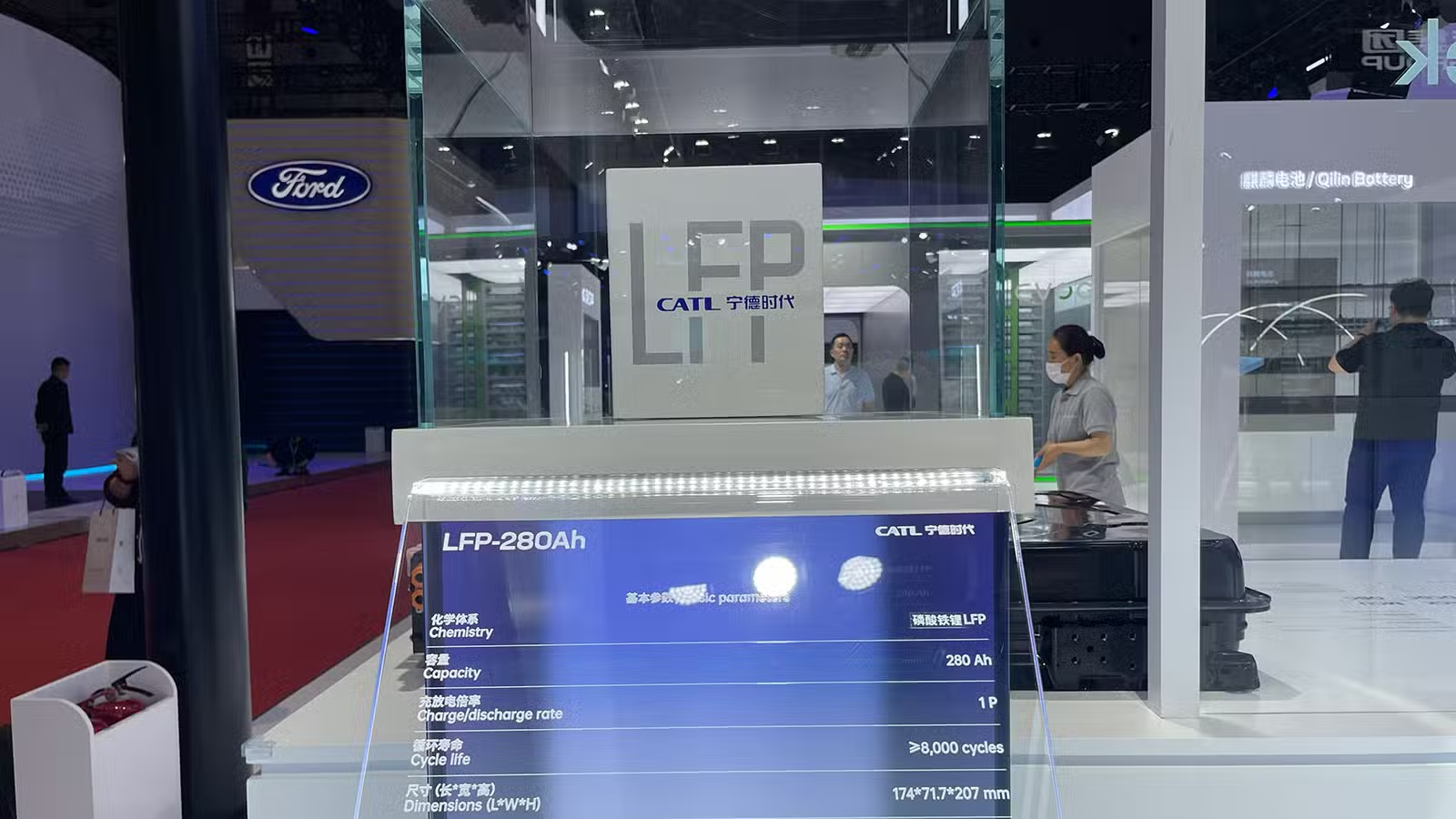
File photo shows a CATL LFP battery cell. Credit: CnEVPost
- A CATL vice president said the plant, built in the US with Ford under technology licensing, was completed and began production in June.
- The CATL-Ford partnership, which began in February 2023, has faced multiple setbacks over the past three-plus years.
The plant that CATL (HKEX: 3750) built with Ford Motor (NYSE: F) in the US under a technology licensing and service model was completed and began production in June.
CATL vice president Meng Xiangfeng revealed the information at the annual meeting of the China Automotive Battery Innovation Alliance (CABIA) on Tuesday.
He also said the company’s overseas plants in Hungary and Indonesia would begin production within the year, according to a Caixin report.
The CATL-Ford partnership began in February 2023, when Ford announced plans to invest $3.5 billion to build a lithium iron phosphate (LFP) battery plant in Michigan, wholly owned by the US automaker.
CATL provides Ford with LFP battery technology licensing as well as plant construction and operation services.
The plant has an initial designed annual capacity of 35 gigawatt-hours (GWh), expected to supply batteries for 400,000 EVs, according to a February 2023 announcement.
The project’s progress, however, has not been smooth. In July 2023, US Republican lawmakers publicly sent letters questioning the partnership and demanded that Ford fully disclose the agreement documents.
The dispute centered on the Inflation Reduction Act, introduced by the US government in 2022. Automakers that produce their own cells and assemble modules can receive a production subsidy of $45 per kilowatt-hour.
Ford’s battery plant was originally eligible for the subsidy. US lawmakers argued that part of the subsidy funds would flow indirectly to CATL.
Under pressure from multiple parties, the project was suspended at one point. Not until November 2023 did Ford announce its restart, though the investment and capacity were cut to $2 billion and 20 GWh, respectively.
In 2025, Ford again faced EV policy headwinds. After Donald Trump took office as US president, he scrapped the US EV transition plan, and the tax credit ended early in September 2025.
He also significantly relaxed fuel economy standards for gasoline vehicles. The reversal in US policy direction led several automakers to revise their electrification plans and book losses, and Ford was among them.
In December 2025, Ford released an adjustment plan, with impairment losses on EV-related assets reaching as high as $19.5 billion. Ford also canceled some battery partnership projects but planned to expand into the energy storage battery business.
The Ford-CATL LFP battery project remained largely unchanged, with part of the capacity shifted to energy storage products, the Caixin report noted.
Ford also plans to convert an existing power battery plant into an energy storage battery plant based on CATL’s technology.
In January 2026, the project again drew questions from US Republican lawmakers because Ford’s battery plant added the energy storage business.
Despite the repeated twists, Ford has pressed ahead. Based on information disclosed by both sides, the jointly built battery plant is expected to enter formal mass production within 2026, Caixin said.
Ford said on June 17 that the plant had completed full-process trial production of its first batch of prismatic LFP cells, with all processes meeting stringent safety and quality standards.
The cells are currently being tested according to CATL’s validation specifications, with the goal of achieving a defect rate of one in a billion.
The plant is on schedule to deliver its first batch of automotive power batteries in 2026, to be used in Ford’s economy and mid-size electric pickup truck models.
A CATL executive said 10,000 to 20,000 EVs are expected to carry the company’s sodium-ion batteries this year.
