

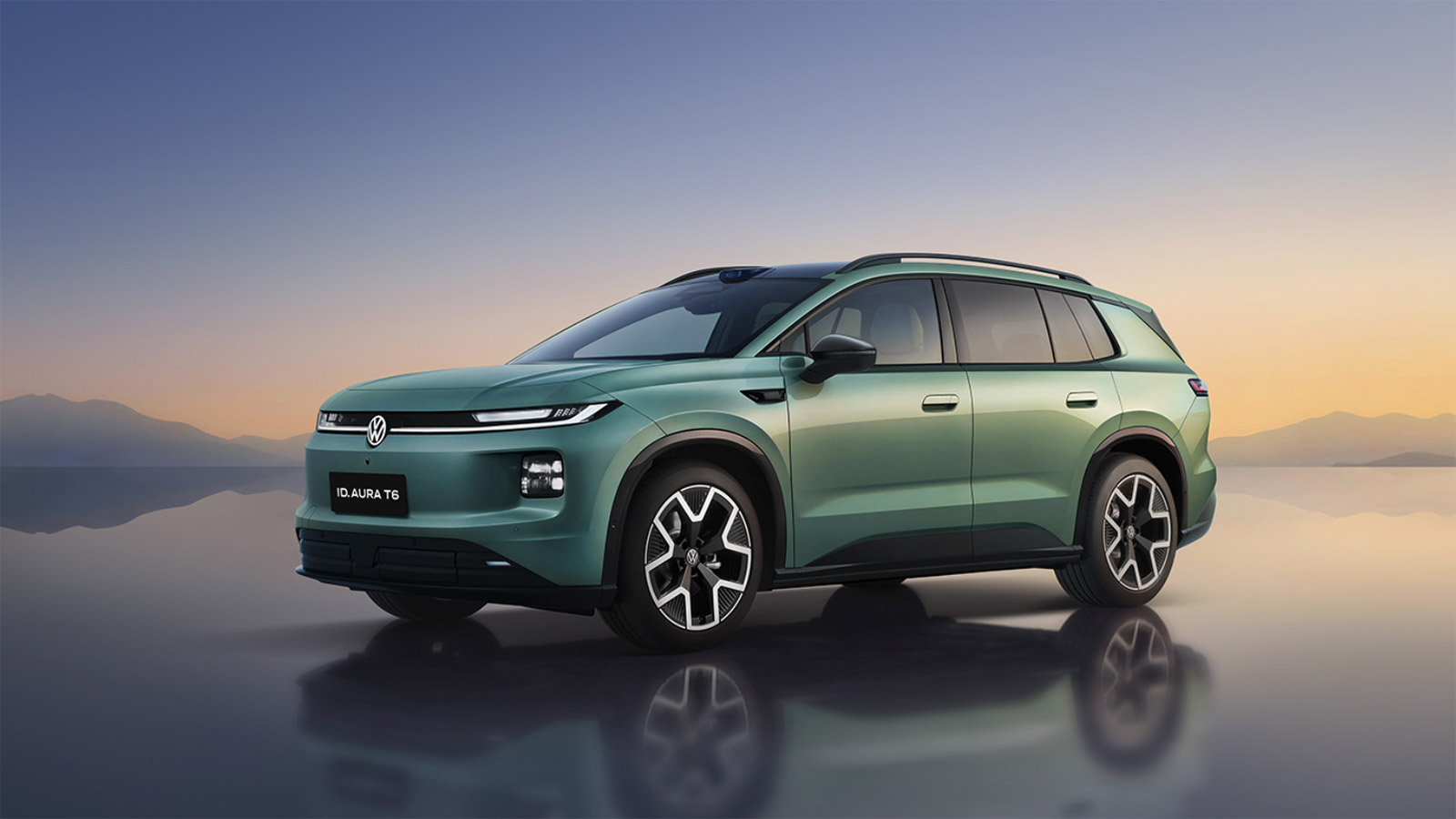
The FAW-Volkswagen ID. AURA T6 electric SUV. Credit: FAW-Volkswagen
- The ID. AURA T6 starts at a pre-sales price of 135,900 yuan ($20,040) and offers a range of up to 660 km.
- It uses the CEA architecture jointly developed by Volkswagen and Xpeng, while the 2 higher-end variants feature LiDAR and urban NOA.
FAW-Volkswagen, Volkswagen’s joint venture in China, opened pre-sales for the ID. AURA T6 on Friday, further expanding its lineup of locally developed electric vehicles (EVs).
The 5-seat all-electric mid-size SUV (sport utility vehicle) is available in 4 variants, with pre-sales prices ranging from 135,900 yuan ($20,040) to 169,900 yuan.
The 540 Pro and 660 Pro variants are priced at 135,900 yuan and 149,900 yuan, respectively. The LiDAR-equipped 660 Max and 660 Ultra are priced at 159,900 yuan and 169,900 yuan, respectively.
The ID. AURA T6 is the first model in FAW-Volkswagen’s new AURA lineup and is tasked with helping Volkswagen narrow the gap with Chinese smart EV brands.
The vehicle measures 4,811 mm in length, 1,879 mm in width and 1,648 mm in height, with a wheelbase of 2,836 mm.
It offers 2 battery packs with capacities of 59.9 kWh and 77.5 kWh, providing CLTC ranges of 540 km and 660 km, respectively.
It is powered by a single motor with a peak output of 170 kW (228 hp).
The 2 higher-end variants feature 192-channel LiDAR and use a driver-assistance system developed by Carizon, a joint venture between Volkswagen and Horizon Robotics (HKEX: 9660).
The system uses Horizon Robotics’ Journey 6H chip, which delivers 420 TOPS of computing power. It supports highway and urban NOA (navigation on autopilot), as well as memory parking across multiple floors.
The ID. AURA T6 is also Volkswagen’s first all-electric SUV to feature LiDAR, showing that the German automaker is increasingly tapping Chinese technology suppliers to improve its smart-driving capabilities.
The vehicle is built on the CEA (China Electronic Architecture) jointly developed by Volkswagen and Xpeng (NYSE: XPEV), using a central computing and zonal control design.
The architecture supports over-the-air updates, Sentry Mode and remote vehicle control. The cabin uses a 4-nanometer chip with about 20 TOPS of computing power and supports on-device deployment of AI models.
The interior features a 15.6-inch central display, a 10.25-inch instrument panel and a 25.8-inch augmented reality head-up display. It is also compatible with CarPlay, HiCar and CarLink smartphone connectivity.
The vehicle has a 90-liter frunk, while rear cargo capacity can be expanded from 576 liters to 1,796 liters.
When folded down, the front seats align with the rear cushions to create a 1.8-meter resting area, reflecting FAW-Volkswagen’s effort to compete with features tailored more closely to Chinese family buyers.
The ID. AURA T6 made its exterior debut at the Beijing Auto Show in April and is part of Volkswagen’s intensive product push in China in 2026.
Volkswagen plans to launch 13 new models in China in 2026, including 7 new NEVs, according to plans announced earlier this year. FAW-Volkswagen will contribute 4 NEVs, including 2 ID. AURA models.
Volkswagen Group plans to launch more than 30 new NEVs in China by 2029. FAW-Volkswagen aims to increase NEVs’ share of its total sales to about 60% by 2030.
The ID. ERA 5S is the first sedan in the ID. ERA family and Volkswagen’s first sedan globally to support urban NOA.
($1 = 6.7811 yuan)
