

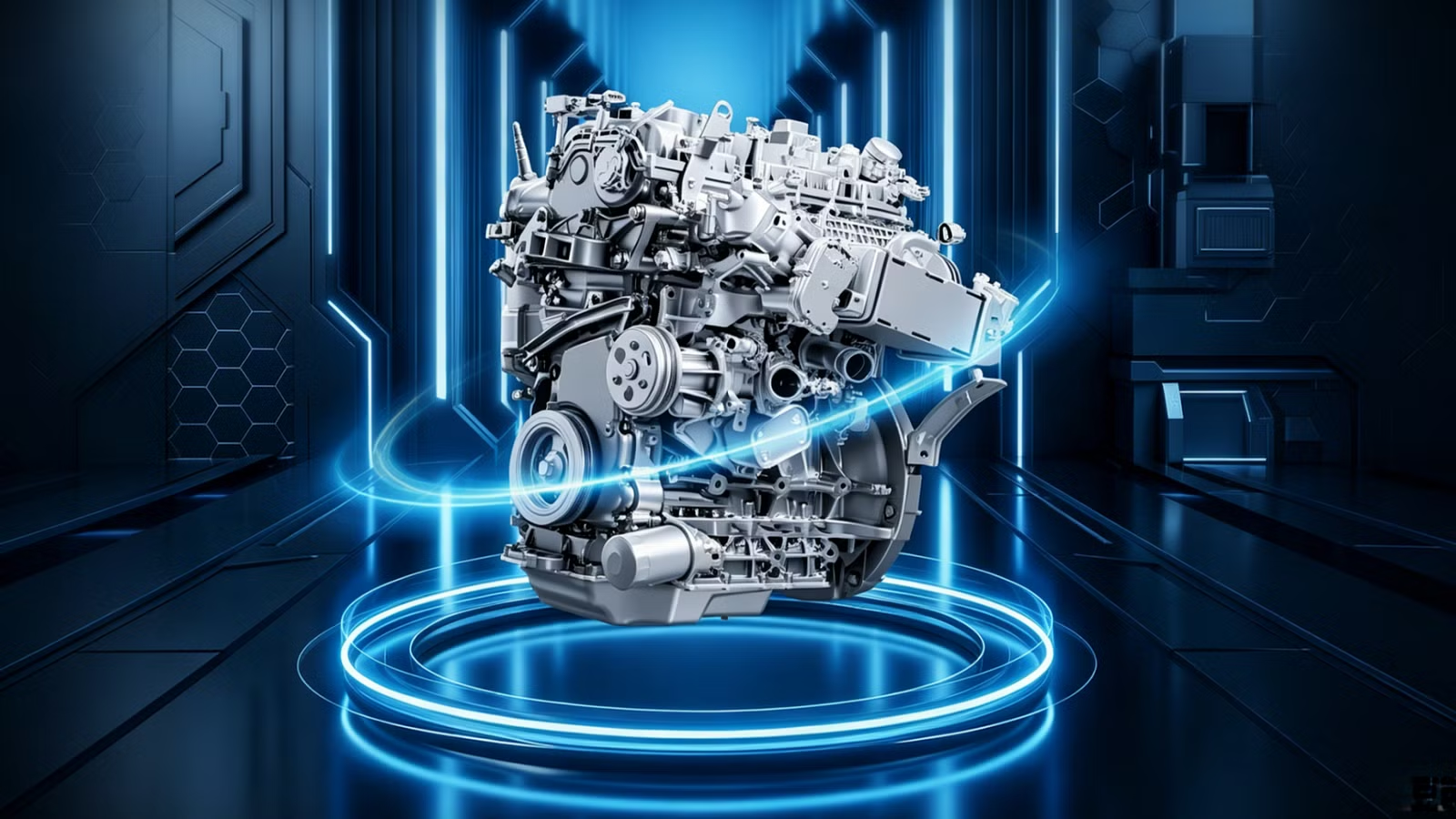
Toyota has spent decades working to continuously improve its gasoline engine’s efficiency, and it shows. Currently, Toyota produces the A25A-FXS 2.5-liter four-cylinder hybrid engine, which boasts a thermal efficiency rating of 41%, higher than virtually any other in the world. Now, though, the Chinese automaker by the name of Dongfeng claims one of its newest mills, the Mach Power 2.0T hybrid, is even more efficient.
The company claims the new mill can reliably operate at a 45.5% efficiency rate, trumping the A25A-FXS by a significant margin. The methods used by the Chinese power plant include a long-stroke design, a cooled EGR, and extremely low-friction coatings found throughout. Like it or not, Dongfeng’s achievement serves as another indication that China’s automotive engineering deserves closer attention.
45.5% Is A Number That Makes The Mach Power 2.0T Different
Dongfeng FactoryDongfeng
Make no mistake: the 45.5% thermal efficiency rating is no baseless claim. China’s CATARC Huacheng, which can loosely be thought of as a combination of our EPA and NHTSA regulatory bodies, awarded the engine with the impressive percentage in May of this year, giving Dongfeng’s creation much more validity than if the brand had simply claimed it randomly.
The impressive efficiency rating correlates to how well the engine can use its fuel. When the engine operates under normal conditions, 45.5% of the fuel’s chemical energy is converted into useful mechanical energy. The remaining amount is wasted through means such as heat, friction, and exhaust. Toyota’s A25A-FXS only manages to properly utilize 41% of its fuel energy under optimal conditions, giving the Mach Power 2.0T a relatively large 4.5% advantage. In the world of efficiency, that’s a big gap.
However, this doesn’t mean that Dongfeng’s wonder engine will automatically use less fuel than the A25A-FXS. You also have to take things like hybrid system efficiency into account, and even the specific gearing the car it’s installed in will use. Electric assistance will also play a hand in an individual engine’s fuel economy. The human element matters, too. A lead-footed driver will always tend to use more fuel than someone who drives like your grandma.
What Dongfeng has done is push the gasoline engine-efficiency bar higher. Because the Mach Power 2.0T’s efficiency rating has been made official by China’s CATARC Huacheng governing body, that rating should be taken seriously by all of us in the West, as well as in Japan. It’s no small feat to reach 45.5% efficiency, either, as a great deal of cutting-edge engineering needs to work in tandem for things to come together.
A 1.29 Ratio And 350-Bar Injection Make Quick Work Of The Largest Issues
M-Hero 917Dongfeng
The central aspect of the Mach Power 2.0T’s incredible efficiency rating is something called MAKC – High-Efficiency Anti-Knock Rapid-Combustion Technology. A mouthful, but the MAKC tech is, in essence, an umbrella term for Dongfeng’s many combustion-focused technologies working in tandem. Part of the pie is the engine’s 1.29 stroke-to-bore ratio, which means its piston stroke is 1.29 times longer than the cylinder bores are wide. Engines utilizing a setup like this are commonly referred to as “undersquare.”
Longer strokes help engines achieve higher thermal efficiency for a couple of reasons. First, a long stroke helps engineers focus more on target combustion efficiency rather than sheer power output. This is because undersquare engines tend to favor torque output, giving the cars they’re installed in a bit more oomph at a lower rpm by nature, meaning less attention needs to be paid to overall horsepower output.
The 350-bar fuel injection system also serves to up the efficiency ante. For us in the States, we’d measure 350 bar as about 5,076 psi. Typical hybrid engines operate at a lower fuel pressure, but Dongfeng’s decision to employ much higher pressures than standard means the fuel itself is atomized more efficiently. This allows the Mach Power 2.0T greater control over how the fuel going into the cylinder is parsed out, and eventually utilized for combustion.
Working alongside the 1.29 ratio and 350-bar fuel system is Dongfeng’s cooled low-pressure EGR, or exhaust gas recirculation. Because the system is cooled, it reduces combustion temperatures, making the air/fuel mixture more dense, and therefore able to make more power with less overall volume. The setup also keeps knocking to a minimum, allowing engineers more freedom to pursue a higher compression ratio and a higher rate of efficiency without risking significant pre-ignition.
But hitting a high peak efficiency number is only half the battle – the harder engineering problem is making sure that efficiency doesn’t bleed away the moment the engine leaves its ideal operating window.
Dongfeng Made Combustion More Efficient While Also Chasing Out Efficiency Loss
M-Hero 917Dongfeng
As a Dongfeng engineer, the next step was figuring out how not to waste that 45.5% efficiency rating through unnecessary means. Every single engine ever produced wastes a good bit of fuel energy simply by operating, but the Mach Power 2.0T makes use of things like a map-controlled variable-displacement oil pump to make up for some of that lost efficiency. The variable pump means it can operate at exactly the level that’s needed, reducing the risk of taxing the motor more than it needs to be at any given time.
Inside the engine’s cylinders, you’ll find what’s called diamond-like carbon (DLC). DLC is an advanced, new-age compound that’s reportedly excellent at reducing unwanted friction in places where it’s most seen, such as on cylinder walls. The Mach Power 2.0T makes use of the material in other places, too. Those of you reading with mechanical knowledge will also know that friction generates heat, and excess heat is the enemy of an efficient power plant.
Every single parasitic loss, no matter how minor, must be mitigated and/or eliminated in the pursuit of ultimate engine efficiency. When you’re dealing with moving the proverbial efficiency needle by fractions of a percentage point, any and all means of reducing unnecessary losses become paramount to the project.
Taking up a good chunk of the ultra-efficient work within the Mach Power 2.0T, however, is the variable-geometry turbocharger. Most of the time, we think of a turbo as a way to extract more power out of an engine, but the Mach Power 2.0T uses its turbocharger in a much different, efficiency-oriented manner. The turbo works by employing its variable geometry to keep the engine’s efficiency at optimal levels across a wide range of altitudes and loads.
Keep in mind: an engine tasked with going all around China will need to contend with high mountains, hot deserts, and cold climates. Dongfeng reports its turbo maintains its power density at up to 2,500 meters of altitude, or roughly 8,200 feet. For comparison, smaller turbocharged engines found in cars begin to lose some of their power output and fuel efficiency at around 6,000 feet.
The Real Threat To Toyota Is Deeper Than A 45.5% Efficiency Rating
M-Hero 917Dongfeng
Pictured above, and throughout this article, are examples of Dongfeng’s Mengshi M-Hero 917, one of the large SUVs that will likely utilize the new Mach Power 2.0T engine. At present, the brand hasn’t said which models the engine would be featured in specifically. Rather, it’s only hinted at large SUVs, vans, and other heavier hybrid applications. A big SUV may seem like a strange medium to house a small, ultra-efficient engine, but Dongfeng itself has stated that the Mach Power 2.0T is much more efficient than the previous-generation engine across a wider range of driving conditions, including under heavy load.
The best example of its higher-efficiency operation when compared to its older sibling is its 30% increase in its high-efficiency operating zone. It can be posited that this is much more important to a hybrid engine than the 45.5% peak efficiency number, because the engine will likely spend most of its life outside peak operating conditions.
Dongfeng is not the only Chinese automaker pursuing ultra-efficient powertrains, either. Chery, another brand, reports an in-progress engine design that can produce anywhere between 44.5% and 48% efficiency, and Geely reportedly has a powerplant that can hit 48.4% in the works. If we were inclined to speculate, we’d wager that there is an unreported Chinese race to the 50% thermal-efficiency threshold.
We cannot sit here and discount Toyota’s achievements in the scope of thermal efficiency, however. The brand has spent decades honing its hybrid craft, and deserves every bit of the respect it’s gained for it. However, Dongfeng seems to be coming for them, signaling that Toyota no longer has a monopoly on advanced gasoline engine tech.
Dongfeng Mach Power 2.0T engine close upDongfeng
While the West has been shifting more towards EVs, China has been hard at work perfecting the already-existing gasoline engine. Now, it seems the country is positioning itself at the forefront of that pursuit. The Mach Power 2.0T’s 45.5% efficiency rating also proves that the internal combustion engine hasn’t had its final word, and that engineers are far from finished with it.
Sources: Toyota, CarNewsChina.com.cn, Motor1.com, Finance.Sina.com.cn.
