

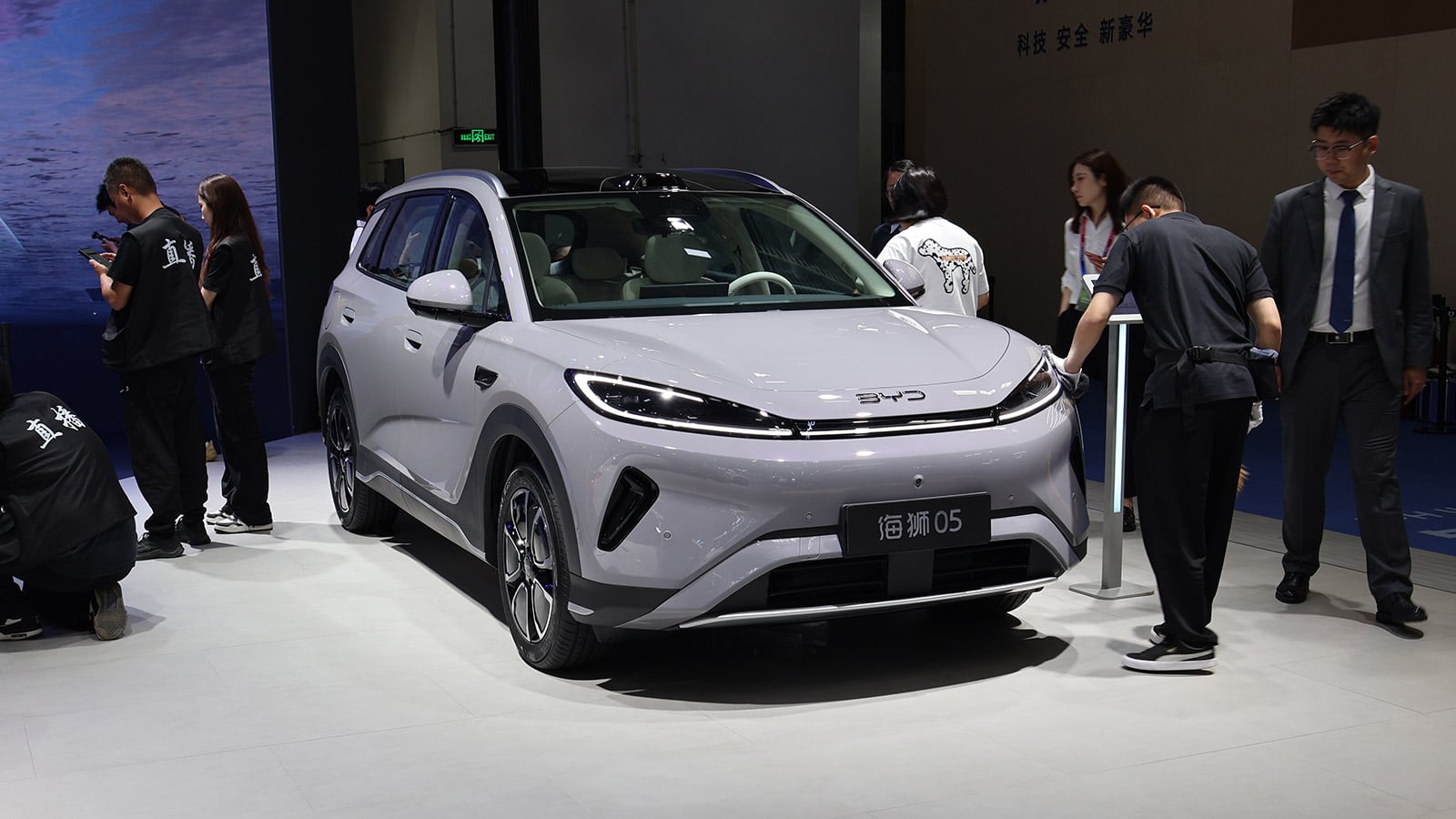
A BYD Sealion 05 EV on display at the Beijing Auto Show in April 2026. Credit: CnEVPost
- China’s NEV ownership reached 48.97 million by the end of June, accounting for 13.19% of the country’s total car fleet.
- New NEV registrations reached 5.195 million in the first half, accounting for 49.42% of new car registrations.
China’s new energy vehicle (NEV) ownership rose to 48.97 million by the end of June, showing that electrification in the world’s largest auto market is still accelerating and offering a new reference point for the country’s 2030 target of lifting NEVs to 30% of its car fleet.
Data released Tuesday by China’s Ministry of Public Security (MPS) showed the country’s car ownership stood at 371 million at the end of June, with NEVs accounting for 13.19% of the total, up 2.92 percentage points from a year earlier.
That ratio rose further from 12.01% at the end of 2025, continuing to move toward China’s latest 2030 target.
China’s State Council earlier this month released a carbon peak action plan for the 15th five-year plan period, proposing that NEVs account for about 30% of the country’s car fleet by 2030.
This means China will still need to significantly expand NEV adoption in the coming years. Based on the current total car fleet, a 30% share would imply more than 110 million NEVs, about 2.3 times the level at the end of June.
China’s electrification push is also shifting from new-car penetration to a broader change in the structure of the vehicle parc.
In the first half, new NEV registrations in China stood at 5.195 million, accounting for 49.42% of new car registrations, up 4.45 percentage points from a year earlier.
The figure suggests that while China’s overall auto market remains under growth pressure, NEVs are now close to accounting for half of newly registered vehicles.
New car registrations in China totaled 10.51 million in the first half, down from 12.5 million a year earlier.
China’s battery electric vehicle (BEV) ownership stood at 33.675 million at the end of June, accounting for 68.77% of the NEV total. The ratio was largely flat from 68.74% at the end of 2025, but below 69.23% at the end of June last year.
China’s NEV ownership first surpassed the 10 million mark at the end of June 2022 and topped 20 million at the end of 2023. The figure exceeded 30 million at the end of 2024 and reached 43.97 million at the end of 2025.
By the end of June 2026, the number had increased by about 5 million from the end of 2025. Compared with 36.89 million a year earlier, China’s NEV ownership increased by about 12.08 million in one year, showing that expansion in the vehicle parc remains rapid.
At the city level, car ownership continued to concentrate in major metropolitan areas.
At the end of June, 105 Chinese cities had more than 1 million cars, an addition of 4 more cities from a year earlier. Of those, 47 cities had more than 2 million cars, and 27 had more than 3 million.
Chengdu, Chongqing and Beijing each had more than 6 million cars. Zhengzhou, Suzhou, Shanghai, Xi’an, Hangzhou and Wuhan each had more than 5 million, showing that major cities remain the core areas for auto consumption and traffic-management pressure.
China’s number of motor vehicle drivers also continued to rise. At the end of June, the country had 567 million motor vehicle drivers, including 533 million car drivers, who accounted for 94.04% of the total.
In the first half, 13.04 million people in China obtained driver’s licenses for the first time, up 3.66% year-on-year. That means the pool of potential car buyers is still expanding despite slower growth in the auto market.
The goal means China’s NEV fleet needs to more than double within five years.
