

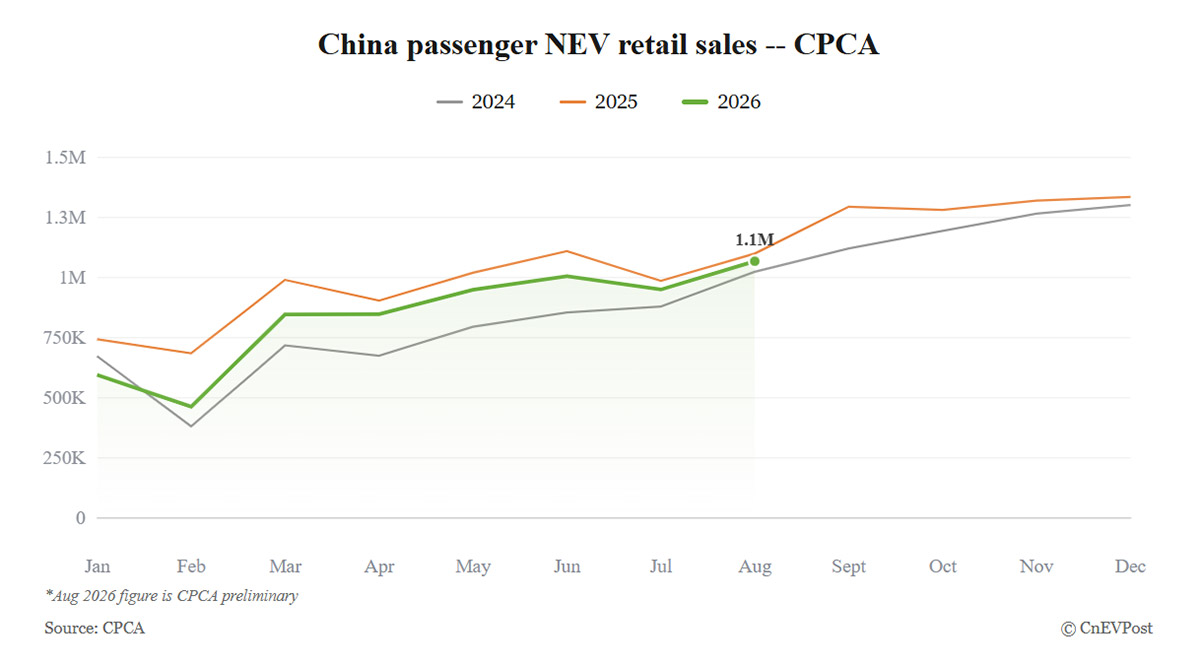
China NEV Monthly Sales (CPCA) 2024-2026
Month
2024
2025
2026
January
673,536
744,052
596,000
February
381,626
686,000
464,000
March
718,498
991,000
848,000
April
675,484
905,000
849,000
May
796,811
1,021,000
950,000
June
856,354
1,111,000
1,007,000
July
881,021
987,000
951,000
August
1,024,848
1,101,000
1,069,000
September
1,122,467
1,296,000
October
1,195,018
1,282,000
November
1,266,990
1,321,000
December
1,302,599
1,337,000
China passenger NEV retail sales — CPCA
2024
2025
2026
*Aug 2026 figure is CPCA preliminary
Source: CPCA
© CnEVPost
- NEV retail penetration rose to a record 65.7%.
- Overall passenger vehicle retail sales fell 19% year on year as demand for gasoline-powered cars continued to collapse.
Retail sales of passenger new energy vehicles (NEVs) in China reached 1.069 million in August, down 4% year on year but up 12% from the same period in July, according to preliminary data released Thursday by the China Passenger Car Association (CPCA).
That marked the eighth consecutive month of year-on-year declines, with the decrease roughly matching July’s.
China’s cumulative NEV retail sales totaled 6.737 million so far this year, down 11% year on year.
Wholesale sales of passenger NEVs totaled 1.506 million in August, up 16% year on year and 4% from July. Cumulative wholesale sales reached 9.754 million so far this year, up 9%.
Penetration reached another record. NEVs accounted for 65.7% of passenger vehicle retail sales in August, up from 65.1% in July and the highest level on record. NEV penetration at wholesale was 63.6%.
The CPCA had previously estimated August NEV retail sales at about 1.04 million, representing penetration of 65.8%.
China’s overall passenger vehicle retail sales totaled 1.626 million in August, down 19% year on year but up 11% from July. Cumulative retail sales reached 11.8 million so far this year, down 20%.
During the first week of August, from August 1-9, average daily passenger vehicle retail sales were 35,236 units, down 22% year on year and 3% from the same period in July.
During the second week, from August 10-16, average daily retail sales were 44,408 units, down 22% year on year but up 2% from the same period in July.
During the third week, from August 17-23, average daily retail sales were 46,847 units, down 22% year on year and 4% from the same period in July.
During the fourth week, from August 24-31, average daily retail sales rose to 83,815 units, down 15% year on year but up 37% from the same period in July.
Passenger vehicle wholesale sales totaled 2.369 million in August, down 5% year on year but up 5% from July. Cumulative wholesale sales reached 17.18 million so far this year, down 5%.
From August 1-9, average daily wholesale sales were 30,616 units, down 24% year on year but up 2% from the same period in July.
From August 10-16, average daily wholesale sales were 43,974 units, down 26% year on year and 3% from the same period in July.
From August 17-23, average daily wholesale sales were 61,273 units, down 13% year on year but up 7% from the same period in July.
From August 24-31, average daily wholesale sales reached 169,560 units, up 12% year on year and 7% from the same period in July.
The retail market recovered at a gradual pace, with a combination of macroeconomic and industry factors keeping it stable at a low level, the CPCA said.
Disruptions to shipping through the Strait of Hormuz sent international oil prices higher amid volatility in July. Chinese refined-fuel prices were raised by nearly 985 yuan ($145) per ton over 2 rounds, increasing vehicle operating costs and continuing to weigh on demand for gasoline-powered cars.
NEV prices remained stable, while consumers continued to take a wait-and-see approach, the CPCA said.
Back-to-school demand helped improve vehicle purchases in mid-to-late August. Although few new small EV models reached the market, demand remained strong, funding for trade-in subsidies was ample, and local policies were gradually relaxed.
Consumer confidence remained cautious, and wait-and-see sentiment toward big-ticket purchases such as cars was strong, leaving the overall auto market with little growth momentum, the CPCA said.
Major automakers took more heat-related production breaks in early August, slowing shipments of gasoline-powered vehicles. The addition of export figures later in the month provided stronger growth.
Flooding in some regions reduced showroom traffic and sales. A wave of new model launches at the Chengdu Auto Show late in the month brought a modest pickup in market activity.
China’s auto market was bottoming out and building momentum for a recovery in August, the CPCA said. As consumption-support measures take effect and the comparison base improves, declines in the passenger vehicle market are expected to narrow steadily, setting the stage for the traditional peak season in September and October.
Leapmotor and Zeekr continued to set records, while Xpeng and Li Auto returned to sequential growth.
($1 = 6.7807 yuan)
