

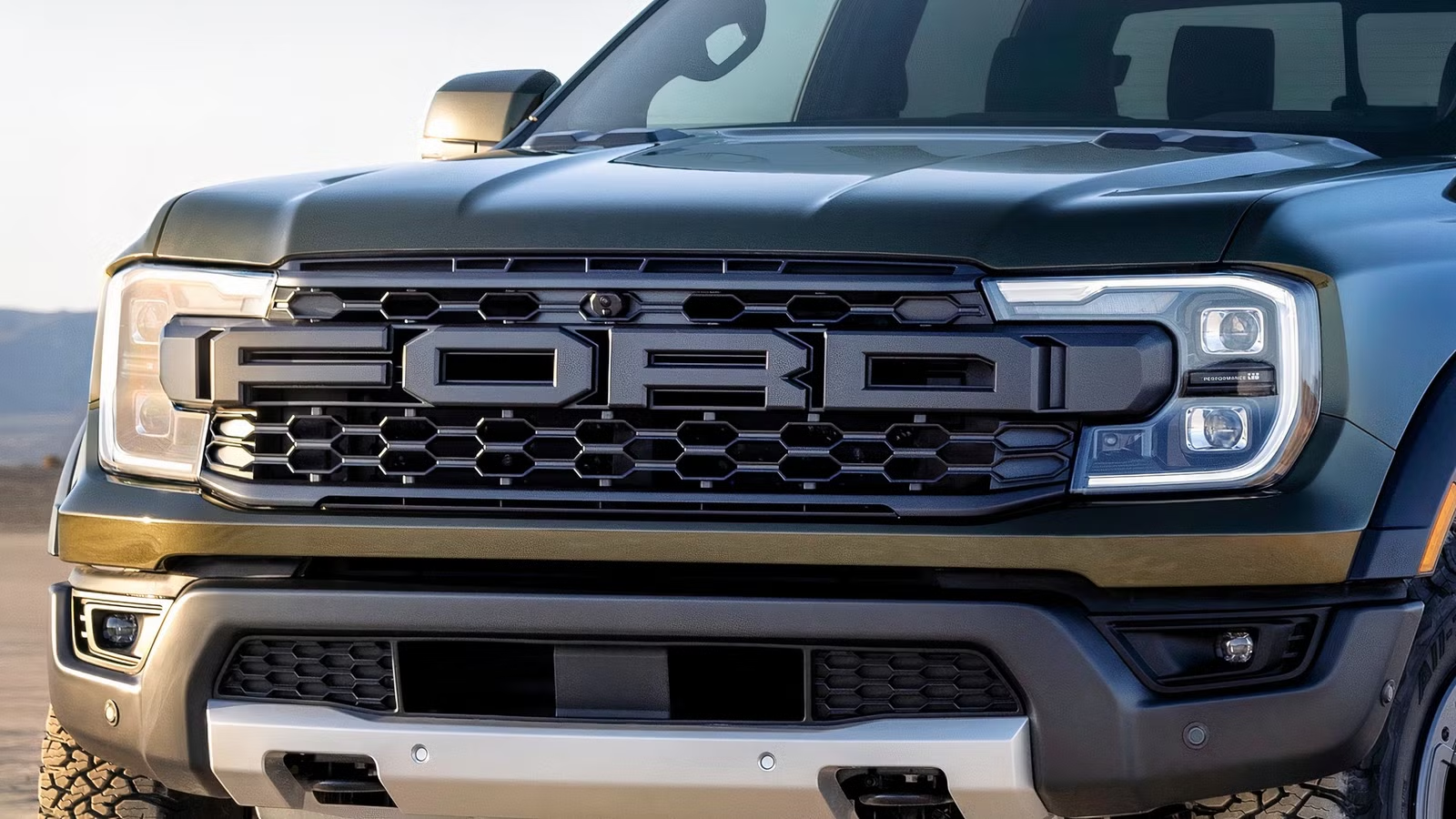
Manufacturers clearly want to sell as many vehicles as they can to maximize potential, and typically, they will try to target each different vehicle at a particular market segment. They will make their mid-size pickups smaller and cheaper so they speak to a different market compared to full-size trucks, but occasionally, the dividing line becomes blurred.
And that seems to be happening at Ford currently, as a new mid-size Ranger Raptor is now essentially the same price as a full-size F-150 XLT. It pays to take a closer look at Ford’s strategy because the numbers on these two window stickers take some explaining.
Just $520 Separates These Two Very Different Ford Trucks
2025 Ford Ranger Raptor Green Front Angled View Jumping Off-RoadFord
Research indicates that one Ford dealer is currently listing a 2026 Ranger Raptor at $60,415, while Ford is also selling its F-150 XLT 4×4 SuperCrew for $60,935. The F-150 also comes with the 302A Mid group and Black Appearance Package Plus, but the key point is that a mid-size and a full-size essentially cost the same, with a difference of only $520 between the two.
The mid-size Ranger Raptor is a SuperCrew version, finished in Avalanche, and it comes with a 3.0-liter EcoBoost V6, a 10-speed automatic, and four-wheel drive. Meanwhile, the F-150 is a four-wheel-drive SuperCrew, and it has a 2.7-liter EcoBoost V6 under its hood while itself sporting a good equipment list.
The F-150’s 302A Mid content package includes a 360° camera, adaptive cruise control with stop-and-go capability, heated front seats, and two-zone climate control. Buyers will also get front parking sensors, remote start, a power sliding rear window, and 400 W Pro Power Onboard. The Black Appearance Package features 20-inch wheels with black exterior detailing and running boards. So, the F-150 is a high-content four-wheel-drive XLT and not a stripped-down rear-wheel-drive truck that somehow makes the headline work.
And there are also a lot of other XLT 4×4 SuperCrews in general Ford inventory around the country, all of which hover around the $60,000 mark. This means that the Ranger Raptor is intruding into a part of the market populated by well-equipped full-size pickups.
The Ranger Raptor Offers A Lot For Its $60k
2025 Ford Ranger Raptor InteriorFord
The Ranger Raptor may well be straying into dangerous territory, but it still comes with ammunition, and it is not really an ordinary mid-size pickup at all. Under the hood there’s a 3.0-liter twin-turbo EcoBoost V6 producing 405 hp and 430 lb-ft of torque. This connects to a 10-speed automatic with four-wheel drive, and locking front and rear axles come as standard.
The suspension is a lot more serious than anything Ford fits to a normal Ranger. It has forged aluminum double A-arms and 2.5-inch Fox Live Valve dampers in front. There’s a coil spring Watts-link arrangement at the rear and another pair of 2.5-inch Fox Live Valve dampers. Ford also equips the Raptor with selectable drive modes like Baja, as well as trail control, pro trailer backup assist, and an integrated trailer brake controller. The Raptor is a little larger than a standard Ranger at 79.8 in. wide, excluding the mirrors, and minimum ground clearance rises to 10.7 in.
On board, there’s nothing bargain-basement about the cabin. Buyers will get heated leather-trimmed front seats as standard with 10-way power adjustment and memory for the driver, and eight-way power adjustment for the person riding shotgun. There’s a heated steering wheel, a 12.4-inch digital instrument cluster, a 12-inch center display, wireless charging, and a 10-speaker B&O audio system with a subwoofer. Other features come as standard too, including adaptive cruise control, a 360° camera, a power sliding rear window, dual-zone climate control, and 400 W Pro Power on board.
Many of the features that make the 302A F-150 XLT look convincing also grace the Ranger Raptor, so perhaps Ford is justified in charging around $60,000 for this Ranger after all. After all, it effectively bundles a performance engine, specialized suspension, serious off-road drivetrain hardware, and a high-content cabin into its top-of-the-line mid-size truck.
The Full-Size Truck Math Starts Fighting Back
2025 Ford F-150 XLT Blue Front Angled View TowingFord
Performance-wise, the F-150 XLT can’t match the Ranger Raptor for output. With the standard 2.7-liter twin-turbo EcoBoost V6 on board, the F-150 “only” produces 325 hp and 400 lb-ft, although buyers can opt for an available 5.0-liter V8, 3.5-liter EcoBoost V6, or a Powerboost hybrid approach if they want to.
But still, the Ranger doesn’t compare to the F-150 when it comes to physical size and capacity. The Ranger Raptor has a cargo bed measuring 59.6 in. at the floor, and it holds 43.5 cu. ft. versus the F-150’s bed, which measures 67.1 in. internally, and provides 52.8 cu. ft. The complete F-150 is substantially larger as well. With a 5.5 ft. box, it measures 232.0 in., which is a full 21 in. more than the Ranger Raptor, and to rub it in, the SuperCrew version also has 43.6 in. of rear legroom in the cabin.
So, in many respects, this is where the price comparison becomes harder to swallow. Once both pickups are essentially $60,000, the F-150 starts to look like a lot of vehicle for the money. After all, it’s got more rear seat room, a longer and larger cargo box, and it also has the potential for substantially more towing capability.
The Ranger Raptor Pays A Real Utility Tax For Being A Raptor
2025 Ford Ranger Raptor interiorFord
Ford may risk an uncomfortable comparison when shoppers look at the towing capability of a Ranger Raptor. After all, it not only struggles when compared to the F-150, but it also offers a lot less than other Raptors in the range. A regular Ranger can tow up to 7,500 lbs. but the Ranger Raptor tops out at 5,510, which is 26.5% less. Meanwhile, the F-150, with the standard 2.7-liter engine, can tow up to 8,400 lbs. in its best configuration.
However, the standard Ranger and the Ranger Raptor are very different machines when it comes to their engineering. The Raptor uses coil springs and a Watts link rear setup for better wheel control and suspension travel. It also has Fox dampers, a wider track, all-terrain tires, and locking axles—all of this because Ford wants it to work particularly well over dirt roads. This may explain why Ford hasn’t tried to max out conventional truck specifications with its Ranger Raptor, and why towing capacity wasn’t front and center at the design stage.
Fuel economy seems to tell a similar story as well. With that 405 hp engine, four-wheel drive system, aggressive tire package, and off-road hardware, the 2026 Ranger Raptor is rated at 16 mpg city, 18 mpg highway, and 17 mpg combined.
Some may still wonder why they should pay dramatically more for a Raptor versus a conventional Ranger and accept less maximum towing capacity and poorer fuel economy. But the Raptor is best viewed as a performance derivative of a pickup, and it’s not simply a more expensive trim level.
The Ranger Raptor Must Be The Truck You Actually Want For That $60k
2025 Ford Ranger Raptor front 3/4 angle in brown while offroadingFord
From a purely practical point of view, it’s difficult to argue against the F-150 XLT. After all, for that approximately $60,000 spend, buyers are getting a well-equipped 4×4 SuperCrew with more interior room, more bed space, and greater potential for traditional truck grunt. So, if those buyers tow regularly, carry bulky loads, or just want the maximum amount of pickup for their money, this full-size truck is difficult to turn down. But then again, the Ranger Raptor may persuade some people to part with their cash for almost the opposite reason. In this case, its smaller footprint may be an advantage on narrower trails or on congested city streets. And crucially, it is not like a stereotypical mid-size pickup because it combines compactness with plenty of engineering heft.
The Ranger Raptor is also surprisingly complete, and buyers won’t need to choose from an extensive options list to get a very desirable truck. It already has heated leather seats, adaptive cruise, a premium audio system, a 360° camera, and dual-zone climate control, and all of that, taken together, can often sway a shopper’s decision. Ford has also engineered this truck to be a complete package, and while it is obviously possible to buy a conventional truck and throw aftermarket parts at it, existing integration is a large part of the acquisition cost here.
The old mid-size value argument is now difficult to make when the Ranger Raptor and a high-content F-150 XLT 4×4 come to market at virtually the same price. And while people can still buy the F-150 if they want more truck, the Ranger Raptor, even though it’s mid-size, is certainly not middling in its presentation.
Sources: Ford.
