

Curb appeal usually applies to shopping for a new home – your first impression when arriving in the driveway, checking out the landscaping, the condition of the roof, the age of the windows, even before you’ve stepped inside for a tour. JD Power tracks a different type of curb appeal for cars, with its US Automotive Performance, Execution, and Layout (APEAL) study.
Lincoln Aviator for sale in a Lincoln dealership.Lincoln
While JD Power also tracks a car’s initial quality and dependability, the APEAL ranking, now in its 31st year, focuses on how satisfying a particular car, truck, SUV, or minivan is to own and drive. Trying to gauge an owner’s emotional attachment to a vehicle after 90 days of ownership, the APEAL study asks owners (78,514 of them surveyed between June 2025 and May 2026) to consider 37 attributes, from comfort, exhilaration, and design to infotainment, storage, and cupholders for both premium and mainstream brands.
It’s a comprehensive survey, but it’s not without some questionable conclusions that caught the eyes of CarBuzz staffers. We chatted with JD Power on that, which we’ll discuss in a bit. For now, let’s check out some of the results.
Porsche, BMW, Hyundai Group Do Well
2026 BMW 2 Series Gran Coupe front 3/4BMW USA
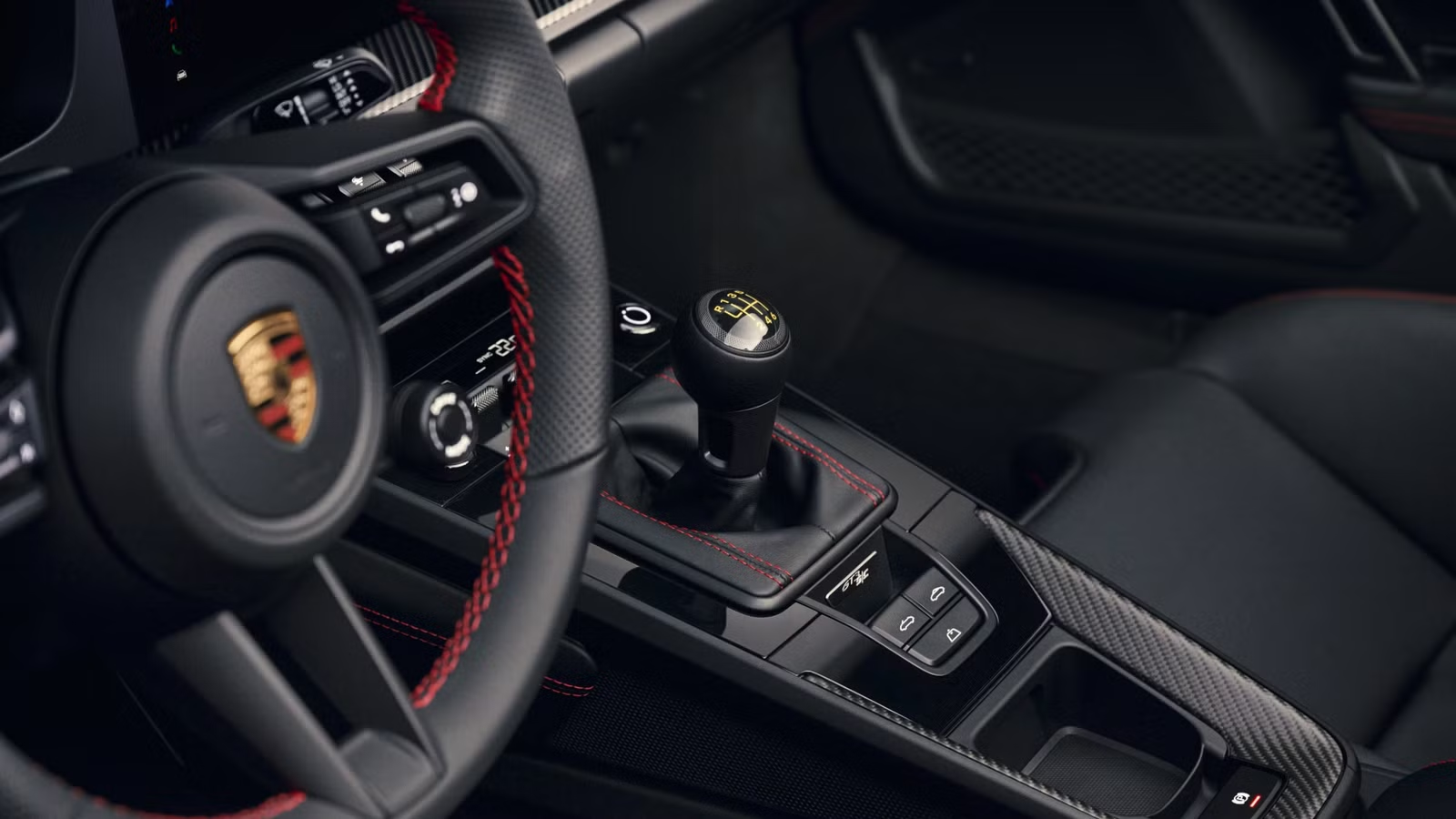
This year, Porsche ranks No.1 overall among premium and all brands, scoring 896 on a 1,000-point scale, based on high scores from 911 owners. Among mass market brands, Mini placed first with a ranking of 875. But JD Power also gives APEAL awards for individual vehicle segments, and in this metric, BMW Group cleaned up, taking honors for the BMW X2, X6, 2 Series, 5 Series, 7 Series, and Mini Countryman. The Koreans did well, too, with the Kia Carnival, K4, and K5, as well as the Hyundai Palisade and Santa Cruz winning their respective segments.
Looking at other brands that did well, General Motors scored segment wins with the Chevrolet Blazer, GMC Yukon, and Cadillac Escalade, while Ford took honors with the Ford Super Duty pickups and Mustang. Land Rover Defender and Jaguar F-Pace also won awards in their respective segments, as did the Nissan Murano and Armada, Toyota RAV4 and Crown Signia, Mercedes-Benz C-Class, Ram 1500 pickup, and Porsche 911. The BMW X6 and 7 Series were the highest-ranking individual models.
But automotive rankings like this always cause arguments or raise questions, and the APEAL study is no different, requiring a number of asterisks and explanations. For instance, Tesla, Rivian, Jaguar, Dodge, and Chrysler were ineligible for the ranking because they “did not meet study award criteria.”
However, scoring for those brands was included anyway, despite it not being official. If it were, Tesla would have pummeled the entire field with a ranking of 920, while Rivian, Jaguar, and Dodge also scored very high. Chrysler would have been dead last with a score of 814. So what gives with all the caveats?
Why Certain Brands Are Ineligible
North America-spec 2027 Tesla Model Y L rear three-quarter viewTesla
CarBuzz reached out to JD Power for an explanation about eligibility, and the company said Tesla and Rivian do not qualify because “we are not able to sample them in all 50 states due to restricted access.” We asked for an additional explanation on that, specifically with regard to Tesla, but a spokesperson said they couldn’t comment on that further.
It begs the question: if brands are ineligible for the ranking, why even show their numbers? But there’s more to it than that. Despite being ineligible, JD Power includes those brands when determining an industry average.
2026 JD Power APEAL survey resultsJD Power
JD Power confirmed for us that the segment average for premium brands is so high (893, right behind No.1 Porsche) because that average includes ineligible scores for Tesla, Rivian, and Jaguar. And how could Jaguar F-Pace win its category if the brand was ineligible, not to mention production ending last December?
CarBuzz Insight – Why This Matters:
The survey methodology is perhaps a discussion for another day, but JD Power offers up a lot of insights to help car shoppers make their final decisions before signing on the dotted line. Talking to 78,000 consumers about how attached they have become to the cars they bought three months earlier is a massive undertaking that puts the buyer’s psyche and philosophy under the microscope.
It must be difficult talking to people who regret their purchases but perhaps uplifting to find someone who is absolutely overjoyed with their choice. That’s how to build brand loyalty.
Source: JD Power
