

Turbocharging has become so commonplace today that it’s easy to forget how exotic and experimental it once was. The technology’s mass-market debut came courtesy of Oldsmobile, which bolted a turbo onto the Jetfire back in 1962. More than a decade passed before BMW revived the concept with the 2002 Turbo in 1973, and then Porsche cemented forced induction in the public imagination with the legendary 911 Turbo in 1974. From that point on, the race was on.
Once Porsche brought turbocharging to the world’s attention, a slew of carmakers decided that they wanted in on the action, too. Brands like Saab began producing models like the 99 Turbo in 1978. That same year, Buick decided to get into the turbo trade with the Regal Sport Coupe and the LeSabre Sport Coupe, both of which enjoy reasonable fame even today. However, Buick also strapped a turbocharger to another famous name, the Century. The thing is, though, few remember the Century Turbo Coupe, and fewer than 3,000 examples were produced.
Buick’s Turbocharged Underdog Had A Famous, Time-Tested Name
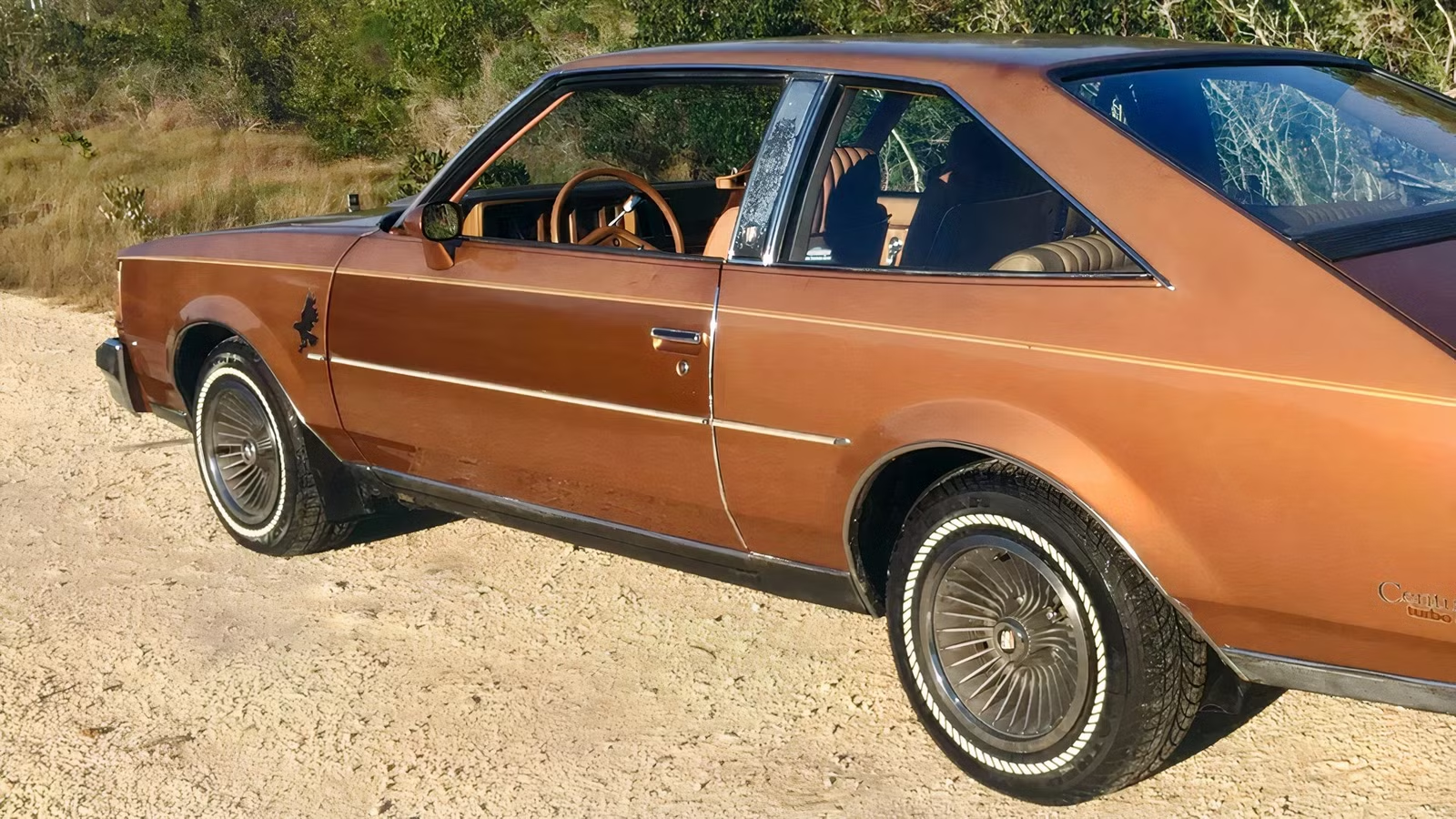
1979 Buick Century Turbo Coupe finished in brown with tan interiorBring A Trailer
Quick Facts About The Buick Century Turbo Coupe
- Introduced in 1979
- Utilized Buick’s 3.8-liter V6
- Offered as a fastback two-door
- Boasted V8-like performance with better fuel economy
- Axed following the 1980 model year
The Century name is far older and more storied than the short-lived Century Turbo Coupe. Its story begins in 1936, when Buick released the Series 60. The model was meant to serve as a smaller and less-expensive competitor to the brand’s Roadmaster, and was quickly renamed “Century.” This original model was produced until 1942, when wartime efforts required the factory to be repurposed.
After World War II ended, the Buick Century nameplate lay dormant until 1954, when Buick decided to resurrect it for an entry-level model under the Limited, indicating a more powerful version of the Buick Special. In a large-scale move to advertise the name, Buick plugged the Century on The Buick-Berle Show in 1955 and also brokered a deal with the popular sitcom The Honeymooners to advertise the model. Once 1958 rolled around, the Century nameplate went into hibernation once again, as Buick was focused on completely revamping its aging lineup.
For a third and final time, the Century was brought back in 1973. Its mission was to replace the Skylark as Buick’s mid-size entry, providing a more upscale-sounding nameplate to the segment after the classic muscle car era, during which the Skylark had been heavily involved with the GS Stage 1, a muscle-bound model based on the Skylark. The Century’s fourth generation debuted in 1978 as a downsized, boxy model meant to better compete with foreign rivals such as Toyota and Honda.
The Century Turbo Coupe
1979 Buick Century Turbo Coupe finished in brown with tan interiorBring A Trailer
Encouraged by its decision to turbocharge the 3.8-liter V6 in the Regal Turbo Sport Coupe and the LeSabre Turbo Sport Coupe in 1978, Buick was eager to expand on that formula. That meant the Century was next in line for forced induction, beginning with the 1979 model year. Because the Century was smaller and lighter than the Regal and the LeSabre, the Century Turbo had the potential to raise some eyebrows — and smoke a few tires — in the process.
1979 Buick Century Turbo Coupe finished in brown with tan interiorBring A Trailer
Once up for sale, Buick no doubt thought it would be a smash hit. After all, the Century had a sporty look to it with its fastback rear end, so adding a turbocharger should send folks surging through showroom doors. However, this would not be the case. Its “aeroback” styling was not well-received, turbocharger or not. Not to mention, it was too closely related to the Regal in equipment and style, meaning the Century was often passed over in favor of the Regal. The largest issue, though, lies underneath its hood.
What The Turbo Did To The Engine
1979 Buick Century Turbo Coupe finished in brown with tan interiorBring A Trailer
The Century Turbo Coupe’s sole engine option, the Buick 3.8-liter V6, is heralded as one of the most reliable engines ever made. The most celebrated iteration of that engine arrived nearly a decade after the Century Turbo Coupe was introduced. Even so, the pre-3800 versions were still regarded as extremely dependable — but only in naturally aspirated form. The addition of a turbocharger made things considerably more complicated.
1979 Buick Century Turbo Coupe finished in brown with tan interiorBring A Trailer
Reportedly, grafting a primitive turbocharger onto the Century’s 3.8-liter V6 rendered the motor grossly unreliable. Problems surfaced almost immediately, stemming from an old-school, poorly engineered turbo control computer that couldn’t accurately or consistently meter boost pressure, resulting in poor performance. The engine also suffered from metallurgical shortcomings — the alloys used in its construction simply weren’t up to the task.
1979 Buick Century Turbo Coupe finished in brown with tan interiorBring A Trailer
Compounding those problems, Buick’s attempt to strengthen the engine to accommodate a turbocharger was simply not comprehensive enough, leaving the powerplant prone to catastrophic failure. Its carburetor was also ill-suited to forced induction, thanks to a “pass-through” design in which the carburetor sits upstream of the turbocharger. This caused the engine to run rich under heavy load, undermining the fuel economy advantage that was supposed to make the turbocharged V6 an appealing alternative to the Century’s available 265 CID or 301 CID V8 options. Adding insult to injury, the Century Turbo Coupe was only offered with a three-speed automatic transmission, as no manual gearbox was available for the model.
1979 Buick Century Turbo Coupe Specs
Engine Details
3.8L turbocharged V6
Horsepower
175 hp
Torque
265 lb-ft
0-60 MPH Time
9.2 seconds
Top Speed
111 mph (est.)
*Specs courtesy of Curbside Classic
Of course, the Century Turbo Coupe was no sales dynamo. In fact, over the course of its two-year tenure, Buick only managed to shift roughly 2,727 examples of the thing. However, because it was ugly, unreliable, and slow, you can pick one up for relatively cheap these days. While it won’t blow the doors off of, well, anything modern, it would be a neat piece of history to bumble about car meets in. According to auction sites like Bring A Trailer, Century Turbo Coupes typically carry asking prices in the range of $6,500 to $10,000, though values can vary depending on condition and originality.
1979 Buick Century Turbo Coupe finished in brown with tan interiorBring A Trailer
The 3.8-liter V6 Didn’t Deserve The Bad Mark
buick 3800 engineBuick
Most enthusiasts will know the Buick 3800 V6 well. It was formally introduced in 1988, though the engine’s basic architecture dates back to the early 1960s. That 1988 unit is known as the “Pre-Series,” with the Series I taking its place under the hoods of many Buicks and other GM products beginning in 1992. Almost immediately, the 3800’s reputation for reliability and durability became well established. A supercharged variant joined the lineup in 1992 as well.
2005 Pontiac Grand Prix supercharged 3800 V6Pontiac
The engine’s second-generation “Series II” version launched in 1996 and is widely regarded as the finest of the family. It was with this variant that the engine earned two of its three Ward’s 10 Best Engines honors, and it was even named the second-best engine of the 20th century by Ward’s. The Series III arrived in 2006 and was discontinued after the 2008 model year. Fortunately, the troubled turbocharged 3.8-liter of the late 1970s did little lasting damage to the Buick V6’s long-term reputation.
Sources: Curbside Classic, Bring A Trailer
