

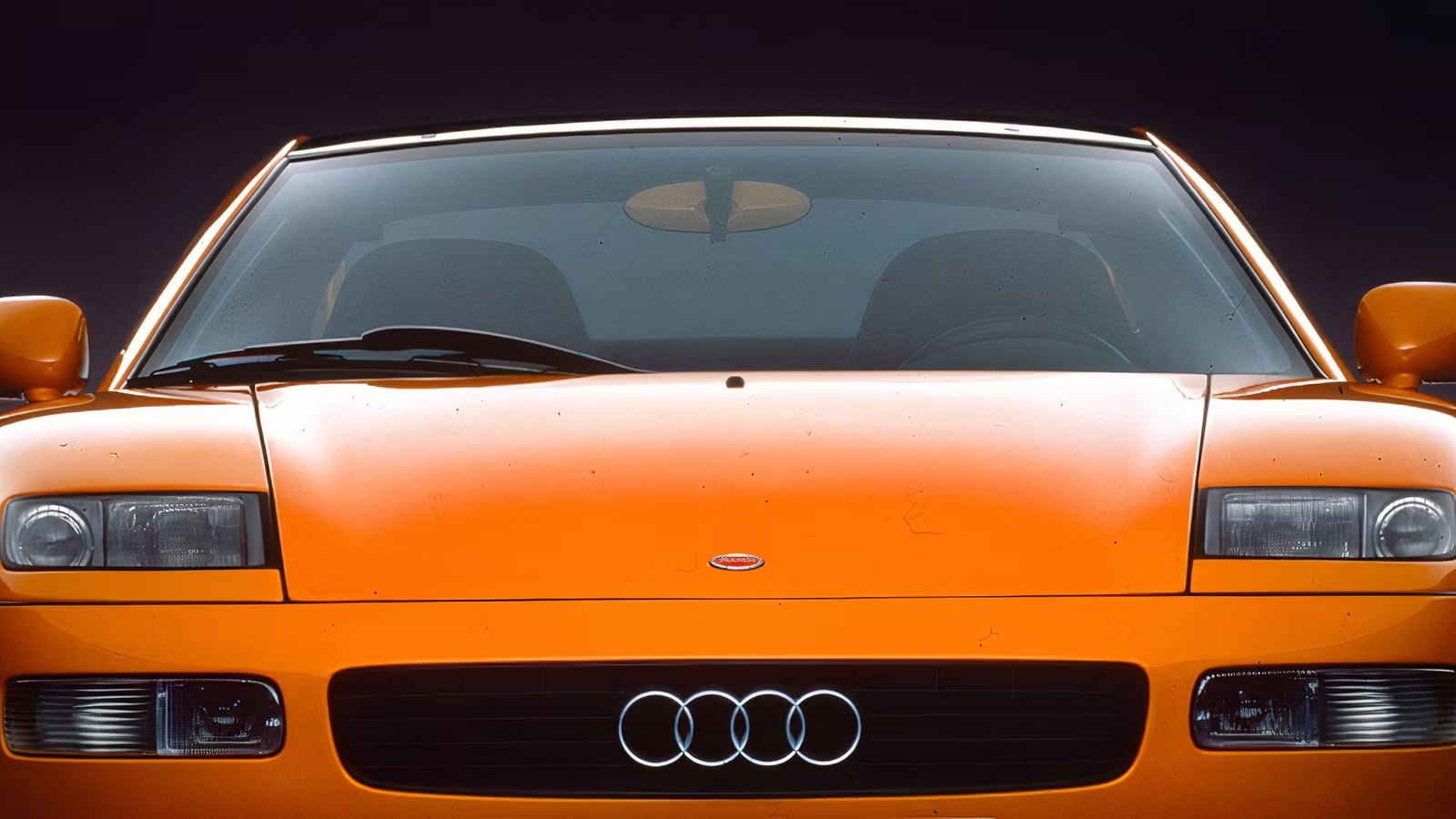
Concept cars are one of the most interesting ways for car enthusiasts to gain insight into what an automaker wants to develop in the future, from design to technology to propulsion methods. Nearly three and a half decades ago, Audi unveiled a fascinating concept car called the Quattro Spyder. This concept showcased the direction the brand wanted to go in: it had a futuristic look and a dual character, being somewhat of a halfway point between a supercar and an everyday vehicle.
If the Quattro Spyder had moved into the production stage, it could have made an amazing “daily supercar”: a model that includes the characteristics of both a sporty, performance-oriented car and a comfortable daily driver capable of handling the everyday commute. This sadly did not come to pass. However, Audi embodied the “daily supercar” philosophy in other ways, most notably through the R8. Let’s take a look back at the Quattro Spyder concept’s history and features.
The Audi Quattro Spyder Concept: An Overview
Audi Quattro Spyder Concept 1991Audi
Audi Quattro Spyder Concept
Engine
2.8-liter V6
Horsepower
172 hp
Torque
181 lb-ft
0-60
~6 seconds
Top Speed
155 mph (limited)
The Audi Quattro Spyder was a concept car introduced in 1991, designed as a potential successor to the Quattro. Unlike the Quattro, which was famous for its angular, squared-off silhouette, the Quattro Spyder had a sleek, aerodynamic design. In terms of looks, its closest relative in the Audi family was another concept car that was being developed around the same time: the Avus Quattro. Like the Quattro Spyder, however, the Avus Quattro also never resulted in a production model.
Audi Quattro Spyder Concept 1991Audi
One of the Quattro Spyder’s most innovative characteristics was its lightweight aluminum body, which showcased Audi’s state-of-the-art aluminum construction technology. A few years later, in 1997, Audi would make use of its aluminum bodywork manufacturing techniques for the A2, a futuristic little family car that was never fully appreciated by the automotive world.
The Quattro Spyder also had another notable feature, which it got the latter half of its name from: the removable glass roof panels, which could be fastened in place above the engine cover. The car was finished in a striking shade of orange, while the back of the roof and the engine cover were dark gray. The interior was minimalistic and sleek, with plenty of aluminum elements and bucket seats upholstered in dark gray fabric.
Power came from a 2.8-liter V6 engine borrowed from an Audi production model, the 100. More specifically, this engine came from the Audi 100’s fourth and last generation, the C4, which was in production between 1990 and 1994. The engine was paired with a five-speed manual transmission, and produced 172 hp.
The Quattro Spyder Concept’s Development
Audi Quattro Spyder Concept 1991Audi
The development process that led to the creation of the Quattro Spyder concept began at the start of 1990, while Audi was looking to build a replacement for the aging Quattro. The Quattro was coming up to a decade old, and would reach the end of its production run the following year. Audi already had a successor model in the pipeline, the S2, but it was looking to develop something even sportier that embodied the Quattro’s characteristics.
Eventually, the Quattro Spyder concept was revealed in 1991 at the Frankfurt Motor Show, and Audi began making plans to turn it into a production model. Around 3,000 prospective customers are said to have placed a pre-order for the Quattro Spyder following the concept car’s introduction. However, the planned production run would never become a reality.
Audi Quattro Spyder Concept 1991Audi
The Quattro Spyder never became a production model due to a combination of several factors. One of the main reasons behind its failure to launch was that the numbers simply didn’t work: due to high production costs, Audi quickly realized it would struggle to meet its target sales price of 100,000 German marks (or around $55,000).
Another important factor was the availability of Audi’s subcontractors. Although Audi’s plan involved potentially hiring subcontractors such as Porsche or Karmann to contribute to the construction of the new model, these companies did not have the capacity to handle the Quattro Spyder’s projected production run of 25,000 units.
The discontinuation of the Quattro Spyder was also a family matter: Audi’s CEO at the time was Ferdinand Piech, a grandson of Porsche’s founder Ferdinand Porsche. Porsche was going through a difficult period at the time, and Piech was worried that the Quattro Spyder would be so successful a rival it would contribute to the company’s troubles. In the end, the Quattro Spyder was killed off for good in 1992, never making it past the concept stage.
The Production Model That Gave The Quattro Spyder Its Engine: The Audi 100
1991 Audi 100E&R Classics
Although the Quattro Spyder never got to be a production model, it borrowed its engine from a car that did: the fourth-generation (C4) Audi 100. This model had been launched in 1990, just a year before the concept’s debut. It shared its chassis, suspension, and several engines in its lineup with its predecessor, the third-generation C3. Some updates were made to the bodywork, but for the most part, the model also carried over most of its looks from the C3.
1991 Audi 100E&R Classics
The 2.8-liter V6 was just one of several engines available with the fourth-generation 100. The lineup included two four-cylinder engines, two five-cylinder engines, two V6s, a V8, and two five-cylinder diesel options. Displacement varied between 2.0 and 4.2 liters. The transmission lineup included a four-speed automatic, five-speed manual, and six-speed manual. Although a front-wheel-drive layout was the default option, several variants of the 100 also offered the quattro four-wheel-drive system as an option. The 100 was eventually discontinued after the 1994 model year.
Audi is known for occasionally giving its naming conventions a slightly confusing overhaul (just look at what the company has been doing with its nameplates over the past couple of years). The 100’s fate was connected to one such instance: when the model was discontinued, it was succeeded by the A6, while the 100’s high-performance version, the S4, was renamed the S6. The S4 name continued to exist, but in a different form: while the first-gen S4, built for just four years, had been a high-performance variant of the 100, subsequent generations were all based on the A4.
The Perfect Daily Supercar: The Audi R8
2008 – 2009 Audi R8 – front 3/4 profileAudi
Although the Quattro Spyder never became a production model, Audi did later release a car that incorporated some of the concept’s “daily supercar” character: the R8. The R8 traces its origins back to a different concept car called the Le Mans Quattro, which was introduced in 2003 at the Frankfurt Motor Show. The production model arrived three years later at the Paris Motor Show, going on sale for the 2007 model year.
The Audi R8 blended the sleek visual design of a supercar with some elements of practicality and comfort. Its narrow headlights gave it an aggressive, track-ready appearance, but the R8 was equally at home tackling the daily commute. Power came from a choice of two naturally aspirated engines, a 4.2-liter V8 (the first to be introduced) and a 5.2-liter V10, which was based on, but not the same as, the one found in the Lamborghini Gallardo. The “magnetic ride” suspension gave the car a comfortable ride without sacrificing performance.
2008-2009 Audi R8 White Rear Angled View DrivingAudi
In 2013, Audi began working on the development of a new generation for the R8. The second-gen model was eventually introduced in 2015 at the Geneva Motor Show, going on sale for the 2016 model year. This generation dropped the V8, leaving the V10 as the only engine option on offer, although two versions of this engine were available. The first produced 533 hp, while the “V10 Plus” model produced 602 hp. The second-gen Audi R8 remained in production until the 2024 model year, when the R8 nameplate was discontinued.
Sources: Audi
