

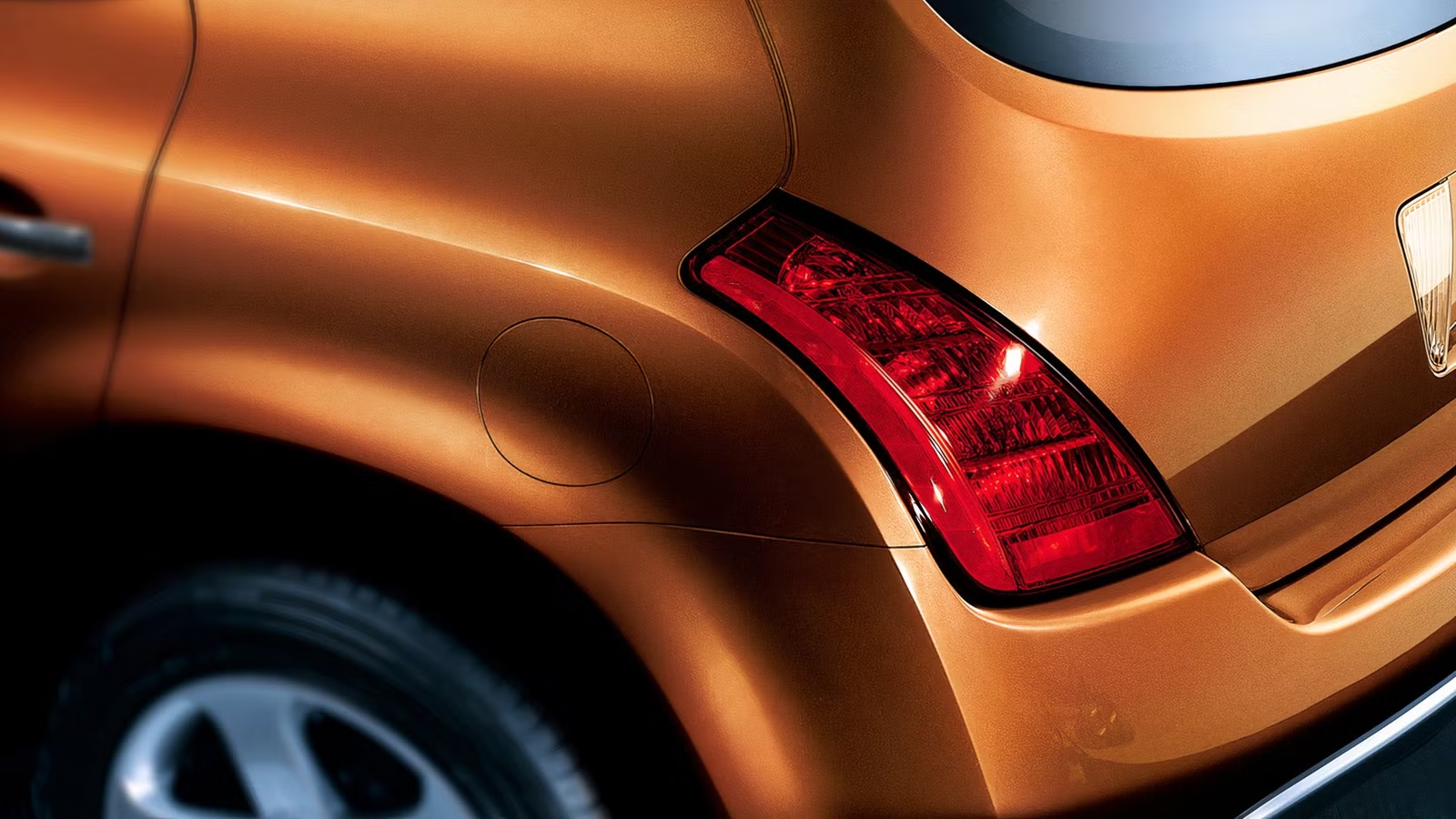
At a time when luxury SUVs are all the rage, it might be difficult to imagine the times before every automaker offered multiple shapes and sizes to fit your needs. The transition from luxury sedans to SUVs began subtly. Luxury was simply not expected in SUVs, since they were generally built on truck platforms and could handle hard work, towing, and hauling as much as some half-ton trucks. It wasn’t until the Lexus RX debuted on a car-like unibody chassis for the 1999 model year that buyers began to open their eyes to a new world of luxurious SUVs for daily driving.
That said, the true luxury models were relatively expensive. Automakers like Nissan had room to arrive with a smaller crossover and lower price point to appeal to budget buyers. Thus, the first-generation Nissan Murano was born to change the high-end crossover game for the better.
Nissan Saw Potential In An Untapped Market
2004 Nissan Murano front 3/4 angle in front of black studio backgroundNissan
SUV popularity was growing throughout the early 2000s, as buyers shifted away from sedans and wagons to carry their families around in models with more cargo space, taller ground clearance, and better perceived safety in larger vehicles. The main problem is that most SUVs were still fairly rugged by this time. The idea of an SUV built like a car had already been brought to fruition with models like the first-generation Toyota RAV4 and the Subaru Forester from the ’90s, but they were still utilitarian with a lack of especially premium features and materials.
As mentioned in the introduction, the first real luxury SUV built on a car platform was the Lexus RX for the 1999 model year — that model’s success sparked Nissan’s interest in developing a segment of its own. The premium crossover segment was tiny. Even though there were some affordable crossovers on the market, only the Lexus RX had stepped up as a luxurious option. Nissan knew it had an opportunity to change the game with its upcoming Murano crossover SUV.
Finding a middle ground between the affordable RAV4 and the luxurious RX wasn’t an easy task. However, the automaker succeeded in debuting the Murano for the 2003 model year; it felt elevated above the cheap available crossovers by using the same VQ35, a 3.5-liter naturally aspirated V6, as the higher trim levels of the Altima and Maxima sedans, as well as the all-new Infiniti G35 that launched the same year. More on its powertrain later.
The first-generation Murano went on to receive a single facelift for the 2006 model year, which updated the styling and introduced a new wheel design while keeping everything under the skin unchanged. The generation lasted until 2007 before taking a gap year for the second-gen to take over in 2009.
Introducing A Different Kind Of SUV
A shot of the 2006-2007 Nissan Murano wheelNissan
Before the Lexus RX debuted, SUVs could be separated into two categories: ladder-frame models built like trucks with large engines to tow and haul anything, or small, weak, affordable models with four-cylinder engines. The RX changed the game with its unibody chassis powered by a 3.0-liter V6, fitting into its own segment; Nissan followed up with the Murano’s 3.5-liter V6 for less money and more power.
The VQ35 engine is best known for its use in sports cars like the Nissan 350Z and Infiniti G35, but it was far more versatile than that. In fact, the VQ engine family is the most-awarded V6 in history, earning a spot on the annual Ward’s 10 Best Engines list 16 times. Now that you know how big of a deal it is, we can put the Murano’s VQ35 into better perspective. It was tuned for 245 horsepower and 246 lb-ft of torque, which was sent to either the front wheels or all four wheels via an Xtronic CVT. It was a stylish SUV with the heart of a sports car and a terrible gearbox.
Unfortunately, that CVT is one of the biggest problem areas for any Nissan of the era.
A shot of the 2006-2007 Nissan Murano gear selectorNissan
Nissan made up for its transmission issues with the Murano’s comfortable driving character while still delivering enough power to overtake on the highway or get up to speed on on-ramps. Its smooth power delivery allowed buyers to sink into a calmer, more relaxed driving experience than larger SUVs would offer. Combined with the model’s bold styling and premium interior appointments, the crossover felt like an all-new experience.
All trims came with an eight-way power-adjustable driver’s seat, dual-zone climate control, power windows, and a keyless remote-entry system. 18-inch wheels were standard, as were sport-tuned, four-wheel independent suspension and ABS brakes. Altogether, the Murano felt more like a lifestyle crossover than traditional SUVs.
It Didn’t Take Long For The Segment To Follow
A shot of the 2006-2007 Nissan Murano grillNissan
Luxury crossovers quickly became mainstream in the years following the Murano’s introduction. Luxury SUVs built on unibody platforms already existed: the BMW X5 and Mercedes-Benz ML-Class were both introduced before the Murano, but landed in the midsize category alongside the Lexus RX. Smaller premium crossovers sparked in the early-to-mid 2000s with models like the Acura MDX (technically a “midsize crossover”) and the BMW X3.
The luxury crossover and midsize SUV segments took off, and by the beginning of the 2010s the market was fully saturated in ladder-frame and unibody models alike. Nissan still held a unique position with the Murano, though, as the model bridged the gap between true luxury models like the X3 and more affordable crossovers. Volkswagen attempted to join Nissan in that market position with the Touareg. It went so far as to offer a mix of engine options in both gas and diesel variations and cylinder counts between V6s and a V10 TDI.
Nissan’s gamble in an unproven segment paid off. Nissan didn’t publish sales results by individual model for the 2003 and 2004 fiscal years, but we know from a Nissan Global financial results report for the 2003 fiscal year that “Nissan Division grew by 16.1% with a richer mix. High-margin trucks rose 34.1%, driven by the Murano and the products from the company’s new plant in Canton, Mississippi.”
Sales figures for the 2005, 2006, and 2007 Murano are publicly available, revealing the first generation actually sold more units than almost every subsequent generation when taking yearly sales data into account. For example, Nissan sold 74,454 units in 2005 in the United States, 81,362 units in 2006, and 76,358 units in 2007. Only the pre-facelift third-gen Murano (sold from 2015 through 2018, but only the 2016–2018 fiscal years outsold the first generation) beat those figures, with the brand selling 86,953 units at its peak in 2016.
The Murano’s Rivals Weren’t As Nice Inside
The first-generation Murano’s direct rivals included the first Toyota Highlander and the first Honda Pilot. However, both models focused more on affordability and utilitarianism, rather than an elevated driving experience through engine power, nicer standard features, and bold styling. The Murano’s position was unique in that there weren’t many high-end crossovers yet.
Toyota and Honda both offered excellent family haulers at reasonable prices, but their target audiences didn’t mind the lack of leather seats and single-zone air conditioning in lower trim levels. As noted earlier, every Murano trim came with those features as standard — buyers had to opt for the 2003 Pilot’s higher trim level (the EX), then pay even more for optional packages to add leather upholstery and a navigation system.
Why The First-Gen Murano Still Matters
A shot of the 2006-2007 Nissan Murano front seatsNissan
This crossover deserves recognition as a segment pioneer. Before there was a slew of premium crossovers from every automaker selling cars in the United States, there was the Murano. Sure, larger, more expensive models were available from higher-end luxury brands, but the Murano piqued buyers’ interest in premium-feeling crossovers with car-like handling and leather seats for less money than a Lexus or BMW.
It had a lasting influence on crossover designs over the years. Of course, other models from Nissan’s stable carried traces of the Murano’s influence; see the Infiniti FX, for example. The FX35 and FX50 were nicer and more expensive — the latter even offered a V8 engine for a few years before its discontinuation — but both carried a clear resemblance to the original Murano.
It made a statement in an emerging market, but was eventually overshadowed by newer competitors, as evidenced by the model’s declining sales during its second generation. The main takeaway there is that those competitors might never have entered the market if not for the Murano’s influence.
What The First-Gen Murano Is Worth Today
A shot of the 2006-2007 Nissan Murano navigation screenNissan
The earliest model years of the Murano aren’t worth much these days. Kelley Blue Book’s data shows every model year from the first generation as being worth less than $3,000 each, regardless of trim level. Real-world listings reveal a more promising market for current owners, with some low-mileage examples going for over $5,000.
On the low end, there’s a listing in Tacoma, Washington, for a 2007 Murano S with 222,491 miles for $2,200. The middle of the pack shows a handful of listings around the country for models in the $4,000 range, but the most expensive listing at the time of writing is for a 2004 Murano SL with only 49,278 miles that the dealership wants $8,400 for. Whether that price is truly justifiable despite the low mileage is debatable, but it speaks to the enduring appeal of the first-generation Murano.
Nissan Opened Up A World Of Crossovers
2006 Nissan Murano, Front 3/4 Rolling, SilverNissan
The Murano might be an inexpensive used car today that we might not recommend buying due to its unreliable, aging CVT, but it started as the spark that ignited an entire segment. Under the hood is a legendary V6 engine with plenty of power and reliability, the model’s interior was nice in all trim levels, and bold styling still sets it apart from the rest of the crowd today. Other unibody rivals from the era could be equipped with nicer amenities, but Nissan chose a different path to bridge the gap between those affordable competitors and the true luxury models.
Sources: Nissan, GoodCarBadCar.net, Kelley Blue Book, AutoTempest
