

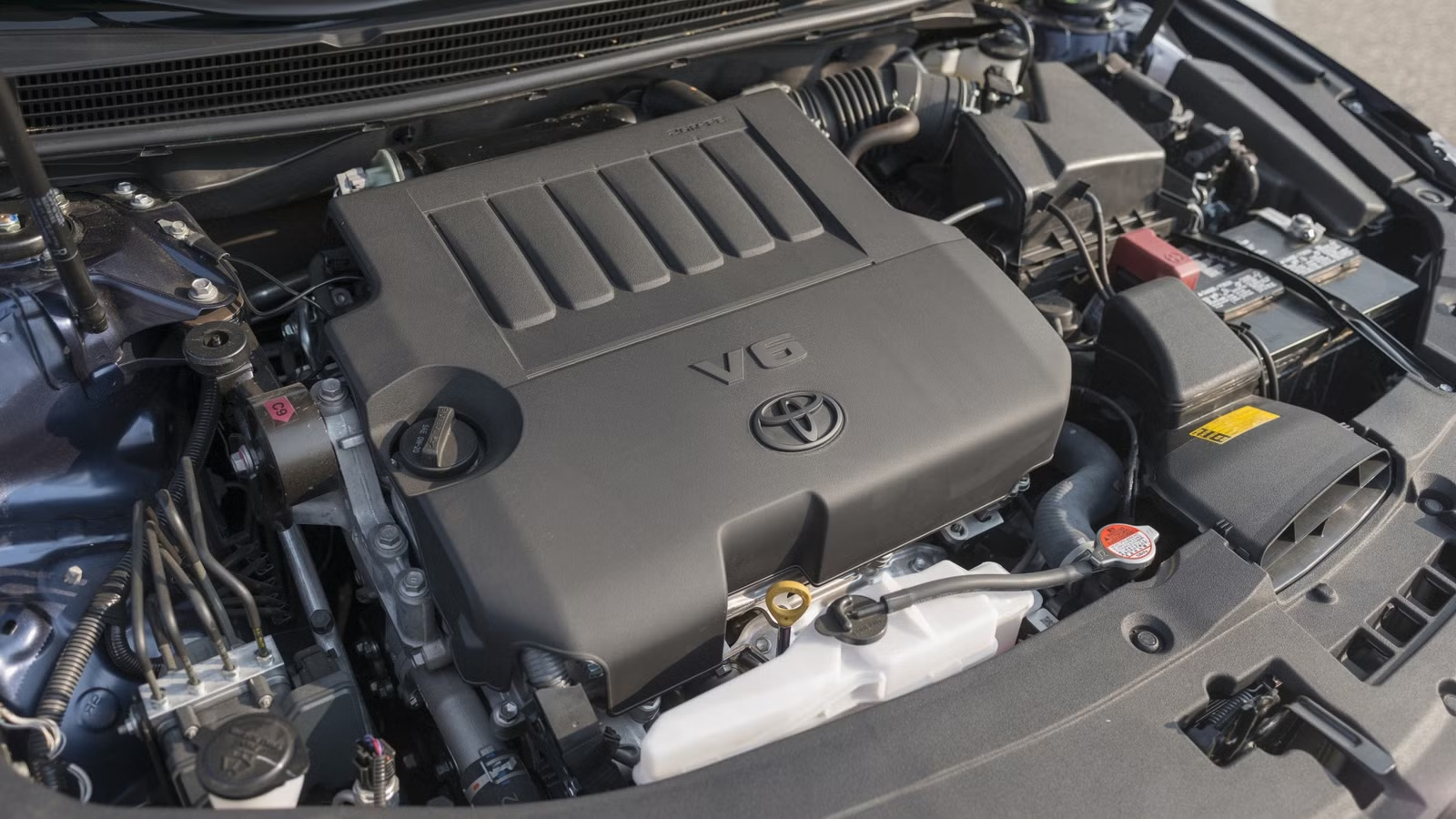
There’s no such thing as an engine with a spotless reliability record, but one engine family has time and again been shown to have one of the industry’s very cleanest: the Toyota 2GR V6. It’s a success story starting from strong bones and developing over decades. Still, the 2GR is easily one of the most dependable engines of modern times, and the unit has helped Toyota sell many vehicles.
What’s behind the gleaming reputation of the Toyota 2GR in 2026? Turns out, it’s a culmination of engineering choices, rapidly deployed fixes, and some major blunders by key powerplants from competitors that it battled for the better part of 20 years. As a new generation of V6s rolled out, many automakers quickly saw their latest and greatest engines dragging down their brand reputation for years to come.
The 2GR had a few scary reliability moments as well– but it escaped its early days with its reputation intact. Then it became bulletproof in an era when owners’ confidence in mainstream engines was being eroded by pricey problems.
It Outshone Its Competition, And Outlasted Most Of Them
2012 Toyota Camry – rear 3/4 angleToyota
2010 Toyota Camry XLE V6
Engine
3.5-liter V6 gas DOHC 24V
Power
268 hp @ 6,200 rpm
Torque
248 lb-ft @ 4,700 rpm
Compression Ratio
10.8:1
Fuel Requirement
regular unleaded
0-60 MPH (approx)
7.2 seconds
When the 2GR first launched in the mid-2000s, the V6 engine was changing before the market’s very eyes. The GM high-feature V6 engine hit the market around the same time, bringing a new era of V6 performance. The Toyota 2GR and GM High Feature V6 engines would fight fiercely for two decades in a variety of segments.
These high-tech new V6 engines launched as Honda continued to evolve its trusty J-series, whose roots dated back to the late nineties. Nissan had its legendary VQ-series V6 engine, which was well into its 3.5-liter iteration when the Toyota GR and the GM High Feature V6’s arrived. An upgraded 3.7-liter unit was on the horizon for Infiniti as well.
Competitor Daimler Chrysler was still about six years from replacing their aging engine salad of primitive V6s from 2.7 to 4.0 liters with the modern Pentastar as a singular solution, which would arrive for 2011 – right alongside a new EcoBoost Twin Turbo V6 from Ford.
None of these engines, including the 2GR, came out of their early years without some trouble. Toyota managed to dodge many of the scandals and issues that affected competitors’ engines on a similar timeline. In many cases, these were the result of unseen integration problems, as both older engine families and clean-sheet redesigns suffered reputation-damaging issues.
Related
Why The Stellantis Hurricane Inline-Six Beats Modern V8s
As blasphemous as it sounds, a turbocharged inline-6 can be better than a V8.
Why The 2GR Escaped Its Early Days With Its Reputation Intact
Toyota 2GR-FKS engine topCars.com
As they aged, many of GM’s high-feature V6S encountered thousands of dollars worth of valvetrain trouble that could scrap the vehicle outright. As warranties expired and engines failed, part of GM’s response involved adjusting maintenance schedules rather than fixing the actual problem: a valve timing system that needed improvement.
It would take two full generations of High-Feature V6 production before this engine stopped snacking on its valvetrain, but the damage to its reputation had set in. Many owners took their V6 business elsewhere. In owner forums, this engine family was quickly known as the ‘timing chain stretch’ engine.
I sold my 13 Avalon with 225,000 miles, still going strong.
Honda’s J-Series engine is known as a reliability champ, though it has encountered some tumultuous periods, too. Around the same time, Honda fitted it with Variable Cylinder Management (VCM), a form of cylinder deactivation, to improve fuel efficiency. As equipped engines age, this system could become problematic, resulting in damaging vibrations, oil consumption issues, performance issues, and engine damage. A lawsuit followed, as did an entire aftermarket built around electronic ‘kill modules’ that could disable the VCM system outright.
2012-2014 Toyota Camry Hybrid 2nd Gen Front FeaturesToyota
Before long, owner forums were full of reports of the latest V6 engines experiencing fouled spark plugs, oil consumption, seized parts, blown gaskets, oil leaks, and other assorted problems that gave drivers no shortage of headaches.
Toyota’s 2GR was among them. It had a serious out-of-the-gate problem, too: oil lines could fail unexpectedly. If they did, the engine’s entire oil supply would be spray-painting the engine bay, pavement beneath, and highway traffic behind in a matter of moments. Mere moments later, the now lubrication-starved 2GR suffered an instant death.
I have a 2018 Camry SE with 225k right now, and the torque converter is just now starting to die. Only had to switch out the battery, alternator, and brakes since I bought it. Easily the best car I’ve ever had without question. Toyota knows how to make cars.
Toyota issued recalls to replace the problematic hoses with an upgraded design that could be easily retrofitted to older engines on Toyota’s dime, and was ultimately applied to newer copies of the 2GR from the factory by 2010.
2017 Toyota Highlander, front quarter view, silverToyota
Unlike the GM or Honda engines along the same timeline, the 2GR’s self-destructing oil lines were an early issue that was quickly and permanently addressed, rather than dragging on for years. The fix was easy, and since this problem was relatively well contained and affected parts that weren’t even inside the engine, the 2GR itself escaped with its reputation pretty much unphased.
Elsewhere, some owners were reporting gasket-related oil leaks and oil consumption from the engine. These gripes would pale in comparison to those of some owners of competitor models, however, and they were fixed quickly, like the oil lines.
A Secret Engineering Weapon Helped The 2GR Steer Clear Of Valvetrain Trouble
2008 Toyota Blade Master G 3.5L 2GR-FE NA V6 Enginej-spec.com.au
Modern V-configuration engines with dual overhead camshafts have five important rotating assemblies connected to one another, and each must move in precise relation to the rest at all times. Metal chains are generally used to connect the crankshaft and camshafts, with some engines using a single long chain and others using an assembly of chain drives with multiple shorter chains.
The timing chain(s) in an engine take a tremendous amount of abuse, and various modern V6s helped prove that using a single timing chain could be a recipe for disaster. More on that a little further down the page. Driving the valvetrain with a single timing chain puts that chain under immense stress, potentially causing it to stretch over time. If your timing chain stretches, very expensive engine damage is likely, and this wiped out a lot of early V6 engines from this era.
2008 Toyota RAV4 – V6 EngineToyota
Important Toyota 2GR Model Years
- 2009 Piston Ring Update: Oil control rings on the pistons could get packed with carbon buildup, reducing their tension against the cylinder walls and allowing oil to seep into the combustion chamber. The 2009 piston ring update replaced the earlier rings with a new design that avoided this buildup and fixed the tension problem.
- 2009–2010 Oil Line Update: Rubber segments on engine oil supply lines, as well as an external oil cooler, could fail, resulting in a catastrophic engine oil leak. By 2010, the problematic rubber parts had been isolated and replaced by a new design with all-metal construction.
- 2010 Engine Sealant Upgrade: With some owners reporting timing covers that could weep oil externally, Toyota updated the 2GR’s production processes to use a new, more durable sealant which drastically reduced the occurrence of this irritating problem.
Not the 2GR, though: its timing system had a chain drive built to handle the abuse. Rather than routing a single, vulnerable chain throughout the entire engine, engineers instead split the duties between three individual chains. By using three smaller, simpler chain drives instead of a single complex chain drive used elsewhere, the entire timing system has an easier, less stressful life, and timing chain stretch can be avoided.
Related
The Most Reliable Toyota Engine Of All Time
Select older Toyota engines are synonymous with longevity and solid reliability. But which one is considered to be the most reliable of all time?
Competitors Were Blowing Engines While Toyota Bulletproofed The GR
2014 camaro lfx v6Chevrolet
With early debugging of oil-line bursts, leaky piston rings, and other oil leaks completed by 2010, the 2GR entered its golden era of reliability. Toyota’s V6 was now dialed in, just as competitors were rushing complex new technologies to market by launching new engines and updating existing ones to meet tightening pollution targets.
“I’d say beyond a water pump at ~75k, and an alternator near 90k, this car has been stupid reliable. Only work I’ve done on it is maintenance as required, its at 185,000 now.”
– ToyotaNation.com Member (2008 Camry)
Elsewhere in 2010? Hyundai and Kia were contending with new direct-injection and turbocharged four-cylinder engines that were self-destructing due to oil starvation, damaging their brand reputations at a time when each was trying to push further upscale. Ford’s early EcoBoost V6 twin-turbo engines were complex, sold in massive numbers, and became known for valvetrain, turbocharger, and intercooler trouble, leading many owners to opt for the more proven V8 engine instead.
Valvetrain and carbon buildup troubles persisted for the GM High-Feature V6, despite a redesign. Even early copies of the newly released Chrysler Pentastar V6 were popping up with factory-defective valvetrain components and cylinder heads. At Subaru, flat-four BOXER engines suffered from frail piston-ring lands and dribbly head gaskets. The straight-six-replacing BMW N20 2-liter four-cylinder turbo engine was shredding its timing chain guides and self-destructing, too. Ford’s early turbo four-cylinder EcoBoost engines were known for cylinder block defects that allowed coolant into the combustion chambers, requiring a new engine as a fix. Heck, even Toyota’s own four-cylinder 2AZ engines in this era were quickly being noted for problematic oil consumption.
Point is, no shortage of mainstream (and luxury) engines were leaving behind trails of stretched timing chains, carbon deposits, broken connecting rods, and warranty claims. At the same time, the now-sorted 2GR just kept rolling out of the factory, showing that a careful evolution of proven engine design beats the rapid addition of high-tech when it comes to reliability for the long haul.
Sources: Youtube.com/Merryfrankster, Toyota, Reddit, ToyotaNation.com
