

Over in Europe, the late 20th century was a time when automotive innovation rode the line that separated normal and “out there.” Wild concepts were coming out of brands left and right, with examples like the Peugeot Quasar and the tiny Mercedes-Benz NAFA, the latter of which could be considered the proto-Smart Fortwo. At the time, the computer age was just beginning to dawn, and many cars began to take on a futuristic, cyberpunk-ish look.
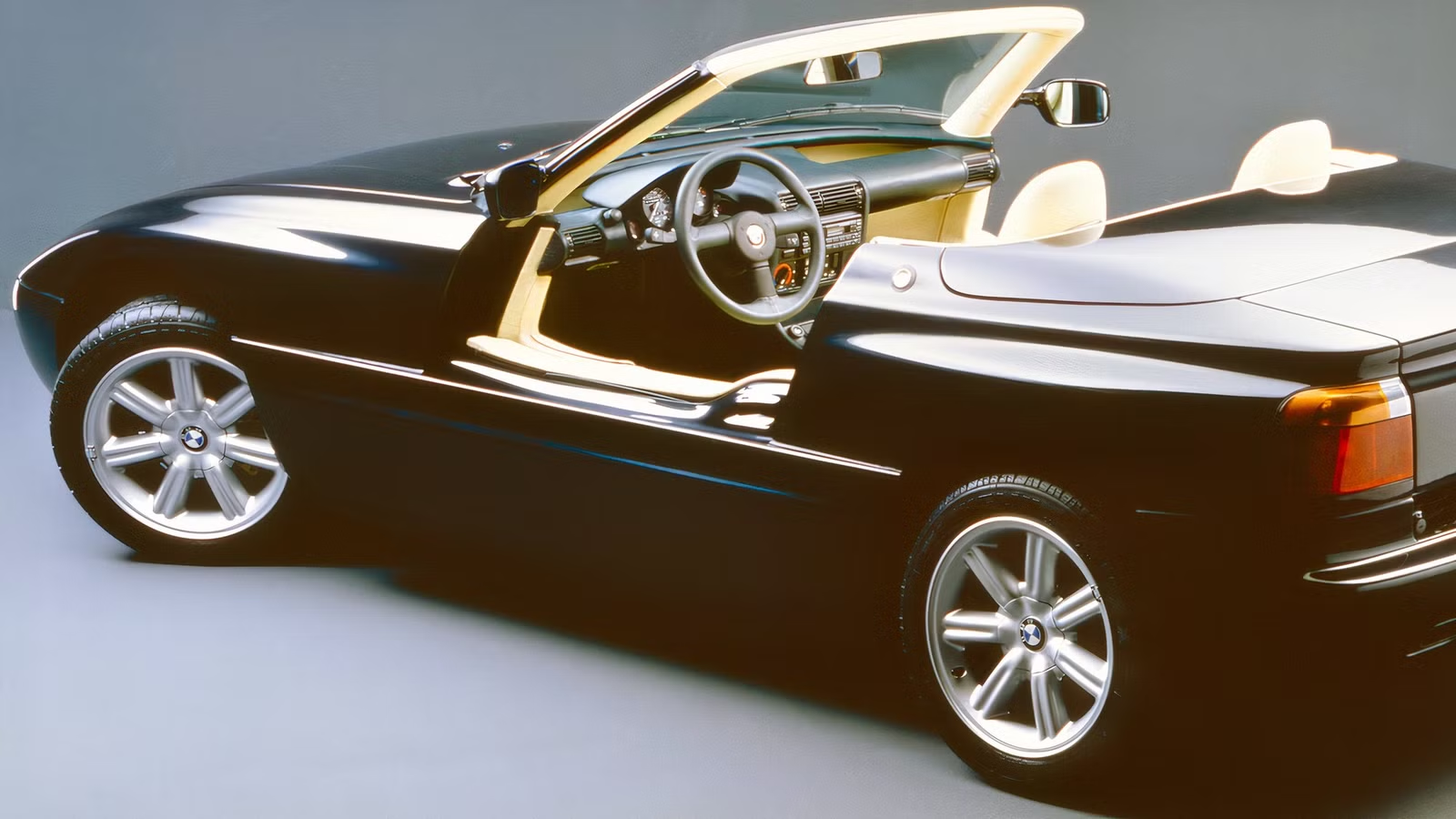
While not as crazy as some of the concepts released at the time, BMW’s Z1 sports car packed quite a bit of the future into its small stature. Apart from the obvious Kidney Grille at its front end, you wouldn’t be able to tell it’s a Bimmer at a quick glance. One of the largest examples of its weirdness isn’t in its wedge-shaped headlights or its funky, A-pillar-mounted mirrors. It’s actually in its doors which, instead of swinging out or up, simply retract down into the body. Forget roll-down windows, the Z1’s got roll-down doors.
Here’s How To Get One Of Your Own
1990 BMW Z1 Gray InteriorBMW
Over the past few years, the BMW Z1 market has been fluctuating a little bit. Back in the late 2010s, the Z1’s value was quite high, reaching $93,118 in August 2016 according to Classic.com. However, it then went through a steep drop, culminating in an average sale price of just $58,864 in May 2021. Nowadays, its value is on the rise yet again, with a median sale price of $62,188 at the time of writing. However, pricing can vary widely depending on condition, location, and odometer mileage.
Here are some examples that have sold over the last few years:
- 1990 model with 29,000 miles for $56,000 USD in Canada
- 1991 model with 52,000 miles for $54,000 in Indiana
- 1989 model with 31,000 miles for $61,500 in California
Related
The 15 Best BMWs Of The Last 50 Years, According To CarBuzz
BMW has produced many Ultimate Driving Machines over the last half-century, and these are our favorites.
The Z1, Its Weirdness, And Its Production
1989 BMW Z1 Blue Roof and Doors Down Front AngleBMW
Around 1985, BMW was keen to begin developing all-new tech for its vehicles, in order to bring the company forward into the new, futurism-dominated age. That year, Technik GmbH, a subsidiary of BMW, was founded to do just that. In charge of the Technik project was a man called Ulrich Bez, a doctor of engineering who, until taking over the new endeavor, was working for BMW as a senior R&D associate. Working directly underneath Bez was Harm Lagaay, a Dutch automobile designer responsible for designing models like the Porsche 911 and 924 before coming to work for BMW in the early 1980s.
The BMW Z1 was slated to be Technik GmbH’s first fully-fledged project. A few months after Technik was set up for business, BMW’s top brass gave the subsidiary the green light for the Z1’s development, after having been pitched the idea. Following close to a year’s worth of design and development, the very first Z1 prototype was ready for road testing. At the same time, BMW unveiled the project to the German press which, reportedly, was somewhat of a sensation throughout the European market.
1990 BMW Z1 Green Roof Down Front Angled ViewBMW
Production began in earnest in 1989 with the Z1 carrying a base MSRP of 83,000 Deutsch Marks. In today’s dollars, that’s about $118,506. Before production even began, demand for the Z1 was nearly overwhelming. BMW reportedly received 3,500 orders for it before the first one even entered production. However, demand dropped steeply around the end of 1988, and issues with production speed further hampered the Z1’s popularity. By 1991, its production was halted, as demand virtually dried up and continuing to build the model was likely deemed a money-wasting endeavor.
Design Quirks
1989 BMW Z1 Blue Roof and Doors Down SideBMW
As far as its strange design is concerned, BMW Technik’s area of expertise was, of course, futuristic tech. The idea behind the roll-down doors was to provide drivers with an “unparalleled” open-air driving experience. In addition, the Z1 was designed with extremely high door sills that doubled as structural supports. The supports were oriented in this way to allow for the Z1’s lower-than-typical center of gravity. Because there was so much room in the sills themselves, designing the doors to retract into them seemed futuristic and cool, and I tend to agree. You could even drive the Z1 with the doors in the retracted position, so long as doing so is actually legal in your country.
1989 BMW Z1 Blue Roof and Doors Down Rear AngleBMW
The Z1’s entire body is also packed full of weirdness, too. For starters, it sports removable body panels, allowing for quick swap-outs should one become damaged or dented. Its windshield support doubles as what’s called a “roll-hoop”, a safety measure employed in convertibles to protect drivers in the event of a rollover crash. GE supplied its own Xenoy thermoplastic material for use on the Z1’s doors and fenders, and the rest of the exterior panels are made from something called glass-reinforced plastic, or GRP. According to BMW, owners could replace every single body panel on the Z1 in roughly 40 minutes, and BMW even suggested to buyers that they purchase a different-colored set of body panels to change the car’s color every so often. Even its paint is weird, as it sports a flexible lacquer.
Related
BMW’s Forgotten McLaren F1 Rival
The story of the little-known Nazca M12: a V12-powered, German-Italian concept supercar.
Under The Hood
1990 BMW Z1 M20B25 2.5L NA I6 EngineBMW
Only one engine was destined for use in the BMW Z1, that being a 2.5-liter M20 inline-six. The Z1’s M20 in particular carried the code name “M20B25”, denoting its 2.5-liter displacement. The mill was shared with both the E30 325i and E34 525i. The B25 iteration was a direct successor to the M20B23, boasting things like an upgraded, higher-flowing cylinder head and a Bosch-bred “Motronic 1.3” ECU. In order to increase its displacement from 2.3 to 2.5 liters, BMW increased the M20’s cylinder bore. However, its stroke was slightly decreased by about one millimeter. The Z1 employs a unique engine mounting setup wherein the mill is placed completely behind the front axle, and is slanted about 20 degrees.
1989-1991 BMW Z1 Black Roof Up Doors Down Front AngleBMW Group
Backing up the M20B25 mill is a five-speed Getrag 260/5 manual transmission, with no automatic on offer. Like its engine, the gearbox was shared with other BMW models, most notably the E30 325i. Being a BMW, rear-wheel drive is the sole drivetrain configuration. The Z1’s suspension system is unique to it, as its rear axle is supported by an independent, multi-link setup called the Z Axle. The Z Axle also marked one of the first times a BMW utilized an independent rear suspension system.
BMW Z1 Specs
Engine Details
2.5L NA inline-six
Horsepower
168 hp
Torque
164 lb-ft
Cylinder Bore
3.31 in
Piston Stroke
2.95 in
Compression Ratio
8.8:1
0-60 MPH Time
7.9 seconds
Top Speed
141 mph
Curb Weight
2,760 lbs
Production Timeframe
1989–1991
*Specs courtesy of BMW & SupercarNostalgia.com
How The Z1’s Body Helped It Perform
1989-1991 BMW Z1 Naked Frame w/ Red Body Panels RemovedBMW Group
The Z1 employed an extensive number of aerodynamically-inclined design features. Its undercarriage was flat, much like a race car, to help provide a smooth channel of air running underneath the car at high speeds. Its rear bumper and exhaust system team up to create a pseudo-diffuser, which also works alongside the flat under tray to reduce rear lift considerably. According to BMW, the wedge-shaped front end helps to maximize high-pressure air, providing a good amount of downforce over the front axle which, in turn, helps to bolster front-end traction through high-speed corners. Better front-end traction means less understeer.
Related
These Are The Only Two Mid-Engined BMWs Ever Built
BMW tends remain loyal to making its cars front-engined, though this doesn’t mean it hasn’t flirted with the other side on occasion.
The Z1’s Quirkiness Sparked A Revolution
1989-1991 BMW Z1 Roof Down Blue Front Angle CorneringBMW
Despite only being around for a couple of years, BMW’s Technik GmbH took some well-gotten lessons from the project. Just a few years after the Z1’s production wrapped up, BMW released its next “Z” car, the Z3. It was much more mass-market-friendly, and even got a huge PR boost as James Bond’s car in the movie GoldenEye. The Z3 also greatly outsold the Z1, with a reported final sales total of about 297,088 units between 1996 and 2002.
Following the Z3 came the Z4, another small roadster, which was in production until 2008. Of course, there was also the Z8, the ill-fated sports car and final member of BMW’s Z family. It was built to commemorate the similarly ill-fated BMW 507 from the 1950s, sold poorly, allegedly handled poorly, and couldn’t manage to captivate folks with its retro-modernistic looks.
1990 BMW Z1 Blue Roof Down Front Angle Driving Around a Hairpin BendBMW
At the beginning of this off-kilter family of misfits sat the Z1 and its weird looks, and even weirder doors. To be honest, driving with its doors retracted and the top down might be worth the car’s price alone.
Sources: BMW, Classic.com, Bring A Trailer.
