

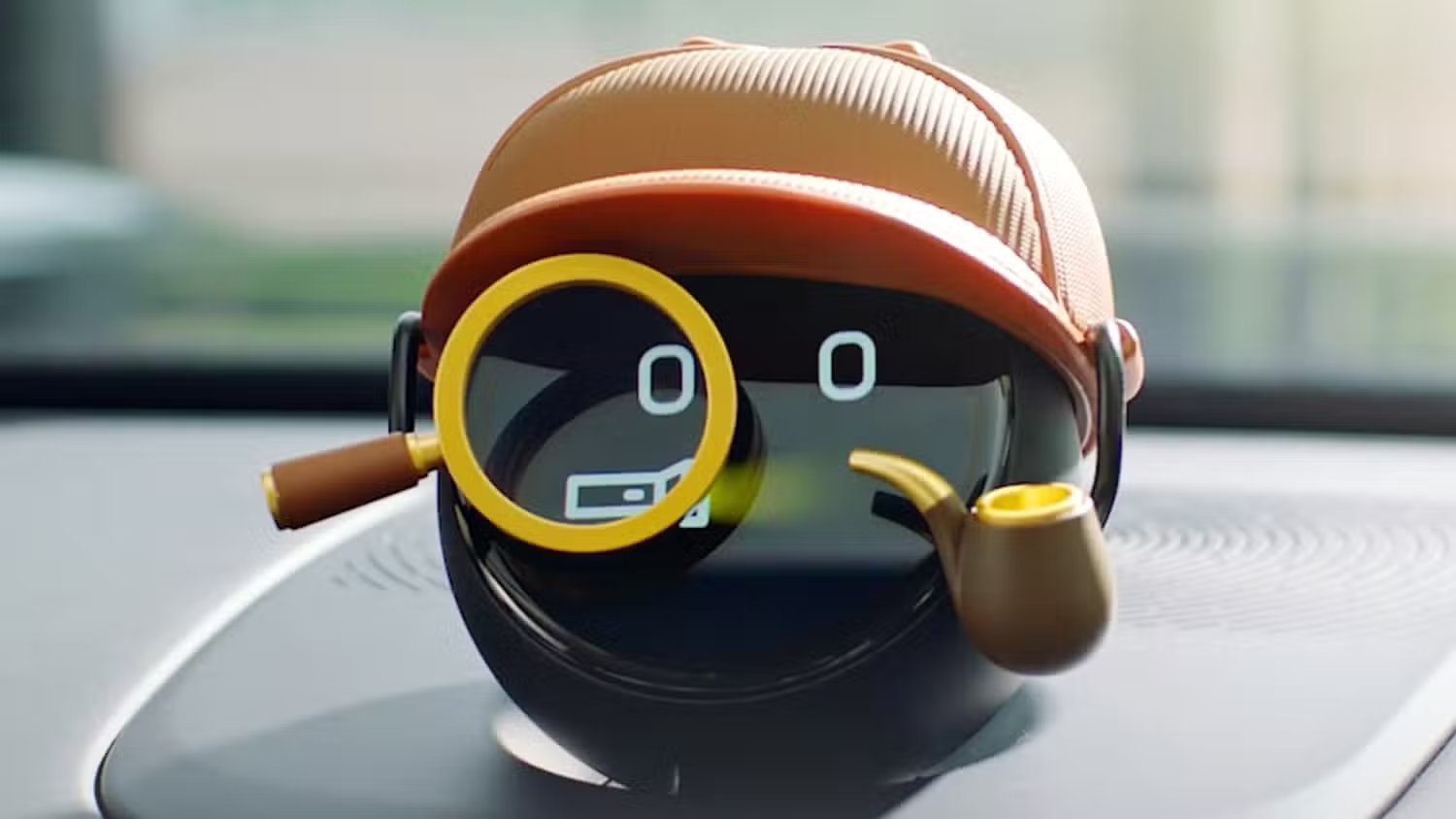
The NOMI Mate in Nio cars. Credit: Nio
- Nio warned that untested counterfeit devices could detach and shatter during collisions, becoming dangerous “in-car bullets.”
- Nio has sued multiple companies over alleged infringement involving NOMI.
Nio Inc (NYSE: NIO) is taking legal action to crack down on the plagiarism and counterfeiting of its in-car AI voice assistant, NOMI.
The legal department of the Chinese electric vehicle (EV) maker issued a statement on Friday warning that these counterfeit products not only infringe upon intellectual property rights but also pose a serious threat to driving safety.
Nio said in the statement that a large number of unauthorized NOMI knockoffs have appeared in the market. These products are highly similar to the original in physical appearance and are widely sold through online channels.
However, they have not undergone strict automotive-grade testing. Under complex conditions such as high temperatures, electromagnetic interference, or vehicle bumps, these counterfeit devices are highly prone to issues like short circuits or component detachment.
The company particularly emphasized the safety risks of these devices in extreme situations. In the event of a vehicle collision or emergency braking, these unverified accessories could detach due to inertia, shatter, and scatter.
They could turn into dangerous “in-car bullets,” causing secondary injuries to passengers and drivers, Nio warned.
Furthermore, if installed improperly, they could even interfere with the normal deployment of airbags, which would directly weaken the vehicle’s safety protection effectiveness.
In addition to hardware counterfeiting, Nio accused some merchants of copying NOMI’s core software design. This includes replicating its visual expressions, interactive logic, and interface layout, and using them in the cabins of other vehicle brands.
Nio said that such intellectual property infringement lacks underlying safety architecture support. In actual driving scenarios, this can easily lead to false system triggers or delayed responses, significantly increasing the driver’s cognitive load and thereby affecting driving safety.
Nio is also cracking down on online disinformation campaigns. The statement noted that some social media and online accounts have deliberately fabricated false comparison content.
They mislead consumers by smearing NOMI and designing fake interactive scenarios. Nio believes these actions further fuel market chaos.
In response to the infringement, Nio has completed the notarization and preservation of relevant evidence. The company has filed civil lawsuits and administrative complaints against multiple entities located in Zhejiang, Guangzhou, and Shanghai.
Nio pledged to continue safeguarding the legitimate rights and interests of the enterprise and its users through legal channels, and will report on the progress of its rights protection in due course.
NOMI is Nio’s core asset and original achievement in the smart cabin sector. Derived from the English phrase “Know Me,” it was first released with mass-produced vehicles in 2017. It is one of the earliest virtual voice assistants launched by a Chinese automaker.
Nio said that the safety performance of the authentic NOMI Mate has passed multiple safety certifications, such as C-NCAP and E-NCAP, along with the entire vehicle, ensuring its operational stability under extreme conditions.
With the rapid development of AI (artificial intelligence) in recent years, NOMI has also begun to possess AI capabilities.
On April 12, 2024, Nio officially launched NOMI GPT, which integrates AI large language model technology. This feature is equipped on the new generation of models using the Banyan system.
While advancing intellectual property protection, Nio reiterated that the all-new ES8 will reach its 120,000th delivery this month, and the ES9 will also achieve the milestone of its 10,000th delivery this month.
NOMI GPT was launched on April 12 with more advanced features powered by AI large language models.
