

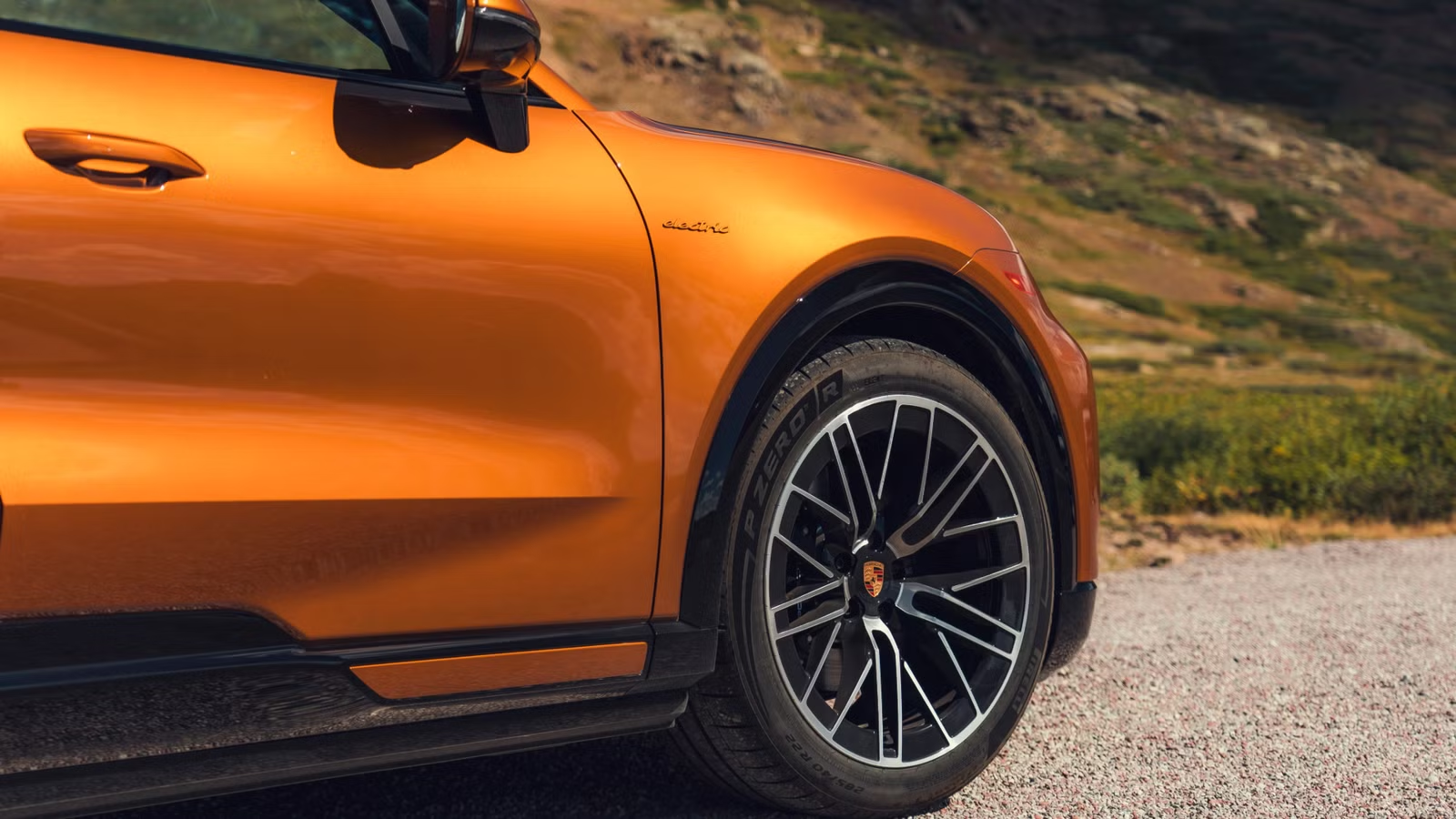
There was a time not so long ago when you had to decide between performance and space in your family car. Sports coupes made you feel like a racing driver thanks to their clever race-bred components and technology, while an SUV had the space and efficiency to carry you over a long journey without any real thrill. With the dawn of software-defined EVs, though, the gap has gotten much smaller.
Now, thanks to technological trickery, huge power figures, and a host of new mechanical upgrades, electric SUVs have become just as fast as (or faster than) most supercars. They may not have the crescendo of an internal combustion engine, but cars like the Mercedes-AMG EQE SUV are fighting back in other ways. Here are the cars, and the features, leading the charge.
Lucid Gravity GT-S: 1,070 hp That Makes Lamborghinis Feel Ordinary
You Want Horsepower? We Got Horsepower
One of the best ways to make anyone feel that they’re in a racecar is to throw power at the wall. Electric motors are great for this, as while the ICE equivalent is still finding its most efficient engine speed, the EV has already taken off. The Lucid Gravity – a luxury vehicle first and foremost – embodies the power-above-all sentiment with an extraordinary 1,070 horsepower in GT-S trim. That gets this hunk of metal up to 155 miles per hour.
It’s not alone in this, with the Porsche Cayenne Turbo Electric having 1,139 horses and the Tesla Model X Plaid somehow making do with 1,020 ponies. Even the lower-rung premium SUVs, like the Volvo EX90, make 450 hp. The Lamborghini Diablo had around 500 hp, so the idea that soccer moms now have access to supercar-level performance is remarkable. Of course, you don’t have to unleash all of those horses all the time, but they certainly make merging and pulling out of intersections quicker.
Porsche Cayenne Turbo Electric: The Push-To-Pass Button Straight From IndyCar
Push To Pass Might Be Overkill
You’re sizing up the traffic in front. You check the mirror, ready to overtake by pressing the oh-so-tempting push-to-pass button on the steering wheel. But you’re not on a racetrack – you’re in the Porsche Cayenne Turbo Electric on the highway, passing a truck. But with over 800 hp when not in the overboost mode, do you really need more? Probably not. But a 10-second boost to your peak horsepower will certainly make you feel like a racing driver.
“A week after the test drive my inner ear is still somewhat shaken from that first hard pull using launch control,” said Seyth Miersma, director of communications at Valnet Auto Group. “What a rocket.”
This feature is also available in the Cayenne’s smaller brother, the Macan. The push-to-pass function is straight from IndyCar, although this one can be used in conjunction with premium audio and seating for more than one. While most electric cars have peak power in launch control modes, Porsche’s push-to-pass function makes the driving experience a little more engaging on the road when you want a surge of acceleration. The BMW IX also has this, albeit called “M Sport Boost.”
BMW IX: Launch Control That Embarrasses Sports Cars
Launch Control For A Clean Getaway
Launch control is nothing new, but you usually expect it in something like a Porsche 911 GT3, which is meant to mirror a road-going racer. The BMW IX certainly doesn’t look like a racecar, but it’s one of many SUVs that now has a launch control mode. With a total system power output of 650 horses and 811 lb-ft for the M70xDrive, you’ll certainly feel it when the computer is working out optimum grip for a fast launch. This huge SUV can get to highway speeds in around 3.5 seconds and do the quarter-mile in only 11 seconds.
“We highly doubt most buyers will ever use the full power available to them. Still, it’ll do borderline supercar acceleration, and that’s a little more than a gimmick since it’s executed so well,” said CarBuzz motor journalist Justin Westbrook.
An electric motor is a great starting place for launch control as it can change the amount of power being sent to each wheel much quicker than an ICE drivetrain, giving the car greater control over a launch. Right now, some of the fastest accelerating EV SUVs are the Rivian R1S (2.6 seconds), Lucid Gravity (3.1 seconds), and Hyundai Ioniq 5 N (3.3 seconds). Even the 9,000-lb Hummer EV SUV makes the run to 60 mph in just three seconds. And that’s certainly no supercar.
Mercedes-AMG EQE SUV: Artificial Sound And Bolstered Seats That Fake a Supercar Cabin
EVs Do Have Sound, Albeit Fake
One of the big complaints with electric cars is that they don’t have the feeling of occasion when you put your foot down. With a gas engine, you get the revs rising and gears changing, but in an EV, only the hum of the electric motor accompanies the drive. Companies like Mercedes-AMG and BMW have tried to make their EV SUVs more interesting through soundscapes, and while BMW went with a Hans Zimmer-composed track, Mercedes follows the industry trend.
In different modes, you can get a unique acceleration sound that makes it feel more engaging to drive. Most sports car drivers also gauge their speed through engine revs alone, so having something like this in the Mercedes helps you stay aware of your pace instinctively. Cars like the Hyundai Ioniq 5 N try to imitate ICE cars directly, while Mercedes actively tries to make the EVs sound unique. Besides, most ICE performance cars have been pumping artificial noise into the cabin, so what’s different here?
It’s Not Just Sound – It’s Feel, Too
2026 Mercedes-AMG EQE SUV Front SeatsMercedes-AMG
Of course, you want to feel like you’re sitting in a sports car when you’re cornering hard. Mercedes-Benz is known for its comfortable massaging seats, but in the EQE SUV, there’s more bolstering to hug you through the bends. Of course, you still get all your ventilation and massaging seats. Pair the sound and the seat bolstering, and you’ll certainly feel like you’re in an SL and not a heavy electric SUV. The supercar choices might have more form-hugging seats, but do you really want that on a cruise?
Rivian R1S: The Off-Roader That Can Lower 5.5 Inches And Unleash 1,198 lb-ft
Driving Modes For The Trail And Track
One of the big ways in which an electric SUV makes itself feel like a supercar is through the selection of drive modes. Most people will be using the “normal” mode, but when you want it, the press of a button unlocks more power, more capabilities, and sometimes firmer suspension to help the vehicle feel like it’s lower on the ground. The latter is done well by the Rivian R1S – and this huge SUV can lower by 5.5 inches.
Throttle response is increased, all 1,198 lb-ft of torque is unleashed, and without anti-roll bars, the air dampers make it feel more like a low-slung coupe. Then, when you want to increase range, switch it over to an efficiency mode to get close to 400 miles on a charge. Nearly every electric luxury SUV has this function because sometimes a supercar makes every journey tiring, and you want to relax in your large, comfortable SUV.
Base Trim Engine
EV
Base Trim Transmission
1-speed automatic
Base Trim Drivetrain
All-Wheel Drive
Base Trim Horsepower
533 HP
Base Trim Torque
610 lb.-ft.
Base Trim Fuel Economy Equivalent (city/highway/combined)
85/72/79 mpge
Base Trim Battery Type
Lithium iron phosphate (LFP)
Infotainment & Features
9 /10
Sources: Mercedes-AMG, Rivian, BMW, Porsche, Lucid
