

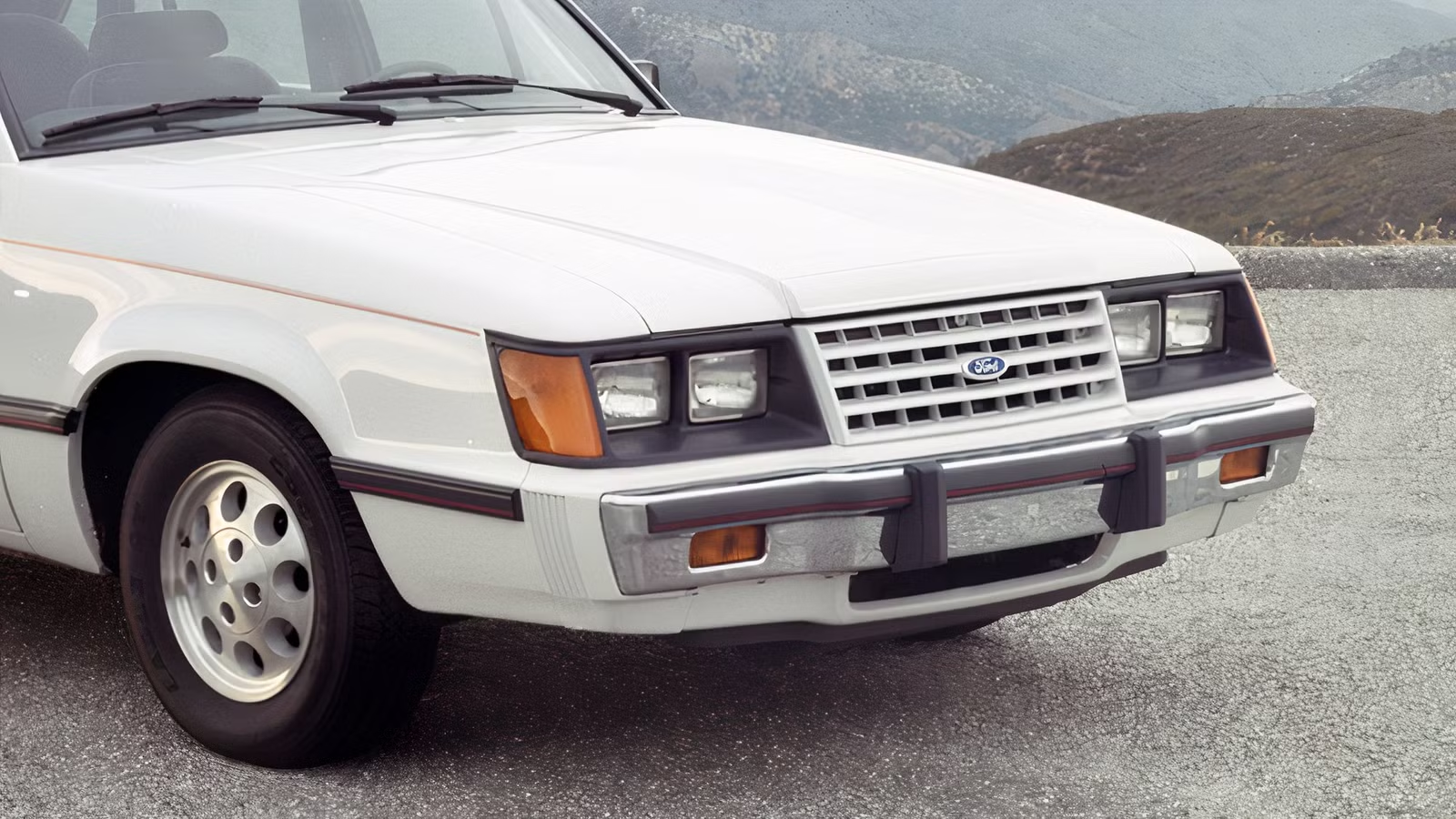
In the mid-1980s, many domestic sedans wore the same old hat: a thirsty, underpowered engine, boxy styling, and a mere whiff of what performance was like just over a decade prior. Ford seemingly decided to try and do something about it with the LTD LX. It broke from that formula – apart from the boxiness – by injecting Mustang GT hardware into the LTD’s family-sedan blood.
It was built for about a year – between mid-1984 and 1985 – and just over 5,000 were produced in that timespan. The LTD LX’s Mustang GT bones sound like a great idea on paper, so why did it never catch on? At the same time, why didn’t Ford continue to build it? The answer lies more with necessity, rather than pure market saturation or demand.
Ford Needed A Hot Four-Door Sedan For A Very Specific Reason
1985 Ford LTD LX Exterior Finished In White Ford Heritage Vault
The LTD LX existed because a driving school instructor had a problem: he needed Mustang GT performance in a four-door body. In the early 1980s, a man named Bob Bondurant was heading up a high-performance driving school, and had been since 1968. The school was charged with training all types of drivers that needed an edge over the average civilian. A whole host of NASCAR drivers, police officers, and even celebrities like Tom Cruise and Christian Bale circulated through Bondurant’s intensive, California-based program.
Bondurant wanted the performance of a Mustang GT, but the problem was, a two-door car wasn’t very suitable for a driving school. Multiple students were often seated in the car, and climbing out of a coupe via the front door isn’t exactly a comfortable experience. So, he requested that Ford build him a four-door car with the heart and soul of a Mustang GT.
At first, Bondurant had his own Mustang GT/LTD Franken-car built for use at his school, but soon commissioned Ford to build a production version. Thus, the Ford LTD LX was born. The production model differed slightly from Bob’s creation, but the core principle remained the same: take a Mustang GT, and shove its essence into an LTD. At the same time, Ford saw an opportunity for the LTD LX to take on the litany of high-performing German sports sedans sold in the US at the time.
Killing two birds with one stone? That’s music to a company’s ears. Saving money by avoiding having to develop a clean-sheet performance sedan? Even better.
Out Went The Boring, In Went The Exciting
1985 Ford LTD LX Exterior Finished Engine Bay Close-UpRM Sotheby’s
A standard 1984 Ford LTD came with a 90-horsepower, 2.3-liter inline-four-cylinder engine. You could upgrade to a 112-hp 3.8-liter Essex V6, but neither of these engines provided the sort of power Bondurant was after, let alone allow Ford to compete with something like the BMW 5 Series.
In the LTD LX, you were treated to Ford’s 165-hp, 245 lb-ft 5.0-liter V8. Keep in mind, in the early 80s, those 165 ponies were considered adequate. That sort of power was a world of difference over the LTD’s standard offerings, and was coupled with a four-speed automatic transmission sporting a floor-mounted shifter. After all, it was designed partly with a driving school in mind, so a stick shift was likely opted against.
1985 Ford LTD LX Interior Cabin RM Sotheby’s
Backing up the Mustang GT mill was a 3.27:1 rear-end gear ratio, along with Ford’s Traction-Lok limited-slip differential (LSD), helping to improve handling through the corners. Its suspension was tweaked, too, with stiffer springs and shocks and thicker sway bars. Its brakes were larger than standard, power-assisted, and the entire system consisted of 10-inch discs up front and 10-inch drums at the back.
On paper, the spec sheet read like a Mustang GT. But did it actually drive like one – and could it really hang with the Europeans it was designed to beat?
The LTD LX Was A Mustang In Every Way Except In Name
1985 Ford LTD LX Exterior Finished In GrayRM Sotheby’s
It had the hardware, and its performance on the track – and Bondurant’s test circuit – was similar to that of a period Mustang GT, too. Its 0-60 mph time was reported to be just over nine seconds, which was roughly two seconds slower than the Mustang GT’s best. However, a Mustang GT equipped with the four-speed automatic managed the feat in a much slower 8.4 seconds, quite close to the LTD LX.
Period reports also showed that the LTD LX was a compelling car when exposed to corners and heavy braking. Many reporting authorities praised its unexpectedly agile handling that was compared to some of its European rivals. One complaint, however, was that its front end felt heavy, no doubt due in part to the large V8 hidden within. Its European contemporaries, such as the BMW 533i, produced more power with lighter, six-cylinder engines.
One large plus side to the LTD LX was its sleeper appeal. On the outside, it looked much like the standard model, apart from the deletion of some chrome here and there. It had all the same boxy proportions, including its huge rectangular rear lights. Looking at it, you wouldn’t expect that it could give the Europeans a run for their money, let alone train high-performance drivers in their craft.
The Canadian market had its own version of the LTD LX called the 1985 Mercury Marquis LTS. It’s said that only about 134 examples were built, and it was virtually identical mechanically to its Ford-branded sibling.
The Formula Was There, But The Market Wasn’t
1985 Ford LTD Sedaqn Exterior Finished In GrayRM Sotheby’s
Ford reportedly built approximately 5,287 LTD LXs in just over a year of production. Within that timeframe, the model seemingly failed to make a noteworthy impact on the market. The LTD retained its family sedan reputation, and the Mustang GT was still seen as the true performance-oriented Ford product of the time. The LTD LX occupied a niche in between, one that simply wasn’t wide enough.
At the same time, the automotive industry as a whole was changing. Americans were becoming more and more interested in European and Japanese models, as they offered more power from smaller engines, better fuel economy, largely better build quality, and more modern designs. These reasons, among others, largely inspired Ford to create the Taurus a few years later, which became a smash hit almost immediately upon its launch.
It looks as though Ford simply didn’t see a reason to muddy its 1980s performance image with a model that potentially confused its lineup image. Instead, it discontinued the LTD LX following the 1985 model year. However, in just over a year’s time, Ford gave the world a spiritual precursor to the Taurus SHO, as well as a capable European-rivaling sports sedan.
Sources: Ford, Hemmings, YouTube.com: MotorWeek.
