

There was a time when US manufacturers pushed the frontier of EV development. After all, the country produced some spectacularly powerful electric sedans, like the 1,020-horsepower Tesla Model S Plaid, or the Lucid Air Sapphire with its 1,234 hp. Recently, however, China has been pushing the four-door horsepower battle even beyond that.
BYD’s Yangwang U7 launched with four electric motors producing 1,287 hp, and the latest powertrain is even more potent. But while Canadians may eventually be able to sample such a machine, there seems little hope for Americans, with US lawmakers seeking to permanently exclude Chinese vehicles.
The Yangwang U7 Has Taken The Electric Super Sedan To Another Level
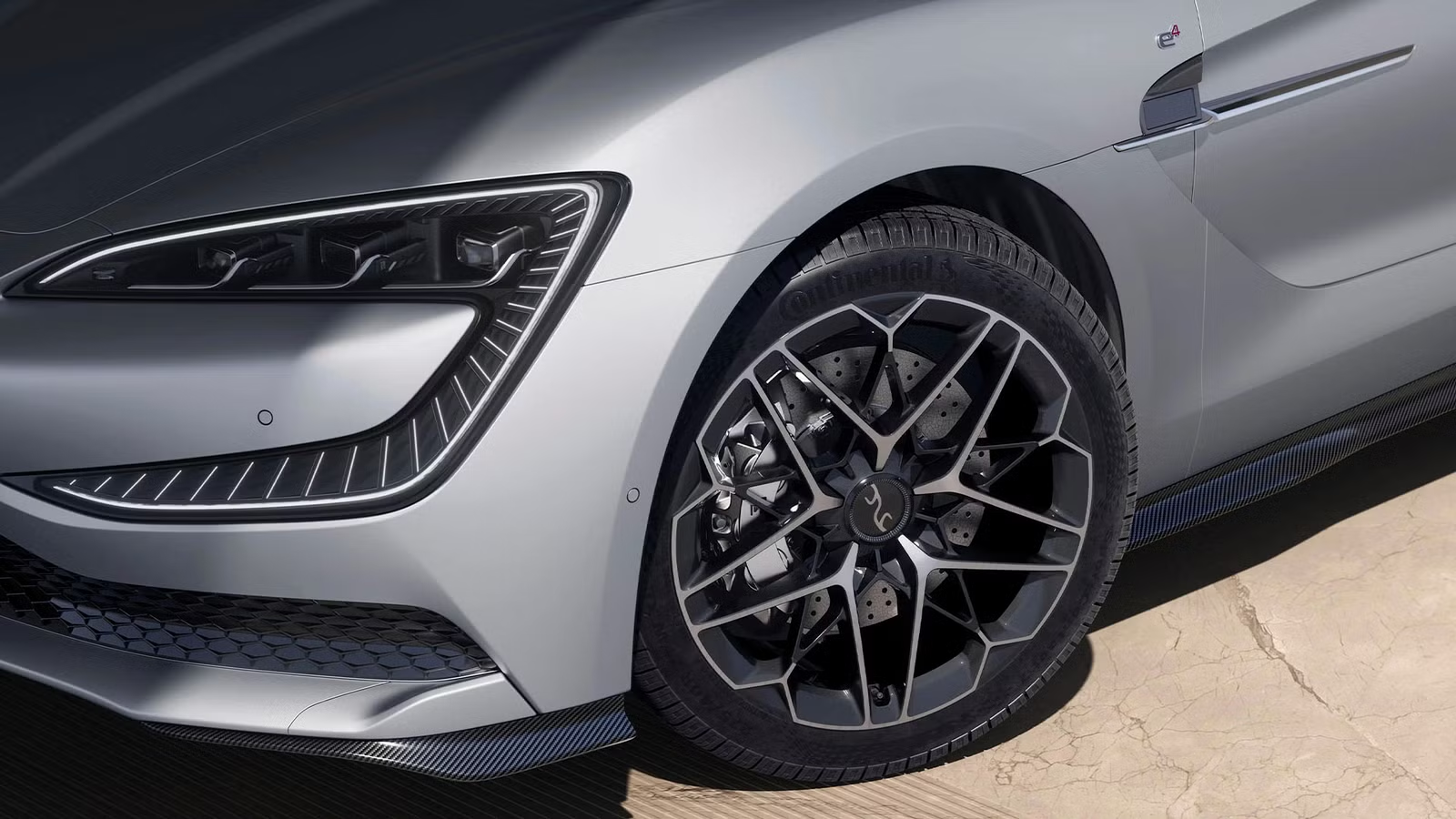
2027 Yangwang U7 sideYangwang
BYD began deliveries of its U7 sedan in China in 2025, featuring independently controlled motors, dramatically longer-range battery technology, and ultra-fast charging. In its launch specification, the U7 exceeded the 1,234 hp of the Lucid Air Sapphire, which up until that point had been America’s most powerful current electric sedan.
Some models of the U7 even appear to have an output of 1,000 kW, or approximately 1,340 hp as well. In its original spec, the U7 could accelerate to 62 mph in a claimed 2.9 seconds, with a top speed of 168 mph. And it had a 135.5 kWh Blade Battery, giving as much as 447 miles of range under China’s CLTC cycle.
In 2026, the U7 moved even further forward and featured second-generation Blade Battery technology. According to company figures, some versions of the U7 have a range of as much as 625 miles under the CLTC cycle. And the U7 is a very impressive full-size Chinese luxury sedan from an engineering point of view as well.
Its e4 architecture independently controls the four electric motors, and the vehicle features as much as 20 degrees of rear-wheel steering with DiSus-Z electromagnetic suspension technology. According to reports, the vehicle can even perform maneuvers like a tank turn or a parallel crab walk.
Perhaps most importantly, this vehicle combines near-hypercar power with chassis technology that the company has designed for series production. But the U7 isn’t the only Chinese EV rewriting the rules – and BYD isn’t even the most radical example of what’s coming.
China Is Attacking Luxury EVs From Several Directions At Once
2026 Nio ET9 from the sideNio
Elsewhere in China, other companies are demonstrating new engineering solutions. For example, Nio now has the ET9 with a full-domain 900 V architecture, which has a maximum system voltage of 925 V. Peak vehicle charge capability is 600 kW and 765 A, with Nio saying that five minutes of connection to a sufficiently powerful charger can add around 158 miles of CLTC range.
The ET9 also has a Skyride chassis with steer-by-wire, rear-wheel steering, and fully active suspension that responds in milliseconds to continuously manage body movement. Nio has even produced a publicity demonstration in which the ET9 effectively shakes accumulated snow from itself, illustrating how much authority the active suspension has over individual body movements.
All this shows that Chinese manufacturers are moving ahead with confidence. They are attacking battery swapping, high-voltage electrical systems, extremely rapid charging, active chassis control, and individual wheel torque management simultaneously.The question isn’t whether China is winning the technology race – it’s whether North American consumers will ever be allowed to buy the result.
Canada Has Opened The Door, But Don’t Book A Test Drive Yet
Yangwang U9 Japan Mobility Show 2025Roger Biermann/CarBuzz/Valnet
When it comes to Chinese EV imports, cracks are beginning to show in some previous North American armor. Canada was once fully against such imports, just like its southern neighbor, and imposed a 100% surtax on those vehicles in October 2024. However, that policy changed dramatically in 2026, with the surtax repealed and a new annual quota appearing in its place. This initially covered 49,000 Chinese EV imports, which would instead face a 6.1% most-favored-nation tariff.
The Canadian government has said that it will increase that quota by 6.5% annually, with the new plan having gone into operation in March and the second allocation period having started in September. The second window covers 24,500 vehicles plus any unused volume carried across from the first half of the quota year.
However, as interesting as this quota may be, it doesn’t mean that Canadians can just rush into official showrooms and order their Chinese EVs. Independent importers and Chinese vehicle specialists may be talking about future availability and advertising certain models, but there’s a long way to go. Various Chinese companies need to establish a Canadian retail operation first, and look at factors like certification, distribution, servicing, warranties, part support, and dealer infrastructure.
And in the interim, Americans can’t simply drive across the Peace Bridge and test a Yangwang U7 or, indeed, an ET9. There’s no established official Canadian dealer network yet to provide that facility, although the doors appear to be opening.
America Is Moving Toward Making The Divide Permanent
2026 BYD Seal rear closeupBYD
In January 2025, the US Department of Commerce finalized connected vehicle rules that restrict transactions involving vehicle connectivity and automated driving hardware or software that has sufficient links to China or Russia. This makes the situation south of the Canadian border very different, as these US rules take effect for model year 2027, with hardware restrictions to follow later.
Meanwhile, Congress wants to go even further, based on the Connected Vehicle Security Act of 2026. This would prohibit the importation, manufacture, sale, resale, or introduction into interstate commerce of covered connected vehicles that originate from designated countries, including China.
Planners propose that this Act becomes law at the beginning of 2027, subject to some detailed provisions and exemptions, but the legislation has not yet advanced sufficiently toward that goal. As of late September, Senators Elissa Slotkin and Bernie Moreno had postponed an effort to secure expedited passage. They would attempt to win over one senator, the lone holdout standing in the way of the unanimous consent needed for a fast-track procedure.
Those in favor of these new laws argue that they are important when it comes to national security, vehicle-generated data, the supply chain, and the protection of American manufacturing. But others argue that restrictions are not realistic and that they are, in effect, insulating the domestic industry from a new source of competition. Either way, it appears that Canadian and American consumers could eventually have very different levels of access to the Chinese auto industry.
The Real Threat Isn’t A Horsepower War
2023 – 2026 Lucid Air Sapphire exterior frontLucid
On current figures, the Yangwang U7 has beaten the top US luxury sedan in the horsepower stakes. The 1,234-hp Lucid Air Sapphire can get to 60 mph in a claimed 1.89 seconds and features a 427-mile EPA range rating, but it stands alone now that the Tesla Model S Plaid has disappeared.
Elsewhere, US buyers can look to vehicles like the 2027 Mercedes-Benz EQS 580 4Matic. This produces 576 hp and 590 lb-ft and comes with updated electrical architecture and chassis technology. It has an 800 V architecture and 430 kW DC charging, and Mercedes has also introduced steer-by-wire technology to the EQS range.
A more interesting angle may revolve around the developing North American split. Companies like Yangwang may be able to establish a solid Canadian operation and sell the U7 to Canadian buyers with proper service, parts supply, software support, and dealer infrastructure. And this means that Canada has effectively created a route through which Chinese EVs can eventually compete, while the US debates legislation that should reinforce the opposite approach.
On the North American continent, the four-door electric sedan industry may develop in very different ways on either side of a west-to-east dividing line. This may produce an entirely parallel EV industry to the north, involving increasingly exotic batteries, charging systems, suspension technology, and drivetrains, while an increasingly contentious political and regulatory battle rages on.
Sources: BYD, Lucid, Mercedes-Benz, Nio, Canadian government, US government.
