

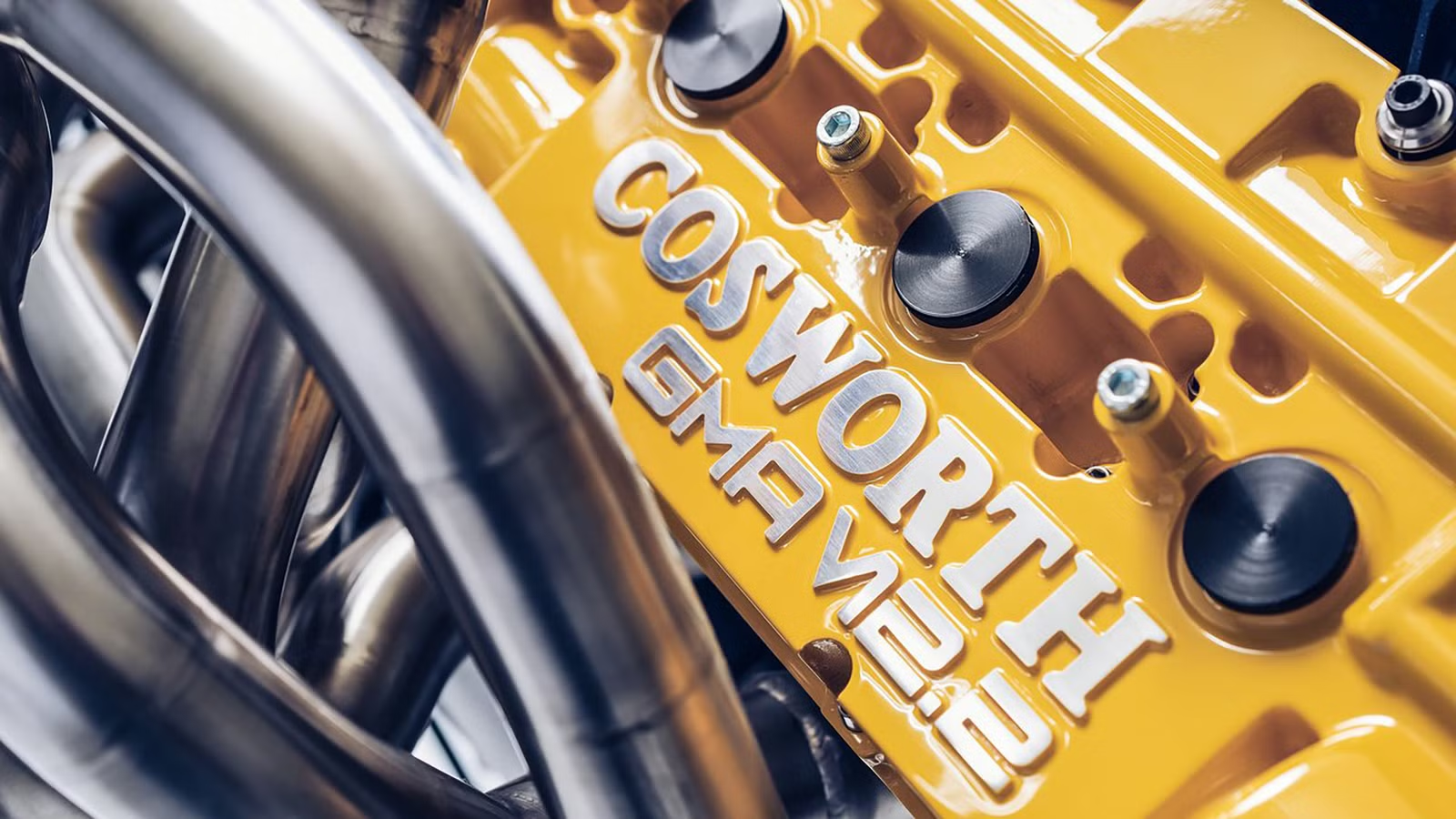
Cosworth is one of the most revered names in motorsport and performance cars. Its technology has been used in some of the most successful racing cars of all time, like with the all-conquering DFV engine in 60s Formula One, and in some of the world’s fastest cars, like the GMA T.50, Aston Martin Valkyrie, and even the V16 engine in the forthcoming Bugatti Tourbillon. When a car company needs a new engine design or upgrade, they know who to call.
At the Goodwood Festival of Speed, the company revealed one of the fastest circuit cars ever, powered by a V10 engine and using aerodynamics courtesy of Adrian Newey, the mastermind behind some of the most successful F1 cars. We caught up with Chris Willoughby, commercial director of the company, to find out what it takes to build bleeding edge internal combustion engines at a time of electrification.
Cosworth Is One of The Greatest Engine Designers Ever
The T.50 is legendary designer Gordon Murray’s modern take on his classic McLaren F1, long considered to be the greatest car on the planet. The T.50’s Cosworth V12 revs to more than 12,000 rpm.Gordon Murray Automotive
Cosworth started out like any other famous British brand: two guys in a shed. In 1958, Mike Costin and Keith Duckworth (where the company name comes from) escaped from Lotus to focus on building the world’s best engines. They started modestly but found themselves with a contract to build Formula One engines for Ford. Together they’d build the Cosworth DFV — the most successful racing engine ever. It was made a part of the chassis structure, increasing stiffness and decreasing weight.
In the 90s, Cosworth won its last championship with Michael Schumacher, and when Ford sold the company in 2004, it started to focus on telemetry and data systems. That helped it stay afloat before Gordon Murray Automotive famously asked the British firm to create a V12 masterpiece for its upcoming supercar. Since then, Cosworth has been creating some of our favorite engines — the Aston Martin Valkyrie’s V12 and even the Bugatti Tourbillon’s V16.
Chris Willoughby joined Cosworth in 1990, right at the end of its Formula One heyday. “We won races with Senna, and the place had a real buzz about it,” he says. “We went through a stage between being a racing company and a hypercar company, where we lost that. But the place has got that buzz back.” Cosworth now has its fingers in aerospace and marine, but its main passion is cars.
Much Of Its Design Comes From Racing
Being a racing company to begin with, it’s no surprise that the way it designs its engines has a lot to do with racing. Motorsport has a rule book that Cosworth is constantly trying to get around, so it applies that same though to its road car divisions. “Someone can turn up and say they want an engine of a specific specification,” Willoughby says. “But I think what we enjoy is pushing the boundaries. When you push one boundary, another moves in the other direction.”
The Mercedes-Benz 190E 2.5-16 Evolution II not only came with a hot version of merc’s Cosworth-developed 16-valve four-cylinder engine, it also had a bespoke aerdynamic package developed in a wind tunnel that gave it an edge over rivals like the BMW M3.Mercedes-Benz
“We really enjoy being part of that visionary journey with our customers. People describe in words what they want the car to be, and the engine is such a dominant part of the car that that’s when we get involved.”
– Chris Willoughby, Commerical Director, Cosworth
In one way, Cosworth becomes part of the design process and can help shape the final car’s characteristics wholly. Take the Gordon Murray T.50. The philosophy for this supercar was low-weight, driver connection and sound. Cosworth certainly delivered with a 12,100-rpm and 661-horspower V12 engine that weighed 392 lbs. It can rev from idle to redline in just 0.3 seconds.
cosworth dfv v8 valve cover with orange ht leadsBring A Trailer
To achieve this, engineers took inspiration from motorsport by using titanium connecting rods, a focus on lowering internal rotational inertia, and gear-driven ancillaries. This all lowers friction in the engine and allows it to be driven at ten-tenths a lot longer, just like a traditional motorsport engine. With GMA’s blessing, the company was given close to free-reign to design its engines, which is how Cosworth prefers working. Experimenting is super important, Willoughby says.
But like a race engine, testing is key to design. “Our customers say it’s good to have us on board because we can take a thought, turn it into metrics, and then feed it back to the customer,” Willoughby explains. “They can then understand what everything means from their vehicle perspective.” The engine is, of course, integral to how the car behaves, so having cross-feedback from the designer, engineer, and manufacturer is key to how final designs are produced.
It Still has To Deal With Emissions Targets
2026 Bugatti Tourbillon Engine bayBugatti
Be it a tiny three-cylinder, or the first production V16 since the 1940s, every engine has to go through emissions testing. Luckily, Cosworth’s status as a very small manufacturer means it can take the necessary steps (and budget) to lower its overall tailpipe emissions. “All our combustion chambers are fully machined,” Willoughby notes. “So every cylinder behaves like every other one, and with our really high cranking speed ignition, we get a really clean combustion.”
“Sometimes, performance drives the engine design in one direction, and emissions drive it in another direction. You have to land on that knife edge.”
– Chris Willoughby, Commerical Director, Cosworth
Of course, Cosworth’s high budget means it can experiment with new ways to skirt emissions targets. This includes electronically heated catalysts which work more effectively when the engine is still cold. “If you fail to meet an emissions test, you can’t sell the car. If you miss the power target by ten horsepower, you can at least still sell the car,” Willoughby says.
Cosworth Understands The Need For Innovation
2026 Bugatti Tourbillon Engine diagramBugatti
Cosworth has gotten to where it is by being very good at building piston engines, but it knows there’s still headroom for emissions, performance, and design. “It’s hard to think of anything sensible beyond the V16 in the Tourbillon,” Willoughby explains. “We’re also involved in aviation, and if you want high efficiency and power density, [pistons are] hard to beat as an engine configuration.” The Tourbillon also uses a hybrid system, something Cosworth has to take into consideration during design.
While now considered a legacy engine maker, the team is not scared to look at new technology or ways of building engines. Its strong specialization means it would take a lot of effort to switch over to building something completely new, like rotary engines, given the extensive skill set it has built around piston engines only. Chris does tell us that the firm has run sustainable fuels for a long time, and is always looking at future technology. “The piston engine still has a part to play in the future,” Willoughby says, happily.
Its Latest Project Is Cosworth At Its Best
We grilled Willoughby about a possible return to top-flight motorsport, but he had his reservations. “We’ve got a business that is diversified across a wide range of customers,” Willoughby explains. “We have got stability through that variety and Formula One would be all-consuming. We don’t want to risk anything.” This apprehensive outlook on a Formula One campaign doesn’t mean it can’t dip in and out. Its latest project, the Red Bull RB17, was built together with Red Bull Advanced Technology, itself an offshoot of theRed Bull Racing F1 team.
“When you’re in the office and you’ve got your head down, it feels like any office. But when you come to places like Goodwood, you see all the vehicles with our engines in.”
– Chris Willoughby, Commerical Director, Cosworth
This V10-powered beast is not constricted by regulations, which is why it can achieve quicker lap times than a Formula One car. There were targets for the development of the RB17’s V10, but apart from that, Cosworth was free to experiment and bring in all their tech to one car. As for power per liter, it’s about 220 horsepower. For reference, the already-impressive GMA T.50 has a figure of 166 horses, so this is unlike any other motor.
“We’ve used air valve springs in this engine, which is tech developed in Formula One,” Willoughby says. “But we know this engine will be used outside the realm of engineers, so it needs to be robust for our customers.” The engineering team spent a year just talking about the design of the engine before anything was put together because of how many things they had to resolve. Screaming at 15,000 rpm, it uses no turbochargers and a small hybrid system to put out 1,200 horsepower.
