

UPDATE: 2026/10/15 05:30 EST BY DAN CLOUGHER
Downsizing Once Again Proves Its Relevancy
We’ve included a section which focuses on the ever-evolving benefits of engine downsizing.
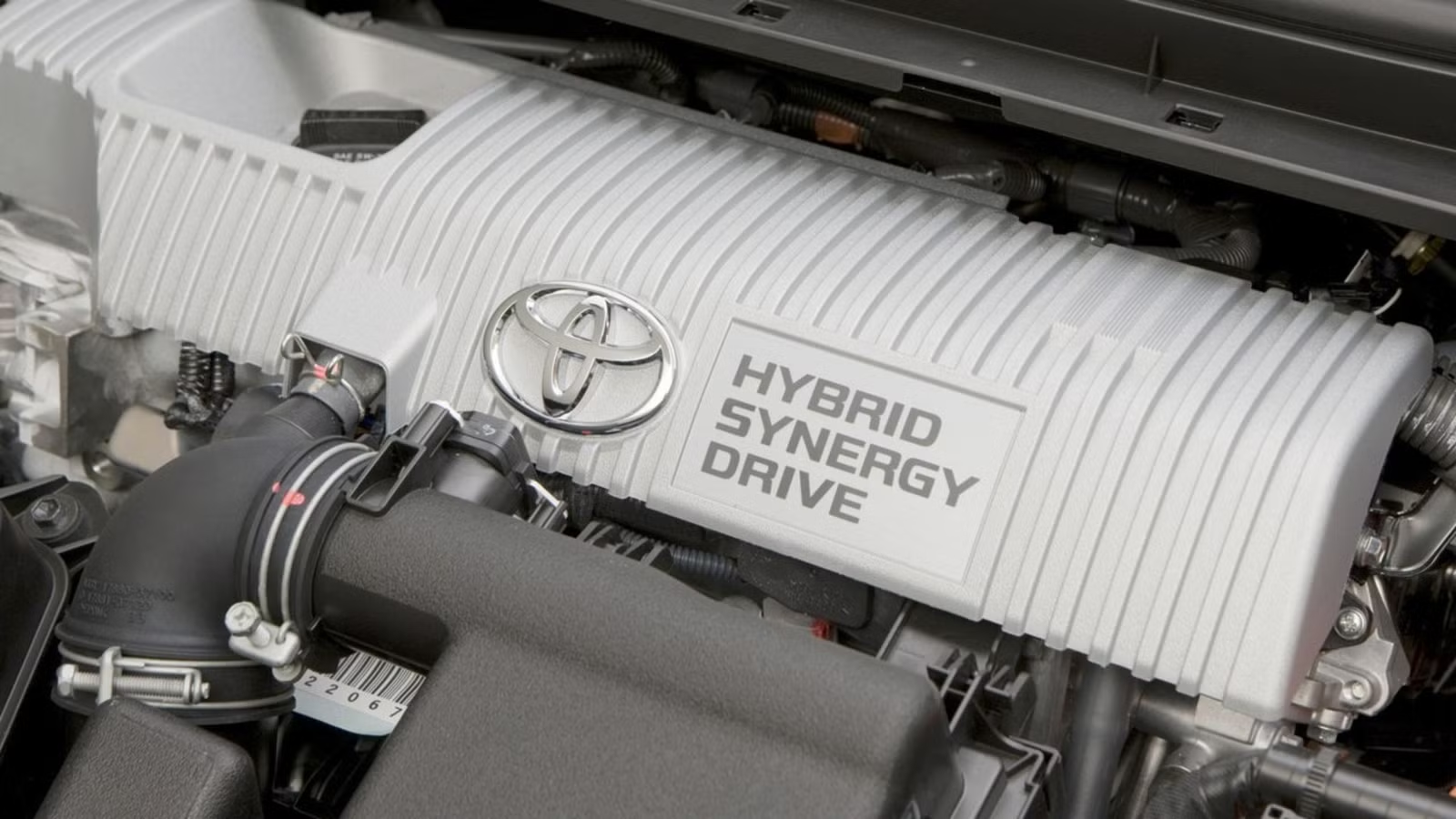
Toyota, Subaru, and Mazda have recently introduced some new, jointly developed engines designed to move further into a hybrid-focused future. Toyota’s contribution to the venture culminates in two inline-four-cylinder mills, measuring 1.5 liters and 2.0 liters. The latter is especially noteworthy, as it’s roughly 10% smaller in both height and volume than the existing 2.4-liter T24A-FTS unit, commonly found in models like the Toyota Tacoma and the Lexus RX 350.
The crux of the new project – as far as Toyota’s involvement is concerned – is to design these two engines around existing hybrid systems and platforms, rather than doing the opposite: creating an engine and then figuring out the hybrid technology afterward. Interestingly, that new 2.0-liter four-pot is reportedly capable of making up to 600 horsepower while also being more efficient than some of its current, less-powerful engines.
Toyota Made Its New Engines Smaller To Change The Cars Around Them
2027 Toyota Corolla 60th Anniversary Special EditionToyota
Before that 600-horsepower ceiling makes any sense, you need to understand what Toyota was actually trying to solve with these engines – and it starts with size. While the new 2.0-liter engine is roughly 10% smaller than the 2.4-liter mill stated above, the 1.5-liter engine developed alongside it is reportedly 15–20% smaller in both height and volume than the existing 2.5-liter A25A-FXS inline-four.
Having smaller, shorter engines pays dividends when it comes to actually designing cars around them, as Toyota’s two new ones allow for lower hood lines, better airflow, and a lot more packaging freedom down the road.
All of those plus sides culminate in something that hybrid models chase after: better aerodynamics. A lower, lighter car will be able to cut through the air with more ease than a taller, heavier one. This means fuel economy gains will likely be seen immediately when compared to the two older engines. The packaging flexibility is key, too, as that can open the door for other models down the road that wouldn’t require an all-new engine to be designed for them.
Toyota itself has done the math. According to the automaker, the new engines could potentially offer up to 12% better fuel economy in sedan-class applications. The report cited improvements to engine efficiency as well as aerodynamic properties as reasons for the incremental increase. While this is a projection, the real results will likely show some form of improvement regardless.
It seems that displacement reduction isn’t the main point in this endeavor. If Toyota found a way through its joint venture to produce a more efficient, lighter, and more compact engine that remained the same displacement or increased slightly, the brand would probably follow that path. However, the 1.5 and 2.0-liter engines appear to offer many of the same benefits as the two existing engines while also shedding a little weight.
Downsizing Once Again Proves Its Relevancy
camry hybrid mainToyota
Downsizing was very much talk of the town throughout all segments in the 2010s, with supercars swapping naturally aspirated V10s and V12s for turbocharged six- and eight-cylinder powerplants, while trucks began boasting boosted four-pots, and commuters looked to dinky inline-threes for motivation. These smaller and turbocharged engines managed to match their naturally aspirated predecessors in terms of outright output, but proved more efficient, enabling automakers to easily meet stringent new emission regulations.This new approach of physically smaller engines from the Japanese brands demonstrates why the downsizing approach is still absolutely relevant. While the efficiency benefits of downsizing are hard to ignore, shrinking the physical dimensions now allows for more options when it comes to hybrid integration. Motors, cooling systems, batteries, and other such hardware all take up space, and clever packaging allows automakers to keep overall dimensions in check, meaning weights can be kept under control, which in turn brings further handling and efficiency benefits.
The 1.5L Throws A Wrench In The Usual Engine Downsizing Formula
2026 Toyota Corolla Hatchback SE front 3/4Toyota
That packaging freedom comes from a 1.5-liter design decision that breaks from conventional engine-downsizing logic in a meaningful way. Instead of simply removing a cylinder from the existing 2.5-liter inline-four – no doubt saving some money in the process – Toyota decided it would be best to shrink a four-cylinder down to 1.5 liters. In doing so, the brand is trying to optimize cylinder count, as more pistons pumping can translate into a smoother and more powerful mill. However, the reduction in size by about a liter means it can do roughly the same with less fuel required.
Inject hybridization into the mix, and things change a bit. Electric power has a notable way of delivering a large surge of instant torque right at the outset. Scaled down to a small hybrid system, that modest amount of immediate torque can help give smaller engines a power boost without hurting the engine’s overall efficiency. The engine it’s attached to then only needs to worry about providing sustained power and its own level of operational efficiency.
2026 Toyota Corolla Cross XLE AWD front 3/4Toyota
The new engine family is also designed to keep a few different fuel types in mind. Alongside the obvious gasoline variety, it’s also designed to use liquid hydrogen, synthetic fuels, and even biofuels. At present, Toyota is working in tandem with a company called MissionH24 to develop a hydrogen-powered GT3 racecar using a 3.5-liter V6, so seeing a potential hydrogen application in the new jointly developed engine may give us a hint.
That hint is what Toyota may see happening in the future. The push for an EV-only outlook has waned considerably among most automakers over the last few years. Things haven’t returned to a “gasoline is the only way forward” mindset by any stretch, but opening itself up to the possibility of using a variety of different fuels means all of its bases are covered, depending on where the market decides to go over the next several years. Toyota simply wants to be ready.
That 2.0-Liter Engine May Have Some Serious Performance Potential
2027 Toyota TRD Pro lineup in Honeycomb and Hot HoneyToyota
In a road car, 600 horsepower from a 2.0-liter engine almost sounds ludicrous. That claim is most likely a projected performance ceiling and not the result of some fevered bench test in which engineers were laughing maniacally. In order to reach that sort of power output, the engine is going to need turbocharging, as well as high-performance tuning throughout.
However, Toyota has reported base outputs around 300–350 hp, so the 2.0-liter will likely be no slouch even at the low end of its power range. A 300-hp performance window leaves a lot of potential applications on the table, too, as the engine could be used in SUVs, trucks, and even finely tuned performance cars without Toyota having to engineer completely new mills.
Speaking of performance cars, the 2.0-liter’s smaller stature may open the door for some new, high-performance models down the road. If Toyota has more freedom in where to place it, it may very well become the brand’s next-generation performance engine for the road. Additionally, some have taken to calling the 2.0-liter engine a “2JZ for the hybrid era” based on its reported performance potential. That claim might be hard for some purists to swallow, though.
As of this writing, Toyota has not concretely stated what models either the 1.5-liter or 2.0-liter engine will be found in. We can speculate – considering the brand has used other existing engines as size-reduction benchmarks – that whichever models those current comparison engines are found in may very well receive the new ones at some point in the future. That means nameplates like the Camry, Corolla, Tacoma, and Highlander may be among those selected.
Toyota, Subaru, and Mazda Are All Betting That ICE Can Evolve
2017 Mazda Mazda 3 driving front 3/4Mazda
One of the core reasons for the three-way venture is the brands involved aren’t convinced that ICE should be written off, even over the next few years. Some automakers have walked back their EV-only commitments, while others are still pressing ahead, like Jaguar. For those who aren’t convinced of an EV-dominated future, the only other place to go at this point is somewhere down the ICE or hybrid path, although the fuel type doesn’t necessarily have to be gasoline.
Toyota, Subaru, and Mazda are also keeping international markets in mind, as conditions ebb and flow differently around the world compared to the US. Some places have very little EV infrastructure, so owning one in such markets is virtually unviable. Residents still need a way to get around that doesn’t rely on fast chargers and similar infrastructure. Some markets simply don’t want EVs either, despite having the infrastructure to support them – the US being one example.
As far as Volkswagen is concerned, the German automotive conglomerate has decided to continue down the path of electrification, cutting underperforming models like the ID.4, while easing off ICE engine development. Backfilling the loss of some of VW’s EV models is a combination of a majority EV push with some hybrid models slotted in, all of which will make use of VW’s shared platform strategy.
Within the plan, three platforms exist: the MQB (Modular Transverse Toolkit) for transverse, front-drive combustion models, the MEB (Modular Electric Drive Matrix) for electric vehicles, and the planned SSP (Scalable Systems Platform). The latter is slated to replace the MQB, MEB, and other platforms at some point in the future.
Both Subaru and Mazda have made meaningful contributions to the joint venture. As for Subaru’s part, it’s currently working to evolve its Boxer engine through electrification integration. Electric drive units and motors, alongside traction batteries – rechargeable units that store electricity for motor use – are being integrated into the mix.
Mazda is working to turn its fabled rotary engine into a viable range extender for electric vehicles. We’ve already seen this in the non-US-market Mazda MX-30 R-EV. Being able to use carbon-neutral fuels is a goal of Mazda’s, as well.
Volkswagen MQB platformVolkswagen-Newsroom.com
While VW risks putting all of its eggs into one electrified basket, the three Japanese automakers are trying to broaden the scope. As for Toyota’s part, it doesn’t seem to be keeping the ICE engine alive for niche, low-interest models, nor is it focusing solely on performance-oriented engines that most buyers wouldn’t consider. The 1.5 and 2.0-liter engines born out of the joint venture seem poised to try and capture a wide swath of the market by offering a range of compatible fuel types and a huge range of power potential. Adapt and survive: that’s the new ICE motto, and Toyota, Subaru, and Mazda are well aware of it.
Toyota’s Cautious Approach Was Criticized In The Past
2016-2017 Toyota Prius V WagonToyota
Only a few years ago, it seemed the entire auto industry had decided that electric was the future, and ICE was to be left in the past. Storied sports-car-makers like Porsche, Lotus, and Jaguar all geared up for an electrified future, while mainstream brands like Audi, BMW, and Volkswagen too bet on such a future.
Toyota, the largest automaker in the world, was heavily criticized by industry experts, environmental groups, investors and rival automakers, for pursuing hybrid interests and alternative fuels, instead of jumping into electrification with both feet. Well, Toyota had the last laugh, as the majority of those automakers which flung themselves into an electric future are now back-pedalling previous promises to the propulsion type, and to the tune of many millions of dollars.
So perhaps other automakers should perk up and pay attention to exactly what Toyota is doing here, alongside the other cautious-looking Japanese brands. It’s been proven really rather quickly how damaging an automaker throwing all its eggs into one basket can be, so developing a powertrain which can be as adaptable as possible to suit future preferences seems a remarkably wise and well-measured approach.
Sources: Toyota, Mazda, Subaru, ToyotaTimes.jp, EV Central, Car and Driver.
