

You’ll often find Ford at the forefront of technological advancement, and it’s a sight that has been common since the American manufacturer first turned up in the early 20th century. The marque established the moving production line in 1913, and developed legendary model lines that revitalized the automotive sectors they took on, such as the F-Series range of trucks and the Mustang pony car.
In 2026, Ford decided to build upon its storied roots by taking on the highly competitive world of Formula 1. And now, it has claimed supremacy once more against rivals such as Ferrari and Mercedes-AMG.
Ford Has A Rich History In Formula 1
Cosworth DFV V8Akela NDE / Wikimedia Commons
It shouldn’t come as a surprise to learn that Ford has an extensive record in the pinnacle of motorsport, given its age and stature as one of the most recognizable and influential brands in the world. It entered as a full-time engine supplier in 1967 in a partnership with British engineering company Cosworth, where the two parties worked together to develop the DFV V8. From then until the early 1980s, the DFV managed to rack up a total of 155 Grand Prix wins, 12 drivers’ titles, and 10 constructors’ championships as it became the favored engine choice for many teams.
It secured further success during the 1990s as the factory engine supplier for the likes of Benetton, which claimed championship success with Michael Schumacher, as well as the Stewart Grand Prix effort. Having run its own F1 team between 2000 and 2004, which ran under Jaguar branding, Ford dipped out of the series in its entirety following the latter year. Its last win came in 2003, when one of the Blue Oval’s V10 engines claimed victory in the bizarre 2003 Brazilian Grand Prix in the back of a Jordan Racing-run car.
Having primarily focused on stock car racing, sports car competition, and rallying in the years since, Ford elected to make a popular return to a battlefield it once dominated.
Ford Struck Up An Eye-Opening Partnership
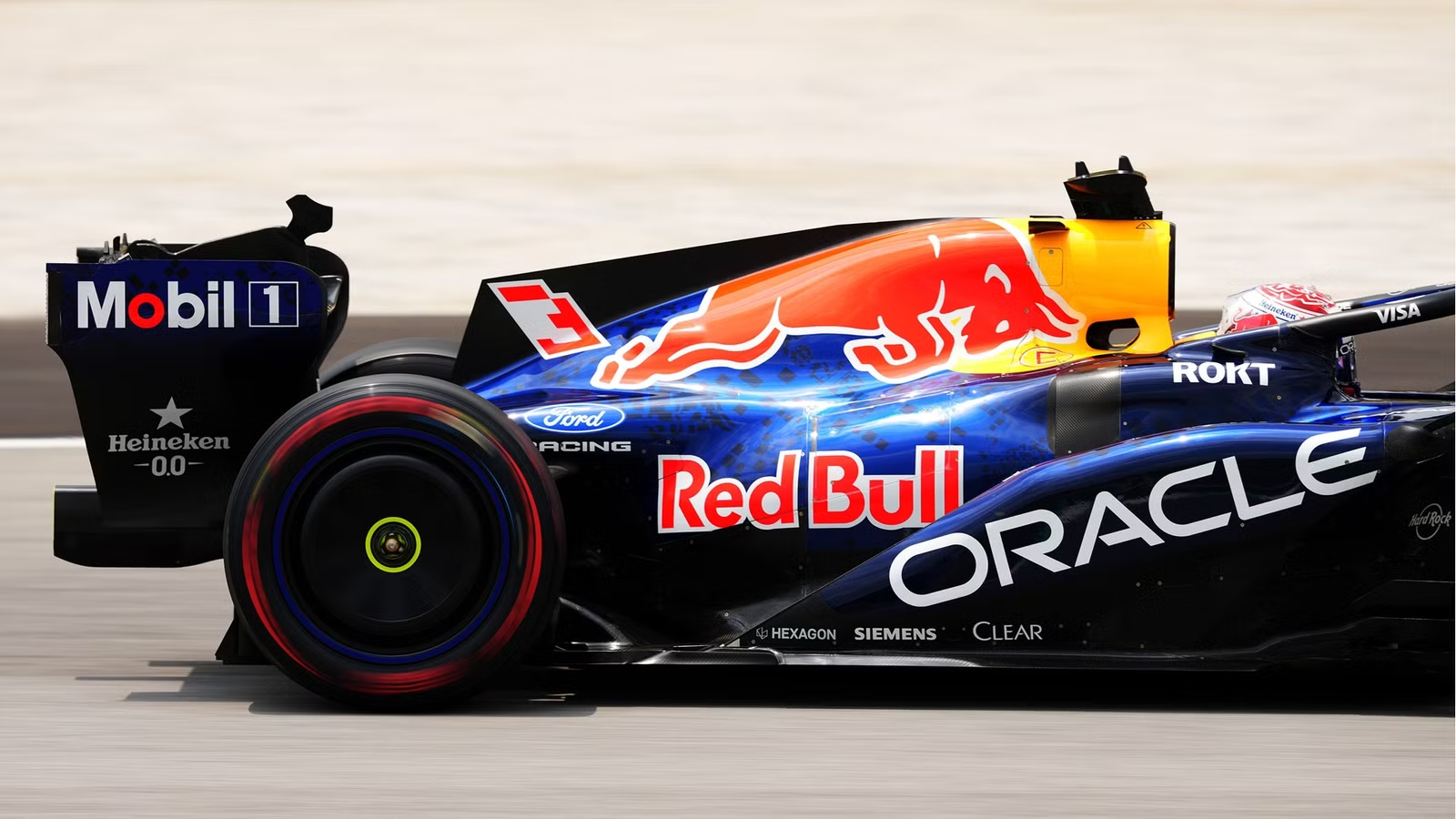
Ford Red Bull Racing F1Red Bull Racing
For the 2026 season, F1 introduced a new engine formula. While still using turbocharged 1.6-liter V6 engines like the previous ruleset, the new regulations put a greater emphasis on the hybrid electric element of the unit. Whereas the preceding ruleset mandated an 80/20 split favoring power from the ICE side, the new ones demanded a 50/50 split between the ICE and the hybrid system. With hybrids being big business in the greater automotive world, Ford spied a great opportunity to further its learning of the complex technology to help improve its road offerings. Plus, since F1 switched to using 100% sustainable fuels, Ford could also make strides developing engines that use such gas, since there’s a decent chance it could become a common sight in the production car world in years to come.
To get its foot in the door, Ford came to an arrangement with Red Bull Powertrains to help it supply engines to the Red Bull Racing and Racing Bulls squads. RB Powertrains is the engine design and manufacturing arm of the RBR operation, and was purchased from Honda when the Japanese manufacturer initially decided to end its F1 engine program back in 2021. The deal was announced back in 2023, giving the two companies plenty of time to develop their new F1 power unit in time for the 2026 season.
Ford Brought Different Areas Of Expertise To The Table
2025 Ford F-150. F-Series. AssemblyFord
Rather than simply throwing a load of money Red Bull’s way simply to have the engine bear its name, Ford influences the program in several different ways. The brand has a number of engineers working directly with RB Powertrains at its facility in the United Kingdom, and it brings its considerable resources in component production and simulation to the table. One such example is Direct Metal Laser Sintering, which allows Ford to produce parts made from materials like steel, titanium and aluminum much quicker than usual, which helps when trying out a load of different designs during development.
Speaking to Top Gear magazine, Ford CEO Jim Farley also revealed that the marque was providing 12 bespoke parts for the power unit design, including components found in the turbocharger and Energy Recovery System. Beyond that, Ford’s advanced computer modeling systems have been utilized to help drastically speed up development time, which allows the operation to zero in on the best design choices much more quickly than usual.
Ford’s experience in durability and performance testing behind closed doors has also come in handy, as the F1 power unit could be stressed in a very similar fashion to reality before it ever hits the track. This allowed RB Powertrains and Ford to work out any kinks with the design, and make changes before ever suffering failures during a real Grand Prix weekend.
This Work Has Paid Off Very Quickly
Red Bull Ford front end through cornerRed Bull Content Pool
As it turned out, the intense preparation from both Ford and RBP would prove to be a success much faster than anyone had anticipated. Even from pre-season testing, the Red Bull Ford DM01 power unit immediately showed itself as being more competitive than expected, especially considering this was the first time RBP had ever designed and run its very own engine. Its previous unit was purchased directly from Honda, leaving RBP simply to upgrade it where needed.
The pure ICE element of the unit even stood out as the best on the entire grid, leading to the operation being denied any chance to upgrade it under F1’s Additional Development or Upgrade Opportunity program. Also known as ADUO, it was instigated to help any constructor that fell behind early on to make upgrades so that they could catch the front-running manufacturers. It only covers the pure ICE though, rather than also incorporating the just-as-important hybrid system. Still, it was found that the RBP-Ford V6 produced more power than the units from the likes of Audi, Ferrari, and Mercedes, despite being new to the game.
While this meant it couldn’t make any upgrades, it was still a nice complement. Things got better in October 2026 though, as Red Bull Racing secured its first victory of the 2026 season in the Malaysian Grand Prix, courtesy of four-time F1 world champion Max Verstappen. This marked Ford’s first F1 win in well over 20 years, and the first ever for RBP’s own engine design.
Securing a win so early in the engine’s life was a very impressive feat, and illustrated that the expertise brought along by both RBP and Ford was a very potent combination. Ford certainly hadn’t lost its touch after over two decades away from the F1 paddock, and based on its previous record, don’t count out the potent partnership claiming further success before too long.
Ford Relies On More Than Just F1
Side view of a 2024 Ford Mustang GT3 race carFord
While F1 is a crucial element in Ford’s plan to help develop its understanding of hybrid technology – not to mention renewable fuels and ways to make existing ICEs as fuel-efficient as possible – Ford uses its racing DNA to find gains in other corners of the motorsport universe. It currently competes in sports car racing with a range of Mustang-based race cars, which are primarily built to GT3 and GT4 regulations.
Thanks to information gathered through testing and racing in international series like the IMSA Sports Car Championship and World Endurance Championship, it has been able to develop hardened production versions of the Mustang, such as the Mustang GTD and Dark Horse SC. Beyond that, its rallying exploits include the World Rally Championship and Dakar Rally, which help it develop components that make its road cars more durable and versatile in a range of conditions. The latter program, which uses a prototype badged as a Ranger, also assists the brand in developing technology that allows its Raptor range to perform so effectively off-road.
Ford has always used racing to help influence its road range, and it usually ends up winning in some way or another. Achieving the feat so quickly in F1 illustrates that, like Ferrari and Mercedes-AMG, it will stop at nothing to come out on top. Now, a road-going supercar featuring the F1 engine could be just what the doctor ordered…
Sources: Ford, Top Gear.
