

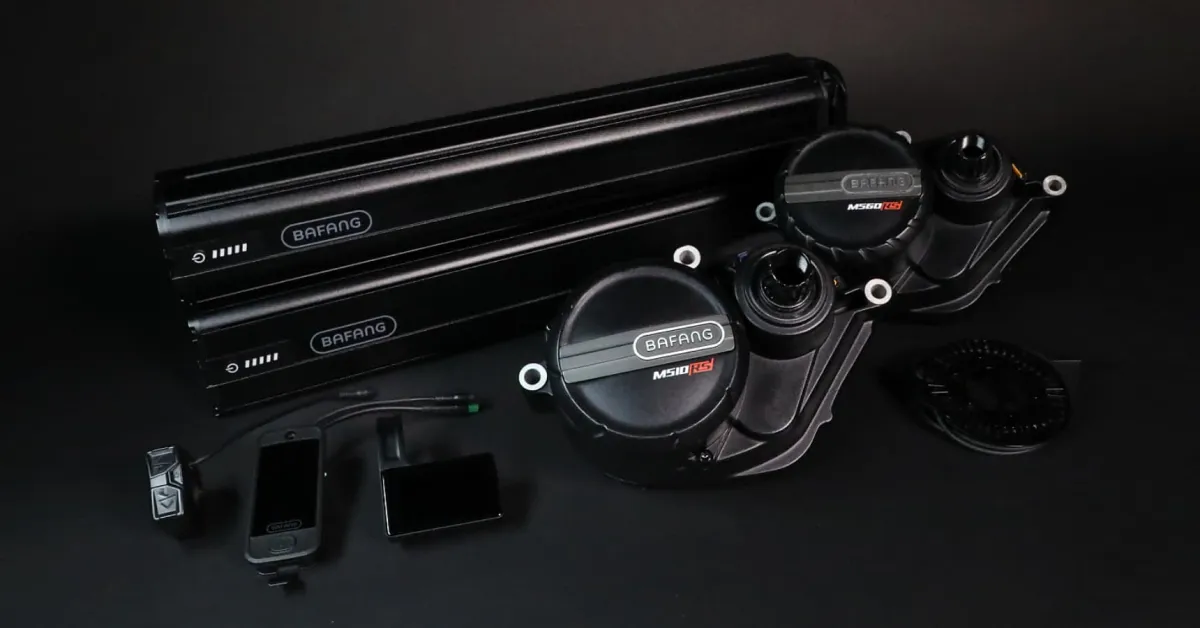
Bafang has never exactly been known for building timid e-bike motors, but its latest pair of high-performance e-MTB drives takes things to a whole new level. We’re talking up to 1,700 watts of peak power, 150 Nm of torque, and 800% pedal assistance.
At that point, “pedal assist” is starting to do some pretty heavy lifting as a phrase.
The new Bafang M510RS and M560RS are production versions of motors first shown as concepts at Eurobike last year. They’re set to make their official production debut at the Italian Bike Festival in Misano, Italy, September 4-6, ahead of series production later this year.
The slightly more reasonable of the two – and I’m using “reasonable” rather generously here – is the M510RS. It offers 110 Nm of peak torque during normal operation, while Bafang’s temporary Boost-to-Limit function can push that as high as 120-130 Nm depending on the system voltage. Peak power reaches 1,100W on a 36V system or 1,300W at 48V.
Then there’s the M560RS, which is where things start getting particularly bonkers.
That motor produces 120 Nm normally, increasing to as much as 150 Nm in Boost-to-Limit mode. A 36V setup can deliver 1,400W of peak power, while the 48V version cranks that figure all the way up to 1,700W. All of that, yet the motor weighs just 3.3 kg (7.3 lb). Sure, chunky for an e-bike – but not that bad in absolute terms.
To put that into perspective, there are plenty of regular commuter e-bikes running around with 350W or 500W motors. Bafang is now stuffing several times that peak power into a compact mid-drive designed to help mountain bikers blast up nasty technical climbs.
Of course, those huge figures aren’t available continuously. Those are the peak figures. Boost-to-Limit is essentially a short-duration overdrive mode meant for particularly difficult obstacles and steep sections. But when activated, Bafang says it can provide an almost comical 800% assistance, meaning the motor can contribute eight times the rider’s own input. The less extreme Sport+ mode still offers up to 500% adaptive assistance.
And Bafang isn’t simply throwing a gigantic motor at the problem.
Both RS motors use a six-axis IMU along with torque, cadence, and wheel-speed sensing to determine what the bike and rider are doing in real time. Bafang says the RS systems react 50% faster than the standard M510 and M560 motors, while also cutting motor power 33% more sensitively. That latter figure could be especially important when you’re trying to precisely control a 150 Nm mid-drive on loose terrain. There’s also Hill Hold to keep the bike from rolling backward on steep starts and an updated Walk Assist function.
Bafang says it spent more than 4,000 hours fine-tuning the systems under racing conditions, including development through the WES UCI E-MTB World Cup series.
There’s another practical advantage hiding underneath all of those headline-grabbing power figures: the M510RS and M560RS retain the same mounting interfaces as the existing M510 and M560. That means bike manufacturers already designing around those motors won’t necessarily need to develop entirely new frames just to adopt the RS versions.
The M560RS will also be offered in versions intended for both European 25 km/h (15.5 mph) and US 45 km/h (28 mph) requirements. Of course, the peak power level blows past the limits of traditional electric bicycles for street use in most countries, but these motors are specifically for eMTBs, which means they’re designed for climbing mountains, not bike lanes.
Electrek’s Take
Inevitably, these numbers are going to draw comparisons to the e-bike motor system spun out of DJI, the Avinox drive systems, which have helped push high-performance e-MTB motors into increasingly absurd territory. And yes, on paper Bafang’s 1,700W figure manages to push the power envelope even farther.
But I think the more interesting story is simply how far e-bike mid-drives themselves have come. We’re now looking at relatively compact motors capable of producing 150 Nm and four-digit peak wattage while simultaneously using IMUs and multiple sensors to meter out that power pedal stroke by pedal stroke.
Whether anyone actually needs 1,700 watts in an electric mountain bike is another question.
But if you’ve ever looked at a ridiculously steep, loose climb and thought, “I wonder if my e-bike could get up that,” Bafang apparently wants the answer to be an emphatic yes.
FTC: We use income earning auto affiliate links. More.
