

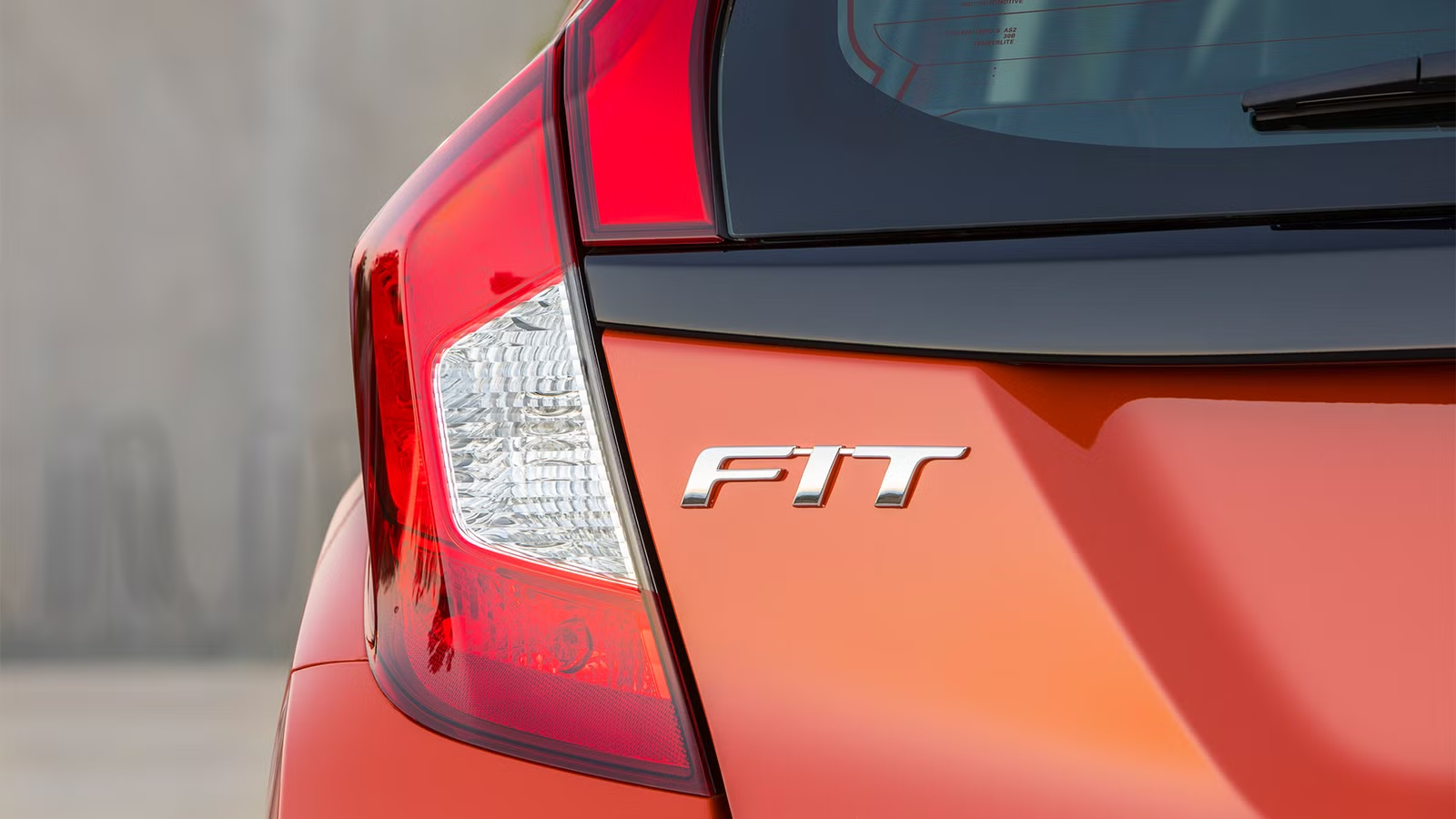
You might be forgiven for thinking that North America is falling out of love with small cars. There is some truth in that statement: consumer demand for small, city-oriented cars such as subcompact hatchbacks is going down. However, the overall picture is not quite as straightforward as it may look.
Take the Honda Fit, for example. This model was discontinued six years ago, but today there are some used examples floating around with higher prices than the model was originally sold for. Some people in the US and Canada are still looking for small cars, and they are happy to part with good amounts of money to get their hands on the sadly now discontinued Honda.
The Honda Fit: Small But Mighty
2020 Honda Fit. Motion, front three-quartersHonda
The Honda Fit (known elsewhere in the world as the Honda Jazz) is a subcompact hatchback, a category increasingly in danger of extinction these days. It was on sale on the North American market between 2007 and 2020, but when the fourth generation was introduced for 2021, Honda decided to focus on other regions due to decreasing demand and a shift towards crossovers.
The most recent version of the Fit available in North America is powered by a 1.5-liter inline-four engine, which produces between 128 and 130 hp depending on configuration. Transmission options include a six-speed manual and a CVT. The 2020 model had a starting price of $16,190.
2020 Honda Fit Sport Rear 3/4Honda
Highly adapted to urban environments and offering a good amount of space and practicality for its size, this model still makes for a great purchase option several years after its discontinuation. It has also partially bucked the trend of depreciation; some used examples available in the US and Canada are now on sale for higher amounts than their original prices.
Here is what our Senior Editor, Gerhard Horn, has to say about his experience of owning a Fit, and its brilliant performance on the practicality front:
“I have a 20-year-old Honda Fit that I refuse to get rid of, for one very good reason. It’s easily the most practical car I own, and its mere presence means I don’t have to go out and buy a silly SUV or crossover. I call it my pickup truck, because whenever something needs to be done that would usually require a pickup truck, I simply use the Fit.”
-Gerhard Horn, Senior Editor
Why Is The Honda Fit Still So Popular Six Years After Leaving The Market?
2020 Honda Fit Sport Driving Front 3/4Honda
The Fit’s combination of practicality, affordability, and compact dimensions have resulted in a curious phenomenon where, thanks to the model’s enduring popularity even after its discontinuation, examples can be found for sale at higher prices than the Fit originally sold for. Take the most recent model (the 2020 Fit), for example.
The price range for the 2020 Fit at launch was between $16,190 and $20,620, roughly the equivalent of $21,000 to $25,000 in today’s money. However, there are currently several listings available online for over $25,000, and even up to around the $30,000 mark.
Here are a few examples of currently available Fits trading for more than their original MSRP in the US:
- A 2020 Honda Fit LX with 7,823 miles, is currently available in Texas for $23,222
- A 2020 Honda Fit Sport with 36,415 miles, is currently available in Washington for $22,998
- A 2020 Honda Fit EX-L with 33,184 miles, is currently available in Massachusetts for $26,990
One of the biggest reasons why the Honda Fit still attracts buyers is that it belongs to a rapidly shrinking category. Small, city-friendly hatchbacks are increasingly rare; as the Fit was one of the best of the bunch in its day, it has retained its popularity among small car-seeking buyers turning to the used market.
Small cars were never really that popular in North America in the first place; post-war prosperity, combined with the large size of roads and parking spaces, has resulted in the US and Canada developing a culture of large cars, which has persisted to this day. A few other factors have resulted in small cars becoming vanishingly rare in recent years. The (not always correct) perception of bigger cars as safer has played a part; automakers have engaged in an arms race when it comes to vehicle size, creating larger and larger models in an effort to make customers feel protected.
2020 Honda Fit Sport SideHonda
Anxiety around passenger and cargo space is another part of the equation; many consumers worry about a small car not having enough space for their families and their luggage, although crossovers frequently do not offer that much more space than a hatchback.
Diminishing demand for small cars in North America has created a feedback loop of sorts: low consumer demand means automakers discontinue smaller models, which in turn creates higher demand for the ones that are left. Although nowhere near as popular as they are in regions like Europe or Asia, small hatchbacks like the Fit do still have a cohort of potential customers in the US, especially among city dwellers.
“If you ever have any doubts about the quality of Hondas, take their budget hatch for a spin and you’ll get it. I totally understand why they’re still worth as much these days. It’s a small hatch that makes SUVs and crossovers look irrelevant, as it’s frugal, comfortable, well-equipped, and has most of them beat when it comes to overall interior space.”
The Honda Fit’s Interior: Surprising Practicality
2020 Honda Fit Sport Rear SeatsHonda
Depending on your personal pop-culture leanings, the Honda Fit is kind of like the Mary Poppins’ bag of the automotive world: tiny on the outside but spacious on the inside, offering more passenger comfort and room for cargo than its dimensions might give away. The Fit offers a high-quality interior for its price point, with ample legroom even for rear seat passengers.
Speaking of the rear seats, there’s another important feature that distinguishes the Fit from its competitors. Honda calls it the Magic Seat. It boasts several modes of operation that allow users to transport a variety of differently shaped items. Utility Mode creates an uninterrupted surface that runs from the back of the front seats to the rear bumper. Tall Mode flips the rear seat cushions upwards, allowing tall items to be loaded behind the front row.
“Honda’s magic seat system is a marvel of smart interior design, and this is true of all generations. You simply wouldn’t believe how much you can fit into this small car unless you’ve lived with one. Over the years, I’ve transported a fridge, a bench, the entire contents of a small flat, and three full-size bicycles. And even after 20 years, the interior is still as rattle-free as the day it was made.”
2020 Honda Fit Sport InteriorHonda
Long Mode reclines the front seats and folds the rear seats back, allowing for long items to be transported. There is also a “Refresh Mode” aimed at passenger comfort, only to be used when parked; this mode involves removing the front seat head restraints, moving the front seats forward and lowering the back of the seats all the way to create a cozy resting spot. The configurability of the Fit is a major selling point that makes it stand out from the crowd.
In terms of infotainment and tech, the Fit comes equipped with a 7.0-inch touchscreen on all trims bar the base-level LX. This screen comes with Apple CarPlay and Android Auto connectivity, as well as a six-speaker sound system (the LX only has four). Bluetooth connectivity is standard, as is at least one USB port on all models (though there is no 3.5mm auxiliary audio socket).
The Honda Fit’s Biggest Rival: The Toyota Yaris
Blue 2020 Toyota Yaris hatch rearToyota
At the time the Honda Fit was being discontinued, another affordable hatchback was on its way out of the American market as well: the Toyota Yaris. While the original Yaris hatchback had been taken off the US market in 2019, for the 2020 model year, Toyota decided to adopt an alternative strategy. The company struck a deal with Mazda, rebadging the Mazda2 and marketing it as the Toyota Yaris hatchback.
This setup only lasted for one model year, after which the Yaris hatchback disappeared from the US market completely. The 2020 Yaris hatchback offered two trim levels, which were offered at a similar price point as the Fit (they came with a starting price of $17,750 and $18,750 respectively).
Blue 2020 Toyota Yaris hatch nose viewToyota
This Yaris, however, did not measure up to the Honda Fit on several fronts. It was less powerful, producing just 106 hp against the Fit’s 130 hp. It was also slightly less efficient than the Fit in terms of fuel economy, and did not perform as well in terms of interior space, an area where the Fit excelled. However, the Yaris did have a few advantages, such as a six-speed automatic transmission in place of the Honda’s subpar CVT.
Sources: Honda, Toyota
