

Lexus has overshadowed a decade of genuinely remarkable Japanese luxury cars – some of which were arguably even better than Lexus itself. For luxury-lovers today, however, the Lexus name is probably the one that comes to mind when “quality interior” and “good ownership experience” are spoken about.
Today we delve into the wonderfully varied Japanese car world for other models from the upper end of the market, or, more affordable cars that still offer a taste of the luxury experience.
Mitsubishi Proudia
Mitsubishi’s V8 Flagship That Was Built Alongside A Hyundai
We start our list with the Mitsubishi Proudia, a luxury sedan introduced in 1999 as the replacement for the brand’s previous flagship model, the Debonair. The Proudia was the result of a collaboration between Mitsubishi and Hyundai; it was produced alongside a Hyundai-badged twin, the first-generation Equus. A long-wheelbase version of the model was marketed as the Mitsubishi Dignity.
The Proudia was powered by two V8 engines (3.5 and 4.5 liters), producing 237 and 276 horsepower, respectively. It only remained on the market until 2001, then after a long hiatus it came back for a second generation in 2012. This time, however, it was a rebadged Nissan Fuga rather than a Hyundai-derived model. This version, sold until 2016, featured a 2.5-liter and 3.7-liter V6 which produced 221 and 329 hp.
Suzuki Kizashi
The Ambitious Sedan That Ended Suzuki’s American Chapter
The Suzuki Kizashi was a mid-size car built with the American market in mind. Although it did not quite succeed in its objective – only lasting four model years in the US and not much longer elsewhere in the world – it remains a curious chapter of Suzuki’s history. The model was powered by a 2.4-liter inline-four engine, which produced 185 hp.
The Kizashi’s interior was fairly luxurious for its era and segment, but the model was otherwise fairly affordable. Its performance, however, was somewhat lacking, which contributed to its short lifespan. The Kizashi was also the last new Suzuki sold in the US, as the company pulled out of the American market entirely after its discontinuation.
Honda Inspire
The Honda That Americans Knew As The Acura TL
The Inspire went through seven generations, over the course of which its squared-off lines were gradually softened and modernized. Models in the Inspire family were powered by a range of inline-five, V6, and inline-four engines over the years.
The current generation was introduced in 2023 and is still in production today. However, like its sixth-gen predecessor, it is only available on the Chinese market. Both are available either as combustion-only models or with a hybrid powertrain on board.
Mazda Sentia
The Luxury Sedan That Inherited A Failed Flagship’s Styling
The Honda Inspire is a close sibling of the Honda Accord, based on the same chassis. Introduced in 1989, it was never sold under the Inspire name in the US. However, for a few years it was imported and sold as the Acura TL.
The Mazda Sentia is a sedan introduced in 1991, as a successor to the recently discontinued Luce. Like many other Mazda models, it was known by a few different names; in some countries it was sold as the Mazda 929 or the 929 Serenia, while in its home market of Japan it was also sold as the ɛ̃fini MS-9 (the MS-9 had a few standard features that were optional on the Sentia). Power came from a range of V6 engines between 2.5 and 3.0 liters in size, producing between 158 and 197 hp.
In 1995, a second generation of the model arrived. It incorporated a few styling cues from the Amati 1000, Mazda’s luxury project that failed to launch due to economic difficulties. This time, power came from a 3.0-liter V6 available in 18- or 24-valve versions (producing up to 185 hp). The second-gen Sentia also had a Kia-badged sibling, the Enterprise.
Isuzu Statesman De Ville
The Australian GM Car Japan Repackaged As A Luxury Flagship
The Isuzu Statesman De Ville is a rare model that comes from unique circumstances. In the early 70s, Isuzu wanted to sell a luxury flagship model but lacked the funds to do so. The company struck a deal with Australian GM brand Holden, which resulted in the Statesman (one of Holden’s models at the time) being brought to Japan as a captive import. The model was sold as the Isuzu Statesman De Ville.
The only differences were cosmetic: new badging, a few different trim options, and fender-mounted mirrors (in compliance with Japanese law). The Isuzu model remained on sale until 1976, while elsewhere in the world the Statesman remained in production until 1985.
Toyota Crown Majesta
Toyota’s Japan-Only Flagship That Predated Lexus
The Toyota Crown Majesta is based on the Toyota Crown, a model that exited the US market in the 70s and only returned in 2023 in a very different form. The Crown Majesta was produced between 1991 and 2018, and was only sold in Japan and a handful of other markets, but not in North America.
The Majesta is effectively an upmarket version of the Crown, with a few upgrades including an extended wheelbase and a softer ride quality for improved passenger space and comfort. Over the course of its lifespan, it has been powered by a variety of V8, inline-six, and inline-four engines; the most recent generation was exclusively available with a hybrid powertrain.
Toyota Century
The V12 Limousine That’s Outlasted Every Luxury Rival Since 1967
Next up, we have another Toyota: the Century is one of the longest-surviving models in the brand’s history. The nameplate has been around since 1967 and, although the model has undergone a few changes over the decades, it is still in production today. The Century was first launched on the 100th anniversary of the birth of Toyota Industries founder Sakichi Toyoda’s, which is how the model got its name.
The Century changed body styles in 2023, going from being a luxury sedan and limousine to an SUV. The new model also introduced a hybrid powertrain. However, the Century has retained its character of exclusivity and timeless luxury, with the comfort of its VIP passengers at the very top of the priority list.
Acura Legend
The Honda That Launched An Entire Luxury Brand
The next model on our list made up an important chapter of Honda’s history. Introduced in 1985, the Acura Legend (known in Japan as the Honda Legend) ushered in the newly created Acura luxury sub-brand and was also the first vehicle in Honda’s history to offer a V6 engine.
The Legend was fitted with a host of luxury features as standard, such as a moonroof and an 80-watt stereo. It also came with four-wheel independent suspension for added comfort. Initially offered exclusively as a sedan, the Legend added a coupe-bodied version to its lineup a few years later.
In 1991, a second generation of the Legend arrived on the market. The new model was larger and more powerful, with a 3.2-liter V6 producing 200 hp. Some of the model’s features included a hands-free phone, automatic climate control, heated leather seats, and electric soft-close doors. The model was eventually discontinued in 1995.
Infiniti Q70/Q70L
Nissan’s Last Luxury Sedan Standing Against The SUV Tide
The Q70 was a mid-size sedan produced by Nissan’s luxury sub-brand, Infiniti, between the 2014 and 2019 model years. It was a successor to Infiniti’s M series, essentially a renamed version of the model with a few minor cosmetic changes. The Q70 was also available in a long-wheelbase variant, the Q70L.
Power came from a wide range of engines depending on region, but in the US the only options on offer were a 3.7-liter V6 (producing 330 hp) or a 5.6-liter V8 (producing 416 hp). While the Q70 gained praise for its interior and design, it wasn’t compelling enough to withstand shifting consumer preference away from sedans and toward SUVs.
Mitsubishi Debonair
The Flagship That Survived 35 Years And Three Generations
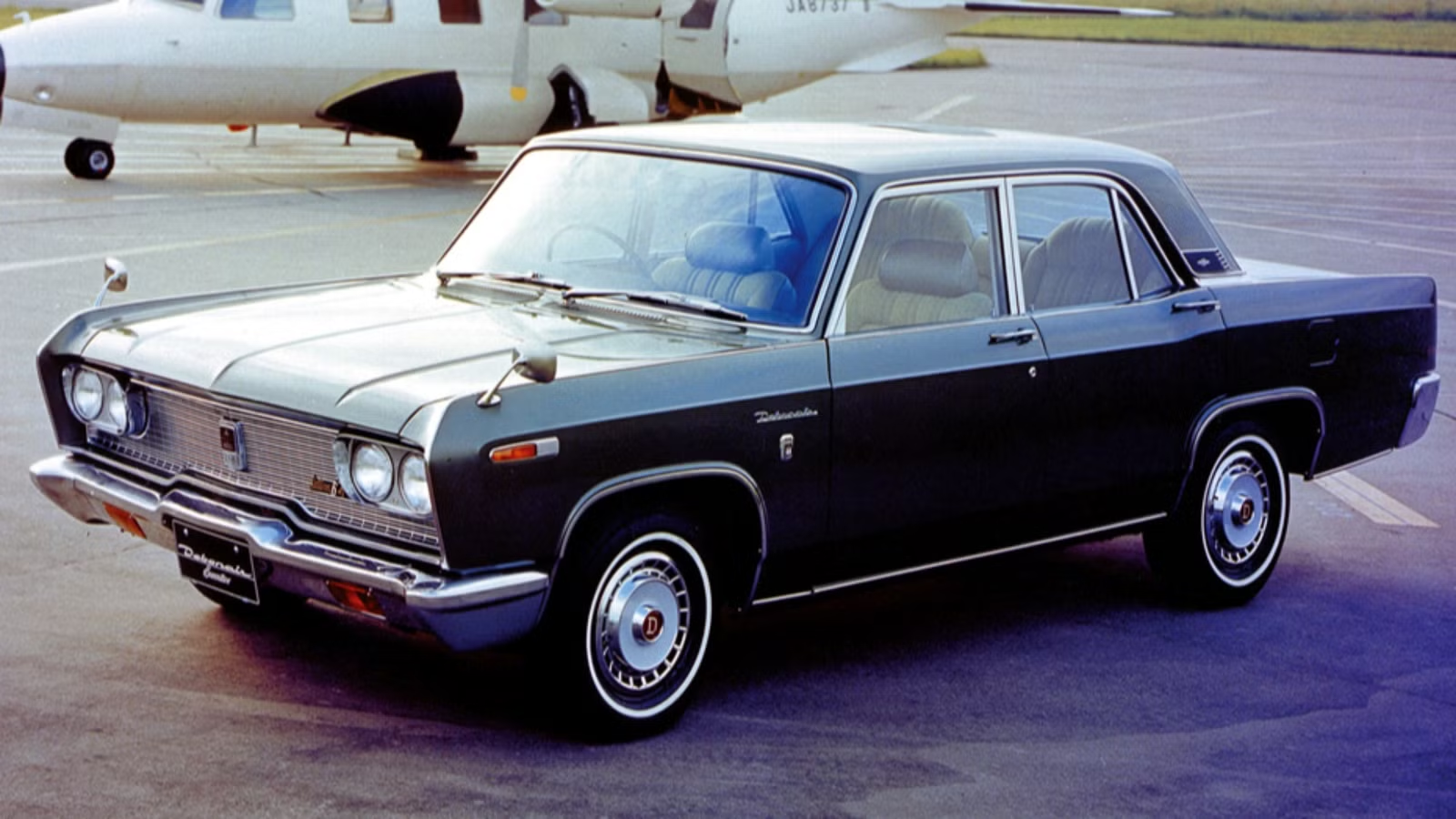
The last car on our list is the Mitsubishi Debonair, Mitsubishi’s flagship model in its home market of Japan. The Debonair enjoyed a long production run, remaining on the market for three and a half decades (between 1964 and 1999) over the course of three generations.
The first-generation model was powered by inline-six and inline-four engines, while its second- and third-gen successors both featured an all-V6 engine lineup. As an executive sedan, the Debonair was equipped with plenty of advanced features for its era; the third-gen model had GPS navigation, self-closing doors, four-wheel steering, ABS, and even a Lidar detection system (in the Japanese market only).
Sources: Mitsubishi, Infiniti, Honda, Toyota, Isuzu, Mazda, Suzuki
