

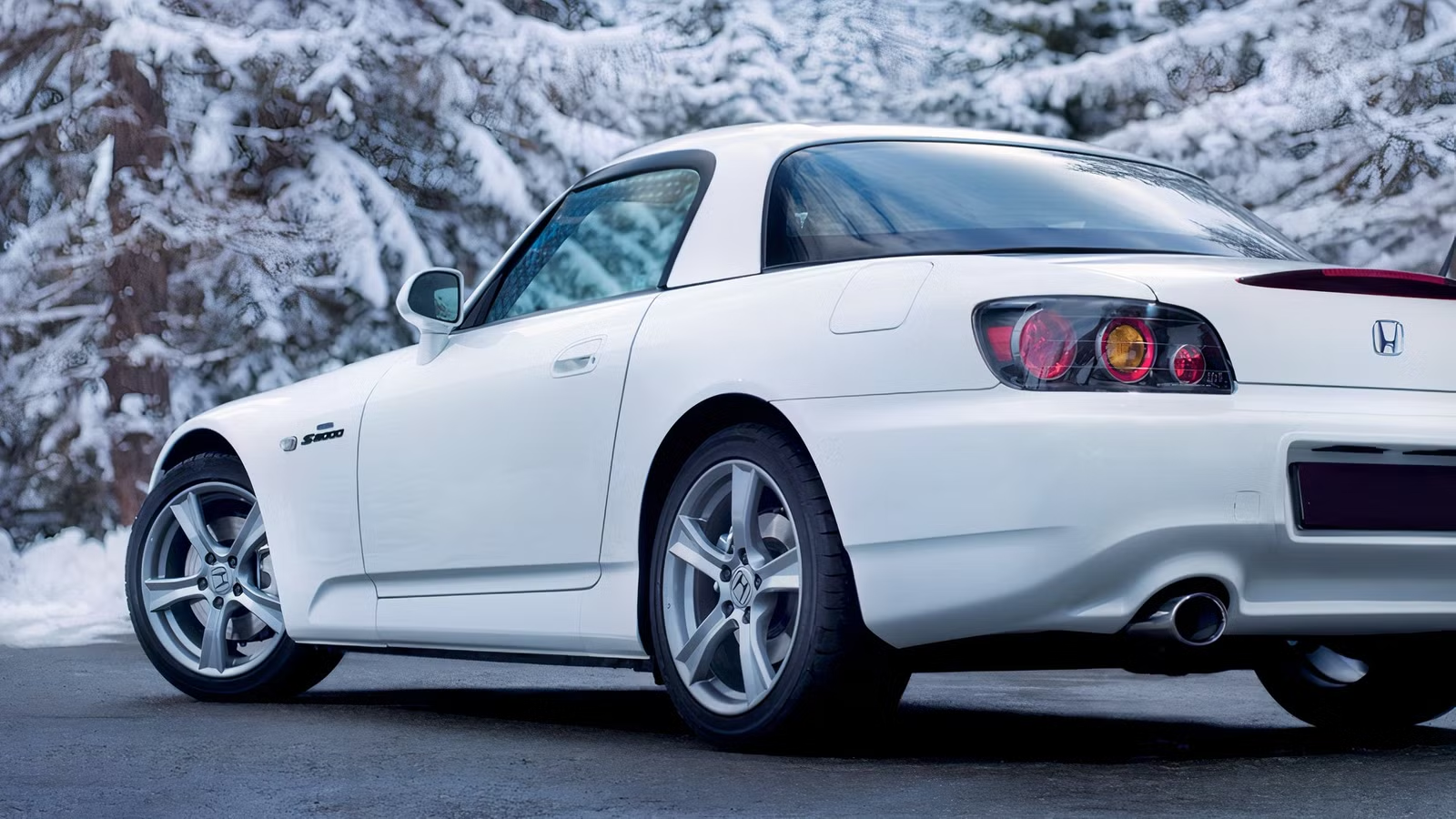
After long serving as Honda’s technological performance flagship for the mainstream, the 2000-model-year Prelude looked on as its sporty new two-seat, rear-drive sibling, the S2000, arrived to join it on showroom floors. The two flagship models coexisted for just a brief moment before the Prelude was retired after 2001, bringing a long and storied chapter of Honda’s front-drive performance era to a close. This era deserves to be remembered with gratitude, not sadness.
After stepping into the spotlight, the S2000 became a legend. Today, 17 years after it was discontinued in 2009, enthusiasts and collectors are still paying big bucks for the S2000 experience. Below, we’ll dig into the key reasons why.
The Torch Had To Be Passed For A New Flagship Era
2000 Honda S2000Honda
In 1999, the automotive landscape was changing, and automakers were trying all sorts of interesting experiments. Luxury SUVs like the BMW X5 and Acura MDX were arriving at showrooms for the first time, as were machines like the Chrysler PT Cruiser and Toyota Prius.
2000 Honda S2000Honda
In the sports car world, Toyota had just launched a modern-day MR2, with rear-wheel drive. Audi brought the TT to market, taking Quattro AWD into the sports car space. Porsche launched the high-performing ‘S’ variant of its popular Boxster, also a rear-wheel-drive machine. The bug-eye Subaru WRX was readying for its US launch, bringing a turbocharged engine and rally-ready AWD to the mix. Other rear-wheel-drive and AWD-equipped competitors from Nissan, Infiniti, Mitsubishi, and Volkswagen would arrive soon to join the party.
The Nissan 350Z’s 3.5-liter V6 engine offers a lot of bang for the buck.Nissan
Meanwhile, the Honda Prelude was getting old. Generations of loyal Honda enthusiasts who grew up with high-performance pocket rockets were now abandoning front-wheel-drive cars in pursuit of rear- and all-wheel-drive machinery.
That was thanks in no small part to machines like the Nissan 240SX, which had helped popularize a growing love of drifting. Enthusiast drivers had a newfound love of power-on oversteer, which the front-wheel-drive Prelude couldn’t deliver. Further, it’s unclear how many car enthusiasts also played racing games like Gran Turismo, which in this same era were introducing impressionable drivers to Japanese performance cars and forming preferences along the way.
2008 Honda S2000 finished in silver with red and black interiorHonda
Many S2000 shoppers were not new Honda buyers. Often, that shiny new S2000 was parked beside another Honda or two in the garage. Other S2000 drivers had previously modified, built, or raced Hondas as well. In this way, even though the S2000 was a cutting-edge flagship, tdifferences between the S2000 variants was still a major level of familiarity and comfort built in.
2000 Honda S2000Honda
The S2000 combined Honda’s well-established brand recognition for dependability with its proven pedigree as an F1 engine supplier in decades prior. Here was a roadster built by one of the most reliable manufacturers on the road, powered by a racy new engine using well-proven technologies from one of the world’s foremost engine manufacturers. After some early teething problems, the S2000’s engine would go on to earn a reputation as an extremely durable performer that was easy to live with, and came backed by full support from a massive motorsports ecosystem that had already been established by popular Hondas before it.
2004-2009 Honda S2000 Side ViewHonda
The Honda S2000 was a popular sight at track days around the world, as more and more drivers caught S2000 fever.The two-seat, lightweight, cloth-top roadster made extensive use of aluminum to keep things lean; steering and balance were nearly euphoric, the engine was an absolute joy to rev to the redline, and the six-speed gearbox was quick and precise. Like an MX-5 or Boxster S, the S2000’s compact size and light weight meant that it was relatively easy on its parts (tires, brakes, suspension) in a motorsports setting when driven by an experienced driver, helping keep maintenance costs down.
2000 Honda S2000 F20C engineHonda
The longitudinally mounted four-cylinder engine, free of forced induction, was easy to service, repair, or upgrade for owners comfortable with turning a wrench. Fluid changes and tune-up work were quick and straightforward for the initiated. Plus, since the S2000 was light, it didn’t need extra-stiff suspension to handle confidently, and it wasn’t even terrible on gas if you could resist the temptation to rev it out.
2004-2009 Honda S2000 Front ViewHonda
The F20C engine was built to tolerate sustained thermal stress typical of track events, and its placement far behind the front axle helped achieve an ideal 50/50 front-to-rear weight distribution. Drivers could expect lightning-speed transitions through tight corners, nearly telepathic agility, and predictable handling limits. Note that the engine’s relatively low torque output and use of a factory Torsen limited-slip differential added another layer of confidence, enabling drivers to power full-throttle out of apexes with minimal drama from the rear tires.
Here’s a car you could take to a track day, drive home comfortably afterwards, refuel for a reasonable amount of money, and even repair and maintain yourself if you were a little handy.
It Had An Engine For The Record Books
2000 Honda S2000 engine drawingHonda
By the time the Honda S2000 arrived, Honda’s engineers were among the world’s undisputed masters of performance engine breathing. Capitalizing on decades of earlier development with multi-valve engines, VTEC and Formula 1 race engines, the S2000’s F20C was a 2-liter four-cylinder with a 9,000 RPM redline.
That engine delivered 240 horsepower at 8,300 RPM, setting a record for specific output in a naturally aspirated production engine (120 hp/liter) that stood until the Ferrari 458 Italia a decade later.
2008-2009 Honda S2000 Club Racer Rear ViewHonda
For 2004, Honda increased stroke to create the 2.2-liter F22C1, adding 9 lb-ft of much-needed mid-range torque and lowering peak revs to 8,000 RPM for better daily usability. Some drivers appreciated the extra torque; others wished for the higher redline of the first-generation engine. There’s much more information on the differences between the S2000 variants here for those who are interested. In an era where engines were increasingly upsizing and turbocharging to make more power, the S2000 boosted its power-per-liter in typical Honda fashion for the fans: by making the engine spin faster.
2008 Honda S2000 finished in silver with red and black interiorHonda
The result? The VTEC power curve drivers knew and loved from their Prelude or Civic Si was alive and well in the S2000, but with much more power and sound along for the ride.
In developing the S2000, Honda engineers wanted to give drivers the feel of an F1 engine, in terms of power output that surges and climbs directly with engine revs. You could hear the S2000’s VTEC hot-cam engage at higher revs, opening up engine breathing to really pile on the power, and adding a distinctive tone to the intake and exhaust soundtracks while engaged. In the right setting, drivers could work the S2000’s gearbox to keep the engine spinning in its high-power VTEC zone, where the all-motor thrill factor was euphorically engaging to fans of natural engine aspiration.
2004-2009 Honda S2000 PedalsHonda
This sort of high power-per-liter, naturally aspirated performance engine was about to go virtually extinct outside of the exotic sports car scene as tightening regulations mounted, but Honda had built an engine for the history books just in time. Today, the most sought-after engines of this era can still fetch big bucks, and the S2000 is one of them.
The S2K Lived Like a Celebrity Collector Car From Day One
From the moment it arrived in showrooms, the S2000 was treated less like a mass-market roadster and more like a limited-production flagship. It wasn’t produced on high-volume commuter assembly lines like some competitors; instead, it was built at Honda’s legendary Takanezawa plant (and later Suzuka), the same low-volume facilities responsible for the hand-assembled NSX supercar.
This was no Miata where production volume was concerned. In fact, over the S2000’s entire decade of existence (1999–2009), Honda produced roughly 110,000 units worldwide, with just under 67,000 reaching North America. By comparison, Mazda was producing over 30,000 Miatas a year during the peak of the 2000s.
Speaking to the S2000’s purity as a ground-up dedicated performance roadster that wasn’t adapted from a commuter-car platform, the S2000’s engine and platform were completely bespoke. Neither was ever used by other models or applications. Today in 2026, this purity is still fetching big bucks.
2000 Honda S2000 chassis bracing diagramHonda
Once the S2000 was discontinued in 2009 amidst the global financial crisis, Honda decided not to replace it. With no successor to the S2000’s platform or engine, the S2000’s abrupt discontinuation created an instant vacuum in the market, leaving no heir to the high-revving Honda performance legacy. It’s not clear if they knew it at the time, but Honda had just handed the automotive world a ready-made collector car.
Aftermarket Support and Community Wisdom Keep Demand Sky-High
Bulletproof Automotive BP25 Honda S2000 SEMA buildBulletproof Automotive
Decades after the final unit rolled off the assembly line, the S2000’s aftermarket ecosystem remains vibrant, continuing to support owners with everything from factory-style restoration components to motorsports-ready performance upgrades. Whether you’re trying to preserve a low-mileage original or build a time-attack machine, the parts and knowledge needed to succeed are never far from reach.
2000 Honda S2000 Dashboard viewHonda
Just as crucial to keeping the S2000 popular and valuable is the collective knowledge built by the global S2000 community on the internet. Nearly three decades of owner experience, archives, DIY guides, and video walkthroughs have documented virtually every modification, component, quirk, and service procedure required to keep an S2000 running. This wealth of shared wisdom can help take the anxiety out of owning an aging sports car.
It all combines into a rare recipe that continues to command strong values today: legendary engineering, a passionate owner community, and robust aftermarket support have helped ensure the S2000 remains one of the most sought-after sports roadsters on the market.
The S2000 Smokes Its Original Competitor Resale Values Today
(2005-2012) Porsche 987 BoxsterPorsche
Original Honda S2000 owners paid about $32,000 to $34,000 for their cars, perhaps $37,000 for the Club Racer model. Today, the Honda S2000 now commands between $26,300 and $54,400 for a standard model in good to concours condition, according to Hagerty. Scarcity drives that figure to a whopping $144,000 maximum for the holy-grail S2000 CR (2008–2009).
By comparison, the first-generation Audi TT Quattro Roadster (2001–2006) carried original sticker prices of $38,600 for four-cylinder 1.8T models (2001–2003) and $42,900 for later V6 variants (2004–2006). Today, buyers will find values ranging from $7,200 to $29,000 for 1.8T models in good to concours condition, while V6 units push closer to the $40,000 mark.
A front three-quarter shot of a 2006-2009 Nissan 350Z Roadster
Nissan
The second-generation Porsche Boxster S (987) was the premium entry when new, starting around $55,000. Present-day values sit between $25,000 and $47,000 for 2006–2008 models, while the DFI-equipped 2009 model rises to between $29,000 and $53,000.
Finally, the Nissan 350Z Roadster (2004–2009) entered the market with original MSRPs of $33,900 to $34,600 across popular trims like the Enthusiast and Touring. It now represents one of the most accessible sports car values on the market, ranging from $12,200 to $41,000 in good to concours condition.
So, just how much do the Honda S2000’s present-day values outpace those of its original competitors? The numbers show you’ll pay 88 to 265 percent more for a standard S2000 compared to a 1.8T Audi TT Roadster, 33 to 116 percent more than a Nissan 350Z Roadster, and 5 to 16 percent more than a pre-facelift 987 Boxster S.
In fact, a standard S2000 even edges out the updated 2009 Boxster S in top-tier concours condition, while the $144,000 S2000 CR leaves the entire field in the dust, commanding nearly five times the cost of its priciest rivals today.
Base Trim Engine
2.2L Inline-4 Gas
Base Trim Transmission
6-Speed Manual
Base Trim Drivetrain
Rear-Wheel Drive
Base Trim Horsepower
237 hp
Base Trim Torque
162 lb-ft @ 6800 rpm
Fuel Economy
18/25 MPG
Segment
Sports Car
Sources: Mazda, Honda, Hagerty
