

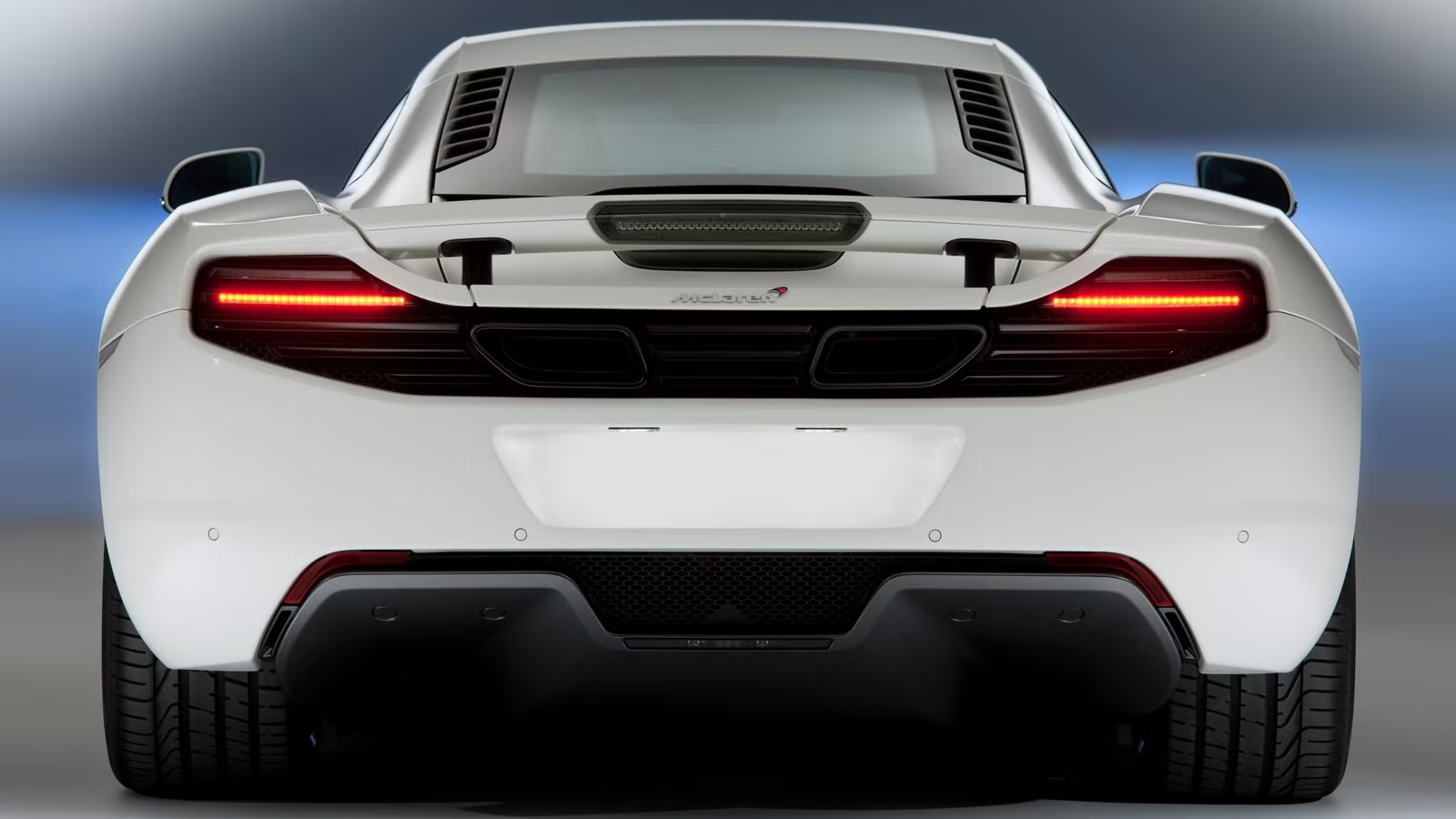
In 2012 America, McLaren wanted people to pay almost as much for its new 12C as they might for a new home. Buyers would certainly be getting plenty of car, with a 3.8-liter twin-turbo V8 producing 616 horsepower after upgrade, a carbon-fiber MonoCell, and a potential 207 mph in its sights.
But 15 years later, depreciation has produced a remarkable reversal, as several 12Cs have recently changed hands for under $120,000. While this puts the 12C into the same price territory as a high-end family SUV or Corvette Z06, this car still comes with plenty of ownership cost and complexity.
Several McLaren 12Cs Are Now Selling For Less Than $120,000
2011 McLaren MP4-12C rear quarter in orangeMcLaren
Before we get to what ownership actually costs, here’s what the market currently looks like – and the numbers are striking. Today’s McLaren 12C market isn’t defined by one unusually cheap car, as several examples appear around or below the six-figure mark. For example, a 20,000-mile 2012 MP4-12C sold at auction for $84,000 in March 2026. This came with a factory upgrade from 592 hp to 616 hp, but it did have some accident history, and it wore an orange wrap over its original carbon black paint.
Another 2012 example with 44,000 miles on its clock sold for $79,500 in July 2026. This one was modified with a Gintani ECU tune and titanium exhaust, so it was far from original, but it also demonstrates just how low the entry point has become.
More desirable cars are starting to move into the six-figure bracket, but the numbers remain compelling. A 2012 example with 7,400 miles on the odometer sold in February 2026 for $107,000. Meanwhile, a 10,000-mile 2012 coupe that had an original window sticker of $274,815 hammered for $120,250 on Bring A Trailer in July 2026.
Mileage, history, specification, servicing, and condition can push the price of a 12C in many different directions, but there does seem to be some depth to the market in the $80,000 to $120,000 region. And that puts these cars within striking distance of what Chevrolet charges for a new Corvette Z06.
The 12C Still Has Proper Supercar Performance
The McLaren MP4-12C has 600 hp of twin-turbocharged V8 living behind the front seats. Lovely.McLaren
When McLaren first launched the MP4-12C, it did so with plenty of authority. This was the start of the company’s modern series production road car empire, and the 12C had some unusually sophisticated engineering.
Initially, the vehicle had the 3.8-liter twin-turbo M838T V8 producing 592 hp, but McLaren recalibrated the engine to produce around 616 hp the following model year, while still retaining 443 lb-ft of torque. The initial owners were offered the increased output as a complimentary upgrade, so the early cars could still be brought up to the latest spec. And in its upgraded form, the 12C could reach 60 mph in 3.2 seconds on standard tires or 3.0 seconds if it had the optional Pirelli P Zero Corsa rubber.
At the center of the vehicle was the one-piece carbon-fiber MonoCell passenger structure, but one of its big selling points was its trick suspension system. The company rejected conventional anti-roll bars and instead fitted a hydraulically interconnected Proactive Chassis Control system. This helped control body roll while retaining unusually compliant vertical wheel movement. And it meant that this supercar didn’t need to be brutally stiff just to keep its body under control when a driver was pushing on.
“You didn’t need rock-hard suspension to post insane lap times. True independent control between the four wheels gave the 12C the ability to glide like a BMW 7 Series.” – Gerhard Horn, senior editor, CarBuzz.
In essence, McLaren had created a car that could make full use of some enormous performance numbers but that still had a degree of everyday usability. And that was not always the case when it came to contemporary mid-engined exotics.
Depreciation Has Put The 12C In Corvette And Luxury SUV Territory
Front profile shot of a yellow 2026 Chevrolet Corvette Z06Chevrolet
McLaren MP4-12C (updated)
2027 Chevrolet Corvette Z06
Engine
3.8-liter twin-turbo V8
5.5-liter naturally aspirated flat-plane-crank V8
Transmission
Seven-speed dual-clutch
Eight-speed dual-clutch
Drivetrain
RWD
RWD
Power
616 hp
670 hp
Torque
443 lb-ft
460 lb-ft
0-60 mph
~3.0 secs
~2.6 secs
Top speed
207 mph
~195 mph (with Z07 package)
Price (when new)
$229,000
$117,700
The 12C now looks like an unbelievable bargain when you set today’s used prices against its original position in the market. The 20,000-mile car that sold for $84,000 changed hands for a little more than a third of the car’s original base price, and that’s without even adjusting the original figure for inflation. Also, the 10,000-mile example that carried an almost $275,000 sticker had a list of options that, by themselves, added more than $42,000 to the vehicle.
For $100,000 to $120,000, a buyer moves into the territory of a new Corvette Z06, but this price also begs a comparison with some large luxury SUVs. For example, a 2027 GMC Yukon Denali Ultimate starts above $100,000, as does the 2027 Cadillac Escalade. Then, there’s the Lincoln Navigator, which comfortably pushes beyond $110,000 in its Black Label form.
Clearly, those SUVs are never going to be direct competitors. Someone shopping with their family for three rows of seats is not likely to abandon the family and drive home in a two-seat McLaren instead. But it’s nevertheless possible to get a lavishly equipped family SUV – or a new American mid-engine performance flagship – for the same price as a used carbon-fiber McLaren. And it’s always possible that the 12C could depreciate further.
A Sub-$120,000 McLaren Can Still Produce McLaren-Sized Bills
The McLaren MP4-12C has 600 hp of twin-turbocharged V8 living behind the front seats. Lovely.McLaren
Whenever heavily depreciated supercars appear on the market, the temptation to buy is understandable. But depreciation does not make the engineering of such a vehicle any less complicated, even as it reduces the cost of acquiring the supercar itself. So, for potential buyers, one of the biggest issues could be the 12C’s Proactive Chassis Control. While it’s true that this hydraulically interconnected suspension system was one of the car’s defining technical achievements, age now adds another dimension.
The hydraulic actuator at each corner may require maintenance as the vehicle gets older and may generate a PCC fault warning or even cause the car to alter its ride height while stationary. As senior editor Gerhard Horn puts it, “PCC is one of the reasons why the 12C is so cheap. The actuators are known to start bleeding within four years, and you’re looking at $2,300 just in parts. It’s also not a job you can fix in your garage. Specialist equipment is needed. You’ll have to find that specialist or go to McLaren directly, and they’ll charge you big bucks to fix the problem.”
The early infotainment system is another potential trap. The first cars used McLaren’s IRIS 1 system and that no longer receives updates. The following IRIS 2 system may have been less troublesome, and it’s possible to upgrade earlier cars, although the economics of retrofitting may not stack up. The transmission also deserves close attention during any pre-purchase inspection. There’s a known gearbox oil seal issue that might cause leakage and some McLaren dealers have actually replaced the sealed transmission itself rather than repairing the inexpensive seal independently.
For context, it’s worth examining the $79,500 modified example referenced above. As part of the documentation, the seller reported more than $44,000 of work after purchasing the vehicle for $73,000 in November 2025. That list of work included a windshield, taillights, rear suspension accumulators, oil pump, water pump, battery, and fuel pump, among numerous other items. And it was a significant amount of money spent in a short amount of time between initial acquisition and subsequent sale.
Yet the 12C does seem to be relatively dependable, with a particularly robust engine, and an inexpensive 12C isn’t always going to be a mechanical disaster waiting to happen. It’s nevertheless important for any shopper to look at service history, hydraulic suspension condition, gearbox behavior, and the electronics. They’ll want to see if the car received McLaren’s factory power upgrade too, and a specialist pre-purchase inspection ought to be part of the acquisition budget.
The Purchase Price Has Changed But The Car Hasn’t
Front shot of a McLaren MP4-12CMclaren
Underneath the dramatic depreciation decline still sits a very impressive machine. In upgraded form, the 12C still has 616 hp, a 207-mph top speed, a carbon-fiber MonoCell, a seven-speed dual-clutch transmission, and that very sophisticated hydraulic suspension. And this is the vehicle that would establish a template for McLaren that would allow it to ultimately develop the 650S, 675LT, 720S, and all the generations that followed.
It’s also particularly interesting to compare this 12C with the brand-new Corvette Z06. The latter represents a modern performance car that has contemporary tech and warranty coverage, while the former offers the engineering and exotic nature of a car that once cost as much as a house.
Both cars bring their own benefits to a buyer’s table but neither makes the other irrelevant. So, perhaps the most important consideration is what may happen down the road following a used 12C acquisition. While the purchase price of that 12C has now fallen into Corvette territory and even come into a luxury SUV conversation, its maintenance requirements have not followed suit.
Base Trim Engine
3.8L Twin-Turbo V8 Gas
Base Trim Transmission
7-Speed Automatic
Base Trim Drivetrain
Rear-Wheel Drive
Base Trim Horsepower
616 hp
Base Trim Torque
443 lb-ft @ 3000 rpm
Fuel Economy
15/22 MPG
Segment
Supercar
Sources: McLaren, Bring A Trailer, Lincoln, Chevrolet, Hagerty.
