

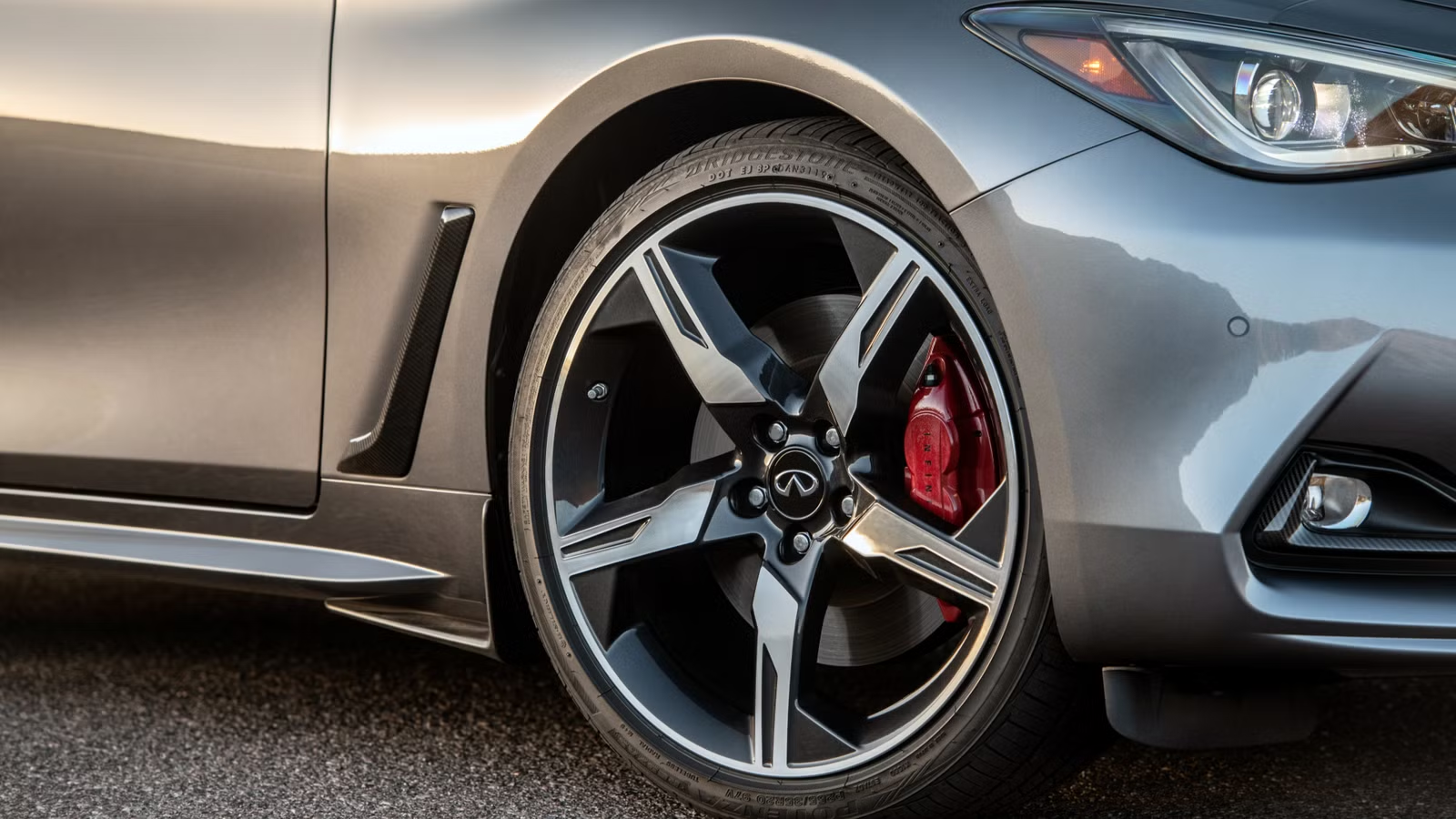
The current Infiniti lineup today consists entirely of SUVs, but not long ago the brand also offered the fascinating Q60 sports coupe. The second generation was partially related to the Nissan 370Z, but the Infiniti distinguished itself by offering a twin-turbocharged V6 delivering up to 400 horsepower.
A close relative of the same engine now lives on in the modern Nissan Z, but the Q60 wasn’t so lucky. Infiniti left the coupe for dead just as Nissan launched its latest sports car. Today, used examples represent a good blend of luxury and performance, all at an affordable price.
From The M30 To The Q60
2022 Infiniti Q60S Red Sport 400 finished in gray with white interiorInfiniti
Infiniti’s history with coupes stretches back further than many people realize. The brand’s first two-door model was the M30, a rebadged version of the Japanese-market Nissan Leopard that arrived for the 1990 model year. It was more of a luxury cruiser than a sports car, but it established Infiniti’s presence in the segment long before the G35 Coupe arrived.
The modern era began with the Nissan 350Z-based G35 Coupe, launched for the 2003 model year, followed by the 370Z-based G37 Coupe for the 2008 model year. Infiniti rebranded the car as the Q60 in 2014 before launching a redesigned second-generation Q60 in 2017. It was also based on the 370Z and remained on sale through 2022. The G35 and G37/first-generation Q60 were essentially rebadged versions of the Nissan Skyline Coupe sold in Japan. The second-gen Q60 didn’t have a close Nissan counterpart in other markets.
2022 Infiniti Q60S Red Sport 400 finished in gray with white interiorInfiniti
Infiniti always positioned its coupes more as grand tourers than as the harder-edged Z cars that they were most closely related to. Buyers could still find plenty of performance. The car’s capability reached its zenith with the second-generation Q60’s flagship Red Sport 400 trim, whose twin-turbocharged V6 delivered 400 horsepower and 350 pound-feet of torque. The model would prove to be the end of the line, as Infiniti chose not to replace the second-gen Q60 even as Nissan pressed ahead with the new seventh-generation Z.
The Q60 Red Sport 400 Powertrain Is A Tuner’s Dream
2022 Infiniti Q60S Red Sport 400 finished in gray with white interiorInfiniti
Both the second-generation Q60 and its predecessor rode on Nissan’s long-serving FM platform, a rear-wheel-drive architecture introduced in the early 2000s. It would go on to span multiple Nissan and Infiniti models right up to the current Z sports car. Developed with performance in mind, the platform features a front-midship layout that places the engine behind the front axle for improved weight distribution, and, depending on the model, supports both rear- and all-wheel drive, like in the Q60.
In the second-generation Q60, a turbocharged 2.0-liter inline-four served as the base engine, paired exclusively with a seven-speed automatic. It does the job, but the available twin-turbocharged 3.0-liter V6 is the one enthusiasts should seek out. Known by its VR30DDTT engine code, the direct-injected six-cylinder produces 300 horsepower in lesser Q60 models and the full 400 hp in the flagship Red Sport 400. That higher figure is the same output Nissan extracts from the engine in today’s Z, highlighting just how potent the powerplant was when it first arrived nearly a decade ago.
2022 Infiniti Q60S Red Sport 400 finished in white with black interiorInfiniti
Infiniti quotes a zero-to-60 mph time of 4.5 seconds for the Q60 Red Sport 400, along with a quarter-mile run in the low 13-second range and an electronically limited top speed of 155 mph. More importantly, the VR30DDTT has a reputation as a tuner favorite. Popular upgrades include ECU tunes, larger intercoolers, high-flow intakes, and freer-flowing exhaust systems, all of which can unlock substantial gains. That said, most modifiers gravitate toward the Z, which weighs about 3,500 pounds in its lightest form, compared with almost 3,900 pounds for a V6-powered Q60.
The extra weight reflects the Q60’s grand-touring mission. You can feel the mass when the road turns twisty, even in the Red Sport 400. As we noted in our first drive of the 2017 Q60 Red Sport 400 fitted with the available by-wire Direct Adaptive Steering system, the steering, while precise, can feel disconnected from the front tires. The seven-speed automatic can also hesitate when drivers ask for a quick downshift.
Where the car really shines is on fast, sweeping roads, where the planted chassis, comfortable ride, and muscular twin-turbo V6 make it an effortless long-distance companion. Infiniti did consider a more focused version, even previewing the creation with 2017’s Q60 Project Black S concept, though ultimately shelved the plans.
Why Nissan Kept The Z And Killed The Q60
2021 Infiniti Q60 Red Sport 400 Front ViewInfiniti
Infiniti pulled the plug on the entire Q60 lineup after the 2022 model year, but the underlying formula didn’t disappear. Instead, Nissan repurposed much of it for the 2023 Z, which rides on an updated version of the same FM platform and comes standard with the Q60 Red Sport 400’s twin-turbocharged 3.0-liter V6. The decision wasn’t difficult to understand. The Z has remained one of Nissan’s most recognizable nameplates, and the automaker needed a halo car to energize enthusiasts as it battled heavy losses and closed factories in the years following the pandemic.
At the same time, Infiniti found itself lower on the priority list. In 2020, then-Nissan Chief Operating Officer Ashwani Gupta said Infiniti would be repositioned as a “Nissan-plus” brand rather than a direct rival to BMW and Mercedes-Benz. With resources stretched thin, low-volume niche products became easy targets.
The Q60’s sales never gained meaningful traction, peaking at just 8,405 units in the second-generation model’s launch year before sliding to only 1,846 deliveries in 2022, its final full year on the market. Infiniti has since doubled down on SUVs, with every new model launched after the Q60 belonging to that segment.
The latest Nissan Z continues the lineage of excellent driving cars, combining turbocharged V6 power with rear-wheel drive and great handling.Nissan
The Q60 also fell victim to a shrinking market. Traditional two-door coupes were always niche products, but today’s buyers overwhelmingly gravitate toward SUVs, leaving only a handful of affordable luxury coupes standing. Unless you’re shopping in six-figure territory, choices are largely limited to cars like the BMW 2 Series, the BMW 4 Series, and Mercedes-Benz CLE.
Eliminating the Q60 also helped Nissan avoid internal competition with the Z. However, admittedly, the two cars target different buyers: the Q60 is aimed at luxury buyers, with 2+2 seating and an automatic transmission. At the same time, the Z is a purer sports car with its two-seat layout and available manual transmission.
How Much To Pay Today
2022 Infiniti Q60 Red Sport 400 Coupe Gray Side ViewInfiniti
While the Q60 and Z targeted different buyers, they ultimately pursued the same performance-minded audience. Today that makes the Q60 Red Sport 400, in particular, an intriguing used buy. Think of it as a Z wearing a sharper suit. There’s the same basic hardware but in a sleeker, quieter, and more comfortable grand-touring package that now benefits from years of depreciation. Given the low sales volumes of the whole Q60 lineup, the 400-hp flagship is actually quite rare.
A look at the CarBuzz Marketplace (below) shows the 2022 Q60 Red Sport 400 averaging around $42,000. However, decent examples are available in the $30,000 range. Even cheaper cars are out there, but may have issues such as high mileage, condition issues, maintenance problems, or other faults.
Even so, the value is on par against competitors with comparable mileage, such as the BMW M440i Coupe and Mercedes-AMG C43 Coupe. Set a strict cap of 50,000 miles, and you can still find Q60s for under $40K. Considering the Q60 Red Sport 400 originally started at $51,300 with rear-wheel drive and $53,300 with all-wheel drive, values have held up surprisingly well.
Reliability information specific to the Q60 Red Sport 400 is hard to come by, but the Q60’s overall reliability record is generally encouraging, though not flawless. JD Power awarded the 2022 model an above-average quality and reliability score, while RepairPal rates Infiniti as a whole above average for dependability. CarComplaints data is limited but suggests that the 2017 model year had the most problems, after which the issues largely disappeared. Still, buyers should pay close attention to common issues that affect used turbocharged performance cars, such as oil and coolant leaks. A thorough pre-purchase inspection remains money well spent.
The Grand Tourer Alternative To The Z
2017 Infiniti Q60 Red Sport 400 Front 3/4 ViewInfiniti
The Q60 Red Sport 400 may have disappeared before it got the recognition it deserved, but that only makes it more compelling today. With handsome styling, strong twin-turbo V6 performance, decent luxury credentials, and a generally solid reliability record, it offers a lot of car for the money. If you’re one of the increasingly rare buyers who still wants a coupe, the Q60 Red Sport 400 deserves a spot near the top of your shortlist.
Sources: Infiniti, CarComplaints, J.D. Power, RepairPal
