

In 2017, I bought an old Magnus chord organ off Craigslist for $10. It’s one of my favorite music gear purchases. Electric chord organs let you play full chords with just a press of a button, making them perfect for aspiring singer-songwriters or fooling around at home. But chord organs largely fell out of favor in the ’80s, as digital keyboards like those from Casio grew in popularity.
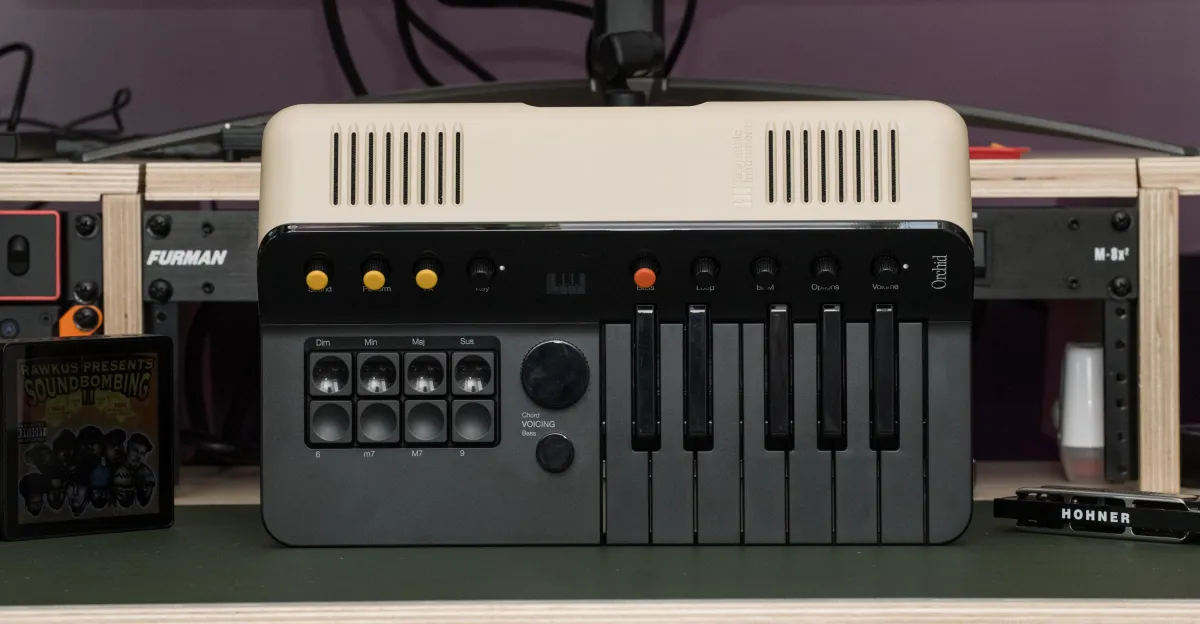
The Telepathic Instruments Orchid attempts to recapture some of that simple parlor instrument magic. Just like those vintage electric chord organs, the Orchid allows you to play rich chord progressions without having to master a ton of theory or complex fingering. It’s not an instrument that demands mastery. It’s a way for songwriters to sketch out ideas with minimal fuss, and it expands on the chord organ heritage with distinctly modern twists.
$649
The Good
- Charmingly retro
- Easy to play
- Solid variety of sounds
- Lots of fun
The Bad
- Pricey considering its limitations
- Only one octave keyboard
- Customizing sounds requires purchasing additional software
The Orchid was designed in collaboration with Kevin Parker of Tame Impala. Aesthetically, it harkens back to ’60s brown-and-tan organs by the likes of Magnus and Bontempi. The speaker grill even resembles the fan vents on those classic instruments. It’s definitely a spiritual successor, just, you know, a lot more expensive at $649.
But where a Magnus organ is limited in how many one-button chords it can play by the number of physical reeds it can hold, the Orchid is all digital and can theoretically play any chord, in any voicing, from any scale. It also means that the Orchid can sound like more than just the beautiful droney cousin of an accordion.
Photo: Terrence O’Brien / The Verge
For a songwriter, this means you can focus on your lyrics and vocal melody. If, like me, you struggle to sing and play an instrument at the same time, this can take a huge mental load off. The variety of sounds also means that not everything needs to sound like a funeral dirge or a sea shanty, which isn’t necessarily the case with an old-school chord organ.
If you have even a passing knowledge of music theory (and it would be generous to call mine even passing), you should have little trouble with Orchid. There’s a one-octave keyboard and a handful of buttons to the left of it that correspond to different chord types, i.e., major, minor, diminished, major 7th, and so on. Press C and major, and you get a C major. Press F# and 9, and you get an F#9. Simple.
The Orchid can really hold your hand if you want it to (and I usually do). You can lock the Orchid to a particular key, so that it will only play chords in the key of E minor or Bb major. That means almost anything you play will at least sound decent and in tune. If your understanding of chord theory is limited, this can really expand your sonic palette with minimal frustration. I often found myself using the chord engine to find a progression I liked as the backbone of a track I could build on top of when jamming in my studio.
But the Orchid can do more than just blast out chords in a single block. It has strum, harp, and arpeggiator modes, plus 13 different preprogrammed patterns. My favorite performance mode (as they’re called) is “slop,” which introduces tiny random timing imperfections that approximate a human actually playing the chord, rather than a machine. The more you turn it up, the more unevenly the notes are struck.
Vintage chord organs have a uniquely droney sound, not unlike a particularly buzzy accordion, that, even 40 years later, was still inspiring artists like El-P. But the Orchid can produce a much broader palette of sounds.
There are three simple synth engines under the hood: one is a virtual analog (VA) synth, another an FM synth for ’80s-style e-pianos and bells, and lastly, a reed piano, perfect for getting those Wurlitzer sounds, but it can also give you more gentle Rhodes electric piano tones as well. I often found myself firing up distorted and heavily reverbed pads on the VA engine and using the Orchid almost like a fidget toy, noodling on simple chord progressions when I needed to focus. You can always connect Orchid to a computer or another synth and use it as a MIDI controller if you want access to its one-key chords but a broader palette of sounds.
Photo: Terrence O’Brien / The Verge
There are 70 presets (excluding bass patches, which we’ll get to in a minute) built into the Orchid, and they cover most of your bases. It’s a good thing, too, since there are very few ways to tweak the sounds directly on Orchid. You can change the filter cutoff or tweak the intensity of effects like reverb or phaser, but that’s basically it. Instead, if you want to design your own patches, you’ll need to spend $99 for the Pistil virtual synth ($50 bundled with the Orchid), which can send custom sounds to Orchid. I’ve found Pistil to be a bit buggy, and the UI often freezes after transferring patches.
Orchid also has a dedicated bass section, separate from the main synth, that you can turn on and off. There are only 12 sounds, but they cover most essentials, from low electric piano octaves to Moog-style synth bass, tuned 808s, and aggressive EDM drones. They can be layered with the main keys to add subtle depth to a chord progression or be played solo.
The accompaniment options are where Orchid can become a bit more complicated than just a simple chord machine. If you don’t lock it to a specific key, and you set the bass to only play along with chords, then you can have the low-end thump locked to your chord progression, and still add melodic flourishes on top without the bass when you’re not pressing any of the chord buttons. Though because of how Orchid handles polyphony — you can’t play multiple keys at once — this can be more frustrating than useful, depending on the patch. If a patch has a long decay time, for instance, chords will cut off abruptly if you try to play a solo note. You’re better off using the built-in audio looper, which lets you record chord progressions, basslines, and melodies separately, for a bit more flexibility.
I am head over heels for the built-in drum machine. It’s extremely limited. You can’t program a custom beat, you can’t tweak the sounds. Yet I think it’s basically perfect, even if it would be nice to have the option for user-uploaded beats from within Pistil. It’s again inspired by vintage gear from the ’70s, namely rhythm machines like the Korg Mini Pops that played preprogrammed beats to accompany home organs. The lo-fi, almost twee sound of these machines is among my favorites in the world of drum machines.
The Orchid is fun, sounds good, and is simple to use. But it’s also quite limited. You can’t design your own sounds without paying extra for the Pistil software. The keyboard is small, and you can’t actually play chords on it: You can only play one key at a time, and all the chord voicings come from the chord buttons on the left. That means that if you do know how to play a Dm13 on the piano, for example, you can’t do it on the Orchid’s keyboard. This is a bit of an annoyance, and one of the key differences between it and a vintage chord organ. It varies from model to model, but my personal Magnus organ only has dedicated buttons for Bb, F, C, A, D, and G major chords. Of course, I can always play any chord I want using the Magnus’ regular two-octave keyboard.
Photo: Terrence O’Brien / The Verge
There are far more capable synths in the $649 price range. But the Orchid isn’t trying to compete with the Korg Minilogue or the Arturia MiniFreak. If you want to tinker and design your own synth patches from scratch, spend your money elsewhere. The Orchid isn’t for tinkering. It’s more of a songwriting tool than a synth. If you’re a singer / songwriter looking to escape the cliché of acoustic guitars or upright pianos, the Orchid offers an approachable, if pricey, electronic option.
Follow topics and authors from this story to see more like this in your personalized homepage feed and to receive email updates.
- Accessory ReviewsClose
Accessory Reviews
Posts from this topic will be added to your daily email digest and your homepage feed.
FollowFollow
See All Accessory Reviews
- EntertainmentClose
Entertainment
Posts from this topic will be added to your daily email digest and your homepage feed.
FollowFollow
See All Entertainment
- GadgetsClose
Gadgets
Posts from this topic will be added to your daily email digest and your homepage feed.
FollowFollow
See All Gadgets
- MusicClose
Music
Posts from this topic will be added to your daily email digest and your homepage feed.
FollowFollow
See All Music
- ReviewsClose
Reviews
Posts from this topic will be added to your daily email digest and your homepage feed.
FollowFollow
See All Reviews
- TechClose
Tech
Posts from this topic will be added to your daily email digest and your homepage feed.
FollowFollow
See All Tech
