

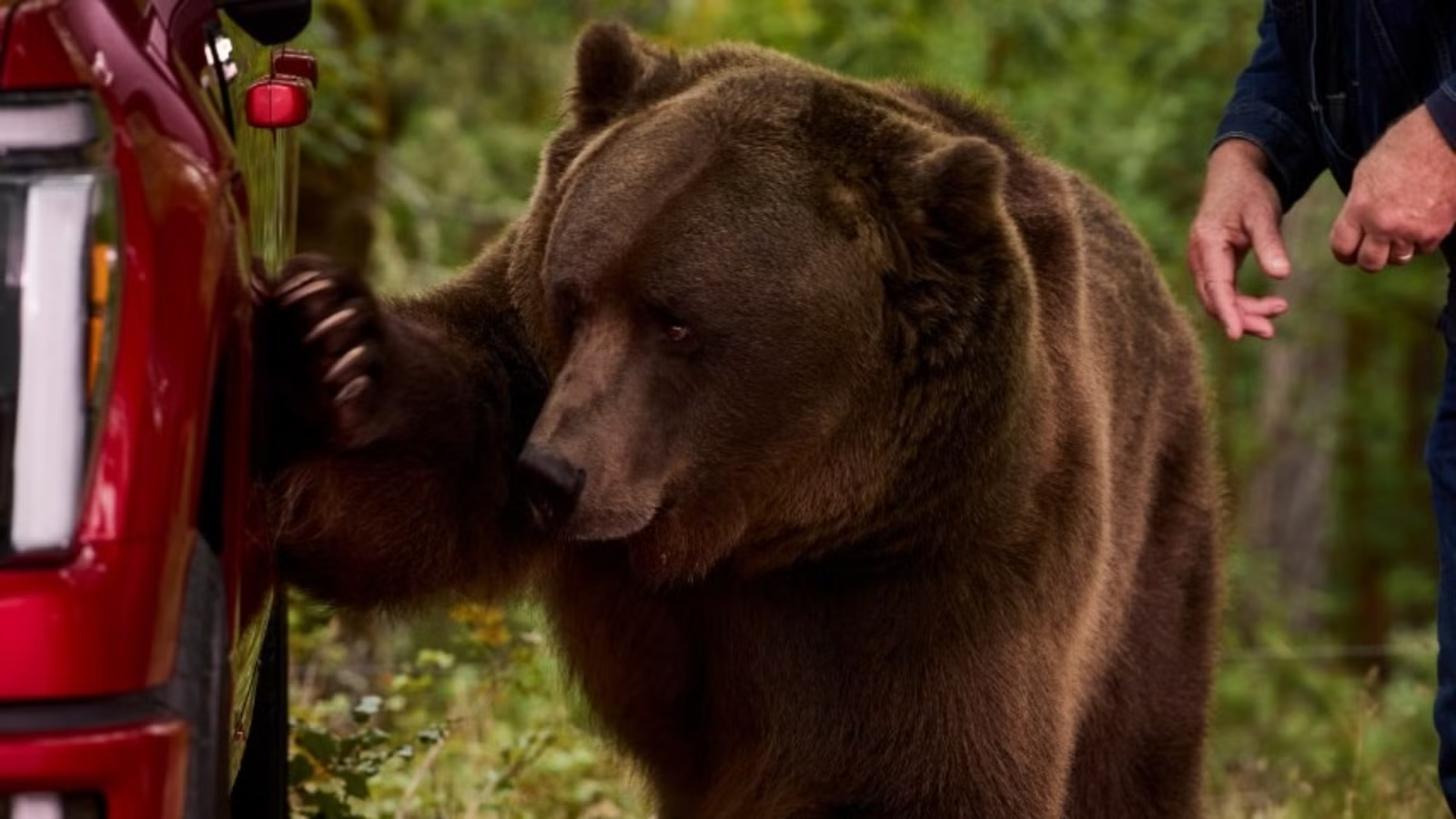
Automakers are constantly pushing the limits of innovation when it comes to testing their vehicles. From wind tunnels to crash test dummies, and beyond, there are a variety of methods that can be employed to put a vehicle to the test. Recently, Ford opted for an extremely creative solution by using a trained bear to test the endurance of its F-150 pickup truck.
As it turns out, this was an excellent way to measure the capabilities not just of the truck itself, but also of the Security Package, an option bundle that helps you keep your vehicle secure in a variety of situations, such as break-ins and theft. Let’s take a closer look at the unique automotive test that redefined the meaning of “Built Ford Tough.”
An Unusual Testing Method: Bear Vs. Pickup Truck
Ford F-150 bear testFord
One of the key figures involved in the test was Sam Harris, director of product for Ford Secure (the division of the company that handles vehicle security). Another was Keith Bauer, a professional animal trainer. The third participant in the test was the real star of the show: Tag, a 7.5-foot, 800-pound Kodiak bear and professional actor. He has appeared in several movies and TV shows, including Yellowstone. Tag squeezed the test in between acting gigs and his winter hibernation, and did a phenomenal job of testing the truck’s resilience.
Ford F-150 bear testFord
Tag provided real-life proof of the F-150’s toughness and the capabilities of the Ford Security Package. Instructed by his trainer, he shook, bashed, and scratched the truck with all his might, in the Oregon woods near the ranch he calls home. Before the official test, Ford had sent Bauer and Tag a practice truck, so he would know exactly what to do on the big day. A special platform let Tag push the truck.
Bears love to destroy things. They like to break things […] I was really happy with the way Tag did the things they wanted him to do […] When he got up there and got the truck rocking, you can see he’s up on his toes because he is really getting into it and liking it.
-Keith Bauer, animal trainer
Tag clawed the truck’s side panel to shreds and smashed one of the windows. He was able to open the door because the F-150’s handles are designed to be usable by people wearing heavy work gloves. Apparently, a bear claw can operate them, too.
While Tag did his thing, an animal welfare specialist closely monitored the situation to ensure his continued well-being, and a team of engineers tracked how the truck and Security Package handled being pushed to its limits. The vehicle was connected to Sam Harris’ phone, and sent several notifications during Tag’s attack. The Security Package did its job of telling Harris that someone was trying to break in and damaging the truck, showing its usefulness in a wide variety of situations.
Related
Ford Just Pulled Off The Quality Comeback Of The Century
Ford rocketed from well below average on the latest JD Power survey to beating Toyota and Honda in just one year.
The Security Package: A Bundle Of Features To Keep Your Ford Safe
Ford F-150 bear testFord
The reason why the F-150 was able to withstand Tag’s attack largely has to do with a crucial bundle of safety features available on the model: the Security Package. This option package helps protect your vehicle in a variety of different situations, including, as it turns out, animal encounters. Alerts are a major component of this package. Vehicles with the Security Package installed can send owners a range of notifications they can enable or disable as needed.
The notifications are triggered by cameras and sensors, including the Ford Truck Bed Camera, which Tag activated multiple times during his test. The camera offers high-definition livestreaming with a 180-degree field of view. Cloud storage lets you view past footage, which comes in handy when making an insurance claim or reporting an incident to the police.
Ford F-150 bear testFord
The Security Package includes, among others, notifications for potential cabin intrusion, door opened, hardware disabled (triggered when the vehicle is tampered with), and unexpected location (triggered when the vehicle moves to a new location without the engine on).
Notifications are not the only component of the package. Another important feature is Start Inhibit, a remote lockdown tool that, when activated, prevents anyone from starting your vehicle, even if they have an authorized key. There’s also a direct line to a 24/7 call center, so you can communicate directly with Ford for assistance in the event your vehicle is stolen.
The Model That Passed The Bear Test: The F-150
Ford F-150 bear testFord
2026 Ford F-150 Base Trim
Engine
2.7-liter twin-turbo V6
Horsepower
325 hp
Torque
400 lb-ft
Transmission
10-speed automatic
The modern-day F-150 is part of a family that dates back to the late 1940s. The first F-Series trucks appeared in 1948, as a replacement for a previous line of car-based pickup trucks. A further thirteen generations followed; the fourteenth and current one was introduced for the 2021 model year. The F-Series truck’s popularity hasn’t waned throughout its lifespan, and it has been the best-selling vehicle in America for nearly half a century.
From the late 1990s onwards, Ford focused its marketing on the F-150 by advertising it as a more family-friendly day-to-day vehicle, ideal for private individuals. Meanwhile, the Super Duty trucks, such as the F-250 and F-350, were better suited as commercial or farm vehicles. This has continued into the present day: the F-150 is now a popular choice for drivers looking for a daily driver, in place of a car or SUV.
Ford F-150 bear testFord
The current incarnation of the F-150 offers a variety of powertrains, including two V6 options, a V8, and a hybrid that pairs a V6 with one electric motor. Power outputs range between 325 and 430 hp. A 10-speed automatic is the only transmission choice, sending power to either the rear wheels or all four wheels. An all-electric version of the model, dubbed the F-150 Lightning, was previously sold between the 2022 and 2025 model years, but was discontinued quickly due to poor sales.
Real And Fake Animals In Automotive Testing
Volkswagen LogoVolkswagen
Tag is not the only animal to have been involved in automotive testing throughout history, but he is almost certainly one of the luckiest. Rather than getting to destroy a truck before going back to their habitat and a tasty snack, most animals involved in car testing across the decades have lived far unhappier lives.
For a substantial part of the 20th century, live animals such as pigs, bears, and baboons were anesthetized and used as crash test dummies (alongside actual crash test dummies and, occasionally, human cadavers). Eventually, due to pressure from animal rights activists and the improvement of crash testing technology, this practice was stopped in the 1990s.
Related
You Can Get 25 MPG From Your New Ford F-150 For Under $55k
Looking for the lowest cost 2026 F-150 Hybrid? We reveal the most cost-effective trim that balances power and efficiency without breaking $55k.
However, this would not be the last time the automotive industry would be involved in a scandal related to animal welfare. In the early 2010s, Volkswagen conducted a test that later became part of the infamous “Dieselgate” scandal. In an attempt to prove that its diesel-powered models’ exhaust fumes were safer than in previous decades, the company exposed macaque monkeys to diesel fumes in an airtight chamber, while showing them cartoons on a TV to keep them calm.
A few years later, a scandal broke out: not only did the test turn out to be rigged to show lower emissions, as were the other tests involved in Dieselgate. The situation also led to an explosion of public outrage over the animals’ welfare. Volkswagen suffered from severe PR damage, from which it took years to recover.
2026 Volvo Ex90Volvo
On a more positive note, other automakers have used fake animals instead when carrying out their testing procedures. The Swedish National Road and Transport Research Institute created a crash test dummy in the shape of a moose, with realistic weight distribution and proportions. Both Volvo and Saab have used the dummy to obtain a more accurate picture of the damage caused by moose-vehicle collisions.
Sources: Ford, WBI Studies Repository, Volkswagen, Volvo, Swedish National Road and Transport Research Institute
