

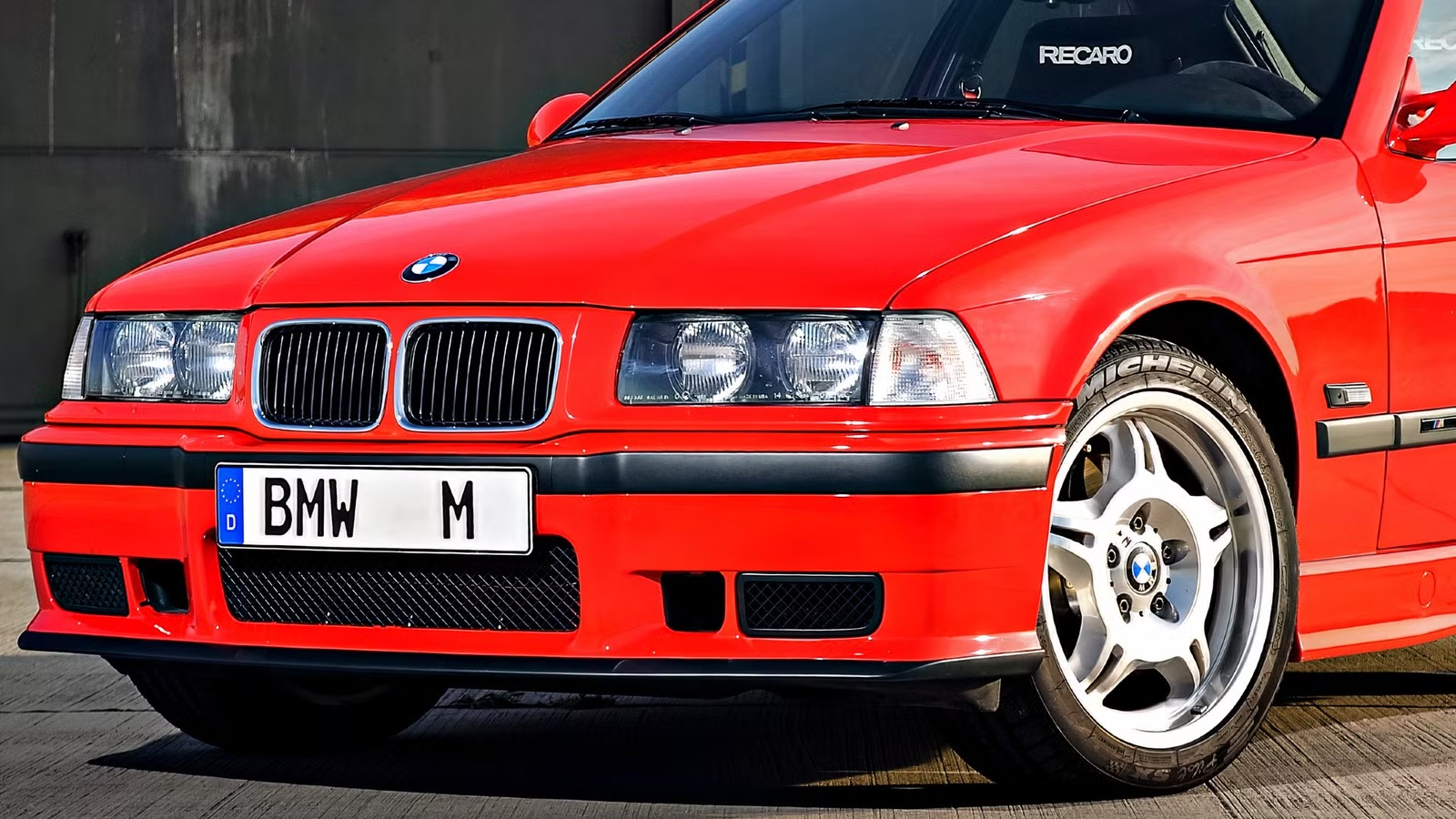
BMW’s 1 Series M Coupe went on to become a big hit for its maker, but some years earlier, the company had already been playing with the same basic idea. In the mid-1990s, BMW liked the idea of a car with a compact body, rear-wheel drive traction, a serious inline-six engine, and a lightweight pose. And while its 1996 prototype would later define the appeal of the iconic 1M Coupe, BMW M ultimately decided that it would not proceed with the experiment.
Today, the concept looks startlingly prophetic, with what could have been the engine and attitude of a full M car in a smaller and more mischievous package. The company based its prototype on the E36-generation 3 Series Compact and while the concept never reached showrooms, it did give an indication of what was to come.
The E36 Compact Was Supposed To Be The Sensible Small BMW
1995-2001 BMW 3 Series Compact E36 Silver Side ViewBring A Trailer
BMW introduced the E36 3 Series Compact at the end of 1993, a three-door hatchback that was shorter than the regular 3 Series by about nine inches at the rear. This was definitely not an M car in waiting but more of an affordable, practical entry point for aspiring BMW owners. It came with a large tailgate, enough room for up to five people, and families often chose the 3 Series Compact as a handy second car.
In many respects, this was BMW’s way of competing with the likes of the VW Golf, but it was never supposed to be a power play. Certainly, the car had enough BMW DNA on board to make that approach possible, but this particular car was just a practical market proposition and certainly not a stripped-out weekend weapon.
As time went by, BMW did give the Compact a six-cylinder engine, and this arrived in 1997 aboard the 323ti Compact. The 2.5-liter M52 inline-six produced 170 hp which started to give this stubby 3 Series a more convincing performance identity. But at about the same time, BMW decided to go all in with the M3 Compact prototype. It would move away from something that was just a warm and usable road car, taking its sensible hatchback idea and embarking on a far more aggressive engineering exercise.
BMW M Gave The Compact The Heart Of A Real M3
1996 BMW M3 Compact concept front quarterBMW
1996 BMW M3 Compact E36 Prototype Specifications
Engine
3.2-liter S50B32 naturally aspirated inline-six
Transmission
Six-speed manual
Drivetrain
Rear-wheel drive
Power
321 hp
Torque
258 lb-ft
The 1996 BMW M3 Compact prototype featured plenty of M-style aggression. It came with the S50B32 inline-six that BMW had sourced from the contemporary European-market E36 M3 Coupe. That 3.2-liter naturally aspirated engine gave out 321 hp at 7,400 rpm, and it also featured double VANOS, a ground-breaking variable valve timing system that worked on both the intake and exhaust camshafts.
This meaty engine would entirely change the character of this car, and gave it a significant power-to-weight advantage. It weighed only 2,866 lb, which was about 331 lb lighter than the already weight-conscious E36 M3 Coupe. And the shape and dimensions of the Compact would also affect how it performed on the open road. After all, the rear section was around nine inches shorter than a regular 3 Series, while the wheelbase was basically the same. So, the shorter rear body meant less overhang behind the rear axle, and this had a significant effect on the car’s response. This started to turn this prototype into the kind of compact rear-wheel-drive performance package that BMW enthusiasts have grown to love.
Onboard, BMW M prepared the car for battle, featuring a minimalist cabin, Recaro racing seats, and a genuine roll bar. As this was a machine with focus, agility, and low weight in mind, comfort and space were not at the top of the menu.
The M3 Concept May Have Been Too Wild For Its Time
1996 BMW M3 Compact concept interiorBMW
On the face of it, BMW seems to have been pleased with its final product, but in practice, the M3 Compact may have been just too big for its boots. BMW M has since said that this was a car for the more experienced driver and that its engineers might have had to dial down the power if the company had gone forward with the project.
Also, this was, in any case, a time when BMW was repositioning its M3 product. The E36 M3 was perhaps a little more mature than the original E30 and available in more body styles, including a sedan. And while the E36 version was certainly more powerful than its predecessor, it still presented as a recognizable premium performance car. BMW wasn’t certain that a short-bodied hatchback with the full European M3 treatment and stripped-out interior would work in this kind of marketplace.
BMW bosses also had some positioning challenges to consider, as the E36 Compact was meant to be the entry point to the brand. Could it still be the accessible, practical BMW if one trim option was the sharp-edged and powerful M3 Compact? Back in the 1990s, BMW clearly felt that this wasn’t the right approach, and perhaps a little risky from an overall marketing perspective. But today, it looks exactly like a formula that BMW would eventually rediscover.
The 1 Series M Coupe Finally Made The Idea Work
2011 BMW 1M Coupe Exterior Finished In Orange With Mountains In BackgroundBMW
In 2011, BMW launched the 1 Series M Coupe, which represents the first time that people would see an M badge on the back of a 1 Series. This was a limited-production variant and while it wasn’t a straightforward copy of the M3 Compact from back in the day, it did seem to answer the same question.
The 1 Series M Coupe had a compact BMW body, rear-wheel drive, six-cylinder power, manual transmission, widened bodywork, and some serious chassis hardware. It featured a twin-turbo 3.0-liter inline-six turning out 335 hp at 5,900 rpm and 332 lb-ft of torque in a low-down and usable power band. It could also get to 60 mph in 4.7 seconds, taking 13.2 seconds for the quarter mile, and had an electronically limited top speed of 155 mph.
Related
The Frankenstein BMW That Turned Out To Be An Epic Investment
The BMW 1M coupe was a parts-bin special that took many of its parts from the BMW E92 M3 and is one of the best cars BMW has ever created.
Some serious hardware gave the 1M some real M-style credibility, with an aluminum suspension system, originally pegged for the contemporary M3. It also had a variable M differential lock, 14.2-inch front and 13.8-inch rear compound brakes, as well as 19-inch wheels that it shared with the M3 GTS. So, with the 1M, BMW clearly showed that it could produce and sell a compact M car. And enthusiasts were now ready to buy the M philosophy aboard a smaller and more unruly coupe, making what looked excessive back in 1996 desirable in 2011.
The M3 Compact Was A Better Idea Than BMW Realized
1996 BMW M3 Compact concept rear quarterBMW
BMW M engineers are nothing if not experimental and have come up with some seriously good performance cars over the years. And here, they clearly understood that a small, powerful rear-drive M car could be appealing way before the 1M became just such a car and the modern icon that it is. But that doesn’t mean that the M3 Compact was somehow a failed hatchback version of the M3. BMW was able to prove that it didn’t just need size and luxury to create the potential for excitement, even if company bosses decided to shelve the overall idea for a later date.
Related
BMW’s Turbocharged 6-Cylinder Hot Hatch Was A Rear-Wheel-Drive Dream
BMW built a hot hatch dream with six-cylinder power and rear-drive thrills – a combination unlikely to ever be repeated.
As time would tell, the later 1 Series M Coupe and M2 both benefited from the same kind of engineering philosophy. Neither of those was a big, expensive, or the most technically extravagant M creation, but they still had a very usable and concentrated appeal. The M3 Compact also showed its mettle way back in 1996, but it was perhaps too bold for its era.
Ultimately, BMW didn’t build the M3 Compact, and it never turned into a predecessor for the actual 1M. In the end, this 321-hp M3-powered hot hatch never reached production because BMW felt that it would probably have been too uncompromising for ordinary buyers back then. But its formula definitely worked in the modern era, as a combination of a serious engine, a small body, rear-wheel drive, low weight, and plenty of manual character. And while BMW clearly knew how to turn the 1 Series M Coupe into such a cult car, it took a decade and a half to actually turn that knowledge into reality.
Sources: BMW.
