

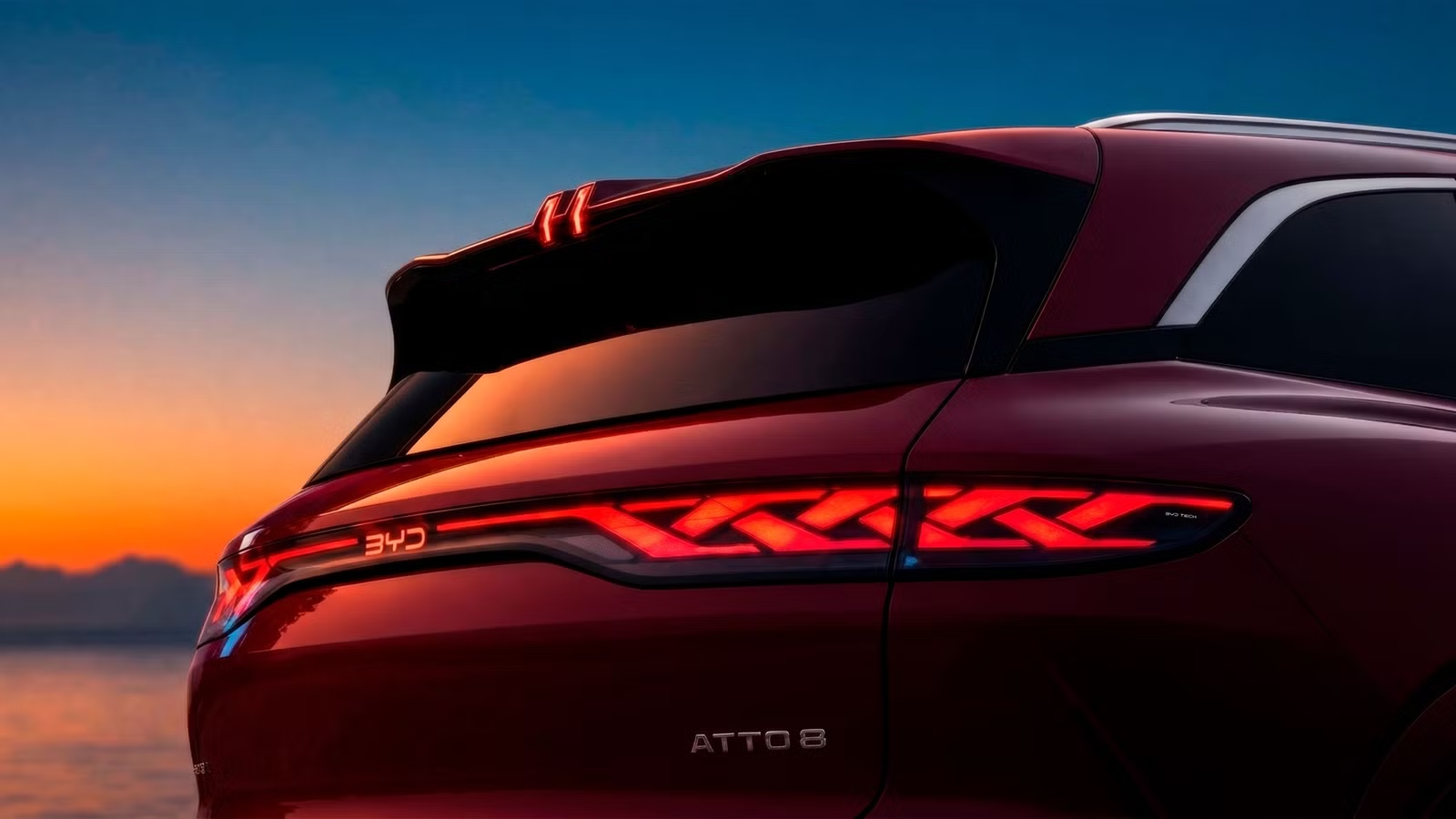
At the Paris Motor Show, Chinese automaker BYD introduced its new flagship SUV, the Atto 8. The seven-seater SUV will hit the market with a range of power outputs and the option of rear-wheel-drive and all-wheel drive when it arrives in markets at the start of 2027. According to BYD, the spread of options will allow customers to prioritize maximum real-world combined range from the 115kWh battery or target ultimate performance.
But the headline comes from the 2nd Generation Blade Battery and the charging system, which makes recharging as quick as refuelling a gas-powered car.
From 10% To 97% Battery Capacity In Only Nine Minutes Using Flash Charging
BYD Atto 8BYD
The claimed charging times are 10% to 70% of the second-generation Blade Battery’s capacity in five minutes, and then 10-97% of its capacity in just nine minutes. According to BYD, charging under extreme temperatures of well below freezing minimally affects the charge cycle, requiring only 12 minutes to refill from 10–97%. BYD has a catchline for that – “ready in 5, full in 9, cold add 3.”
Alongside the intense fast charging ability of the Atto 8, the automaker says an expansion of its Flash Charging network will see 3,000 stations installed across Europe by the end of 2027. In its press release, BYD is attaching the charging time to its network of charging stations, which can deliver up to 1,500 kW of power.
BYD models are specifically optimized for the Flash Charging system, but any vehicle with a 1,000V electrical architecture can use the stations. Presumably, that means it may take a bit longer for BYD vehicles with the new Blade Battery to charge on a different brand’s station.
Why Only Charge To 97% Battery Capacity?
BYD Atto 8BYD
BYD is being clever with its charging system, and caps the charge at 97% so that the vehicle’s kinetic energy recovery system is able to work immediately through braking. By immediately using energy recovery, allowing the vehicle’s kinetic energy recovery system to function immediately through braking, the vehicle’s overall energy consumption is improved. Of course, if the car immediately goes out onto a freeway and traffic is light enough to cruise and not use the brakes, there is no benefit.
Another clever thing BYD does with its charging system is build an energy storage system into its Flash Charging stations. That allows incredibly fast charging times from a system with a maximum power delivery of 1,500 kW without straining the local power grid.
CarBuzz Insight – Why This Matters
BYD Atto 8BYD
A five-minute charging time is close enough to how long it takes to fill up a regular gas-powered car with fuel, which can vary between three and five minutes from a gallon or two to full, depending on the pump. And it really does depend on the pump. That was BYD’s aim, so now it’s about getting chargers out there that can support 1,000V electrical architecture. The Flash Chargers were introduced into Europe in April 2026, and the promise is for 3,000 stations installed across Europe by the end of 2027.
However, Europe is a large continent. The best estimation of how many electric chargers there are in Europe appears to be a count of 1.1 million public chargers. That makes the promise of 3,000 Flash Chargers look underwhelming. The chances of a customer being near one becomes slim, and they will have to wait a long time to be able to reliably find a charger that hits the promised speeds.
The good news is that we are at the point where this kind of speed is entering the mainstream. Now, the infrastructure has to catch up and spread across the globe further than China and Europe.
