

Porsche’s work within the realm of sports car innovation is long-standing, and deeply rooted. In the early 1900s, Porsche’s founder, Ferdinand Porsche, developed the Lohner-Porsche Semper Vivus. It was the world’s first functional hybrid car, which took advantage of an electric motor hooked into a gasoline powerplant. Porsche also developed the 356 model in 1948, which was the world’s first road-going car to boast a deliberately lightweight construction paired with torsion-bar suspension and a rear-mounted engine.
Another innovation came about in the 1970s, but Porsche wasn’t the first to utilize it. It’s called the transaxle. The Stuttgart-based automaker decided to begin installing transaxles into its next-gen sports cars beginning in 1976. By installing one into these sports cars, the models were able to handle better than most others on the market at the time. From then on, Porsche’s use of the transaxle helped to reshape the modern sports car as we know it.
What Is A Transaxle, And Why Did Porsche Use It?
2023 Ferrari Purosangue Transaxle TransmissionFerrari
Simply put, a transaxle is a large piece of kit that combines a vehicle’s transmission, axle, and differential into one unit. The transaxle was pioneered right at the turn of the 20th century by a French automaker. Its first application was found in the 1898 De Dion-Buton, but its use wasn’t popularized until 1934, when the Czechoslovakian automaker Škoda installed it in the Popular model. Volkswagen’s first use of the transaxle was, technically, 1938 in the first VW Beetle prototypes.
As time went on, numerous automakers developed their own transaxle setups. By and large, the most popular users of the transaxle have always been front-drive, front-engined cars or rear-drive, rear-engined cars. In applications such as those, the transaxle allows for a much more compact drivetrain, rather than having everything separate. This means the drivetrain’s footprint is smaller, resulting in more room for the engine and passengers in the cabin.
Emory Motorsports Outlaw Porsche 356Emory Motorsports
When Porsche hit the scene in the late 1940s, the brand employed the use of transaxles in all of its models, seeing as they were all rear-engined, rear-drive cars. The very first Porsche 911 used one, whose production began in 1964. From there, the world of transaxles remained relatively stable and unchanged until the mid-1970s, when Porsche was interested in broadening its horizons past the air-cooled, rear-engined models it was used to.
Related
The Untold Story Of The Porsche 924 Turbo Targa That Never Made It
A look into the history of the 924 that never was.
Porsche’s Transaxle Revolution
1988 Porsche 924 S front-quarter studio shotBring A Trailer
In the early 1970s, Volkswagen was hard at work designing a unique concept model coined the “EA 425”. It was a front-engined model sporting a water-cooled motor, a rarity for VW at the time. In addition, it used a rear-mounted transaxle. However, once the 1973 Oil Crisis hit in full force, the global automobile market began turning its nose up at new sports car models. This forced VW to cancel the project and focus instead on the more-palatable Golf and Scirocco, both of which were yet to be released.
Porsche, though, was enamored with the EA 425 project, partly because the brand was involved in its development in the first place. Once Volkswagen dropped it, Porsche decided to pick up the pieces and resume work. Much of the R&D had already been completed, but Porsche took over the project, modified it – some would say substantially – and the finished product was ready for mass production. By 1975, production was underway.
vw ea 425 concept front orangeWikimedia Commons: Michael Barera
That year, Porsche unveiled the front-engined 924. The new model was styled like it was from the future, and boasted a front-engine, rear-drive layout, marking the very first time any road-going Porsche did so. Its looks earned it a lot of attention from the public, but its performance was, sadly, lacking.
More specifically, its handling was reportedly excellent, largely thanks to the near-perfect weight distribution thanks to the rear-mounted transaxle. However, its use of a piddly 2.0-liter VW/Audi engine meant it was slow, and many folks were quick to complain that the 924 was not capable of the sort of quickness expected of a Porsche.
1976 Porsche 924
Engine Details
2.0L NA inline-four
Power
95 hp
Torque
113 lb-ft
0-60 mph
8.8 seconds
Top Speed
115 mph
*Specs courtesy of Hemmings
After The 924
While the 924 was first, Porsche decided to utilize the front-engined, rear-transaxled layout for three other models, those being the 928, 944, and 968.
Porsche 928
1989 Porsche 928 GT ‘Flachbau’ front 3/4RM Sotheby’s
1995 Porsche 928
Engine Details
5.4L NA V8
Power
345 hp
Torque
369 lb-ft
Two years after the 924 came onto the scene, the V8-powered 928 stormed into the fold. For Porsche purists that criticized the 924’s lack of pep, the new model was a breath of fresh air. Like the 924, it used the same sort of rear-mounted transaxle setup. When it first hit the market, the 928’s 4.5-liter mill churned out 219 hp, followed by 228 hp in 1980. From there, the 928 received a 4.7-liter V8 in 1983, and then a 5.0-liter mill beginning in 1985. By the end of its lifespan in 1995, the 928 was producing 345 hp from a 5.4-liter engine. With it, the model could hit 170 mph and reach 60 mph from a standstill in just 5.5 seconds.
Related
This Porsche Had The Engine From A VW Van
Porsche hasn’t always built expensive and premium sports cars, with this one designed to tackle a global fuel crisis by using an engine from a van.
Porsche 944
1986 Porsche 944 (Oldsmobile 455 V8 Swap) front 3/4Facebook Marketplace
1991 Porsche 944
Engine Details
3.0L NA inline-four
Power
208 hp
Torque
207 lb-ft
In 1982, the four-pot 924 model received a close sibling, the 944. In reality, its entrance into the market was spurred on by the 924’s disappointing performance and lack of a Porsche-derived engine. This time around, the 944 was treated to a 2.5-liter Porsche mill at first, with a 2.7-liter joining the fold in 1989, followed by a 3.0-liter four in 1990, along with a solid bump to its handling prowess.
Porsche promised a much more authentic experience from the 944, and buyers were quick to fall in love with the model. The 944 was so loved, in fact, that it became the brand’s bestselling model up to that point, with about 163,000 units shifted between its release and 1991. Only the introduction of the Porsche Boxster pushed it off its sales pedestal.
Porsche 968
Porsche 968 CabrioletPorsche
1995 Porsche 968
Engine Details
3.0L NA inline-four
Power
237 hp
Torque
225 lb-ft
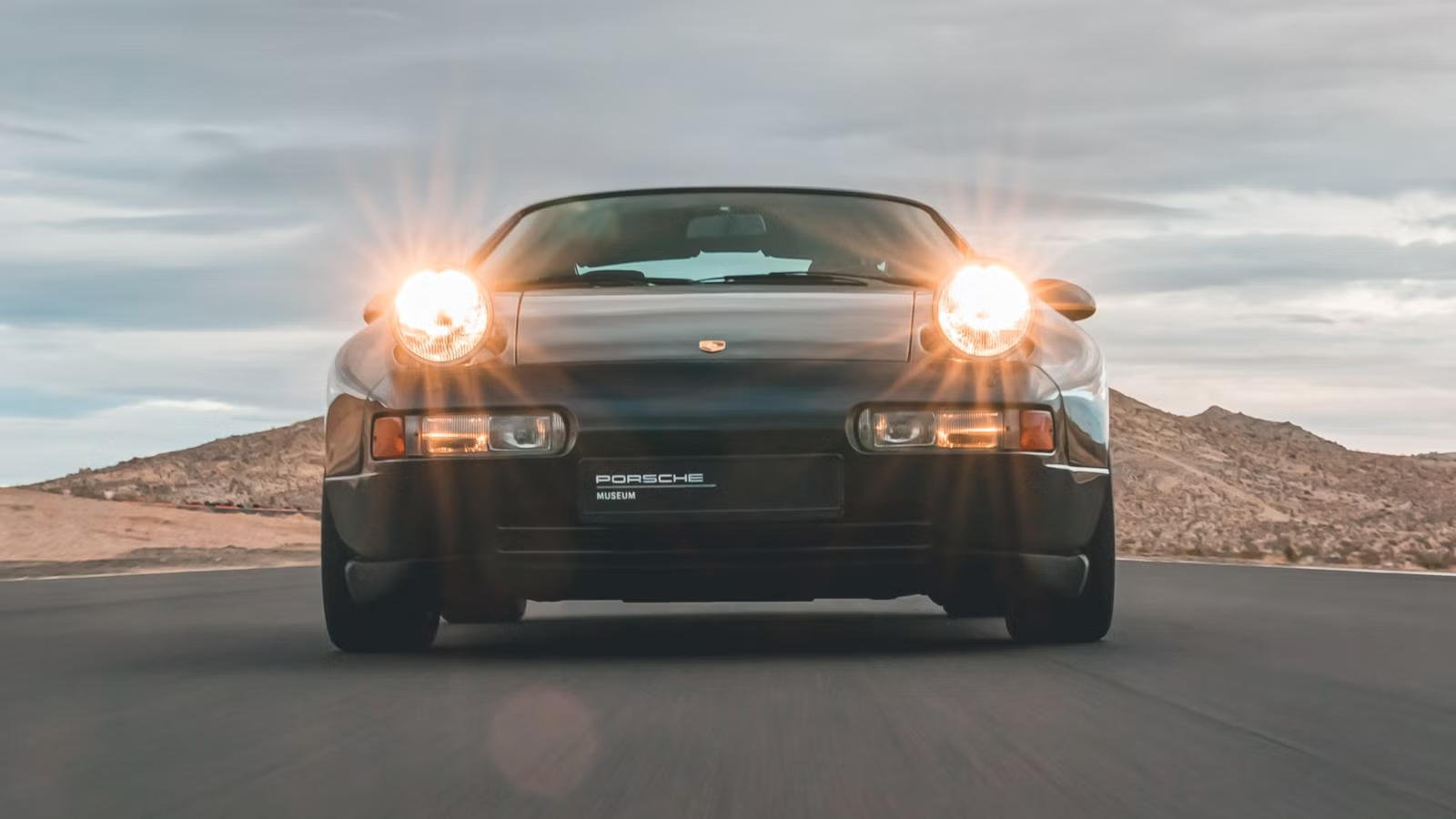
The final model to embrace the front-engined, rear-transaxled layout was the Porsche 968, released in 1991. Its purpose was to replace the 944, which had been axed the same year. However, while the number “8” sits at the end of its namesake, it actually employed the use of a large, 3.0-liter inline-four engine. Both a naturally aspirated and a turbocharged iteration were produced, the latter of which was capable of throwing out 305 hp. NA models made do with up to 237 hp.
Its final model year was 1995, the same as the 928, officially marking the end of the front-engined, rear transaxle era from Porsche.
The Porsche Transaxle In Motorsport
1993 Porsche 968 Turbo RS Yellow Front AngleDan Trent via Pistonheads.com
The rear transaxle layout seen in the models listed above was extremely beneficial when it came to racing. Mainly, this was due to the layout’s near-perfect weight distribution, making the car’s handling extremely responsive, predictable, and precise. Numerous 924, 944, 928, and 968 models achieved wins in racing, with some notable ones being the 1994 Targa Tasmania (944), three total overall wins at the Nürburgring 4-hour race (928), and the 1993 Sandown 6 Hour (968).
Related
The First Porsche With An Automatic Transmission Was Also The First With A Water-Cooled Engine
This model helped Porsche reach two very important milestones.
A Defining Moment In Automotive History
Red 1981 Porsche 924 Turbo rear badge shotBring a Trailer
Despite not being responsible for the creation of the transaxle, Porsche can be credited for bringing the setup into the world of road-going performance. Prior to its use, rear-mounted transaxle use was scarce in the US, as most vehicles used a front-engined, rear-drive layout that was, typically, very heavy at the front end. However, once Porsche showed up on our shores with models like the 924 and 928, things began to change drastically. Suddenly, our performance cars were seriously outgunned in terms of both power and handling.
Sources: Porsche, Hemmings, VWVortex.com.
