

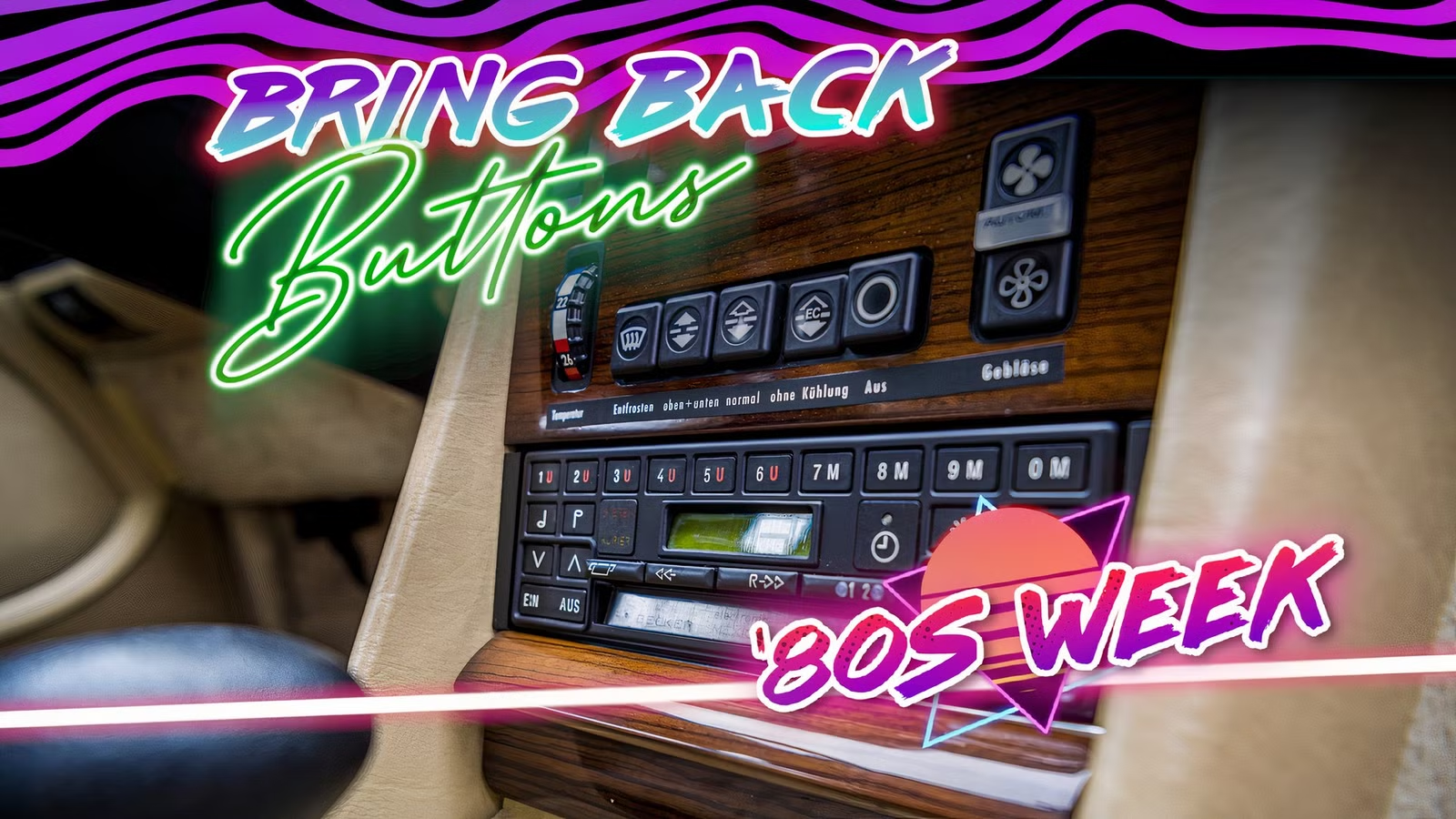
Just the other day, I found myself in a perfectly agreeable electric vehicle built for nothing more than commuting. I got in, started the thing, wirelessly connected my phone, and set off. Soon after, I wanted to adjust the temperature and hit the universal air-conditioning button, but it did nothing. This meant I had to go to the main menu, scroll to the climate control page, and then slide my finger to set the ideal temperature, which was a massive pain because the car’s damping made it feel bouncier than a jackrabbit on a pogo stick.
This is undoubtedly the one area in which cars have taken a giant leap in the wrong direction. It made me miss my 1983 Mini Clubman, not because it had no buttons, but because I could find all the buttons in pitch-black using nothing more than muscle memory. Thankfully, our celebration of 1980s week came along, presenting me with the perfect opportunity to get on my soapbox and complain about how we reached peak buttons in the 1980s.
To do this, I will be using two Mercedes-Benz models, starting with the 2026 Mercedes-Benz EQS.
Being Trapped Inside An iPad
2027 Mercedes-Benz EQSMercedes-Benz
The iPad is one of the best inventions ever, right up there with the pencil, the printing press, vaccinations, and the internal combustion engine. I was an early adopter, and I loved how much work and reading I could get done on this giant smartphone. I suppose it was only a matter of time before this new way of interacting with a computer filtered down to cars. It was okay at first, thanks to smaller, non-intrusive screens and the invention of Apple CarPlay and Android Auto, but now we have to deal with the Mercedes-Benz Hyperscreen, which feels like being trapped inside an iPad.
I could forgive Mercedes (and every other automaker) for plastering screens on every available surface if it actually made the automotive experience better. I honestly think we peaked in the 1980s. I remember growing up and reading automotive magazines during the late 1980s and early 1990s, lambasting automakers for putting too many buttons on the center console. If you look at the interior of the BMW 850CSi, you can begin to understand, and that’s why I think we peaked at cabin controls in the ’80s with a very special Mercedes-Benz.
The Sacco Era Masterclass
1993-1995 Mercedes-Benz W124 E500 Black Rear Angle DrivingMercedes-Benz
The Sacco Era refers to the period when Italian-German designer Bruno Sacco was in charge of Mercedes-Benz’s entire range. My personal favorite from this era might not be the same as yours, but they all shared the same magnificent traits, starting with the vault-like “whump” sound when closing the door.
The Mercedes-Benz of this era I love most is the 560 SEC, the coupe version of the 1979 to 1991 S-Class. I drove one briefly many years ago and thought it would be the perfect Sunday car once I reached 50. These days I look back at it as the perfect example of how progression is being disguised as regression.
The Anatomy of a Perfect Button
Juan Martinez / RM Sotheby’s
Did you know Mercedes-Benz once spent millions of dollars to find the perfect resistance for a button? Basically, the engineers found the exact pressure that a person needed to apply, so that pressing a button was substantial without being a hindrance. Plus, the switch needed to make the perfect “clicking” sound and be positioned in the right spot for the driver to find it without taking their eyes off the road.
As evidence, I want to focus on four features you’ll find inside the 560 SEC.
The Window And Seat Adjustment Switches
Juan Martinez / RM Sotheby’s
Located on the center console, the window switches require a deliberate, heavy press. They feel like industrial switchgear disguised as luxury hardware. They are beautifully spaced, and there’s nothing else around them you can accidentally press. The seat adjustment buttons are located above and in front of the armrest. It’s a feature that works so well that you can still find it in modern Mercedes models.
The Becker Or Alpine Radio
Juan Martinez / RM Sotheby’s
The dials have a heavy, oiled damping to them. Adjusting the volume feels like calibrating a rifle’s scope.
The Climate Controls
Zach Brehl / RM Sotheby’s
These aren’t really buttons, but we’ll discuss them anyway. The system used heavy, mechanical rollers to set the climate, while the fan speed and location of the airflow were set by knobs that wouldn’t feel out of place in a modern Bentley.
The Steering Wheel
The steering wheel doesn’t have any buttons, and that’s equally important. In a 560 SEC, the steering wheel is used only for steering, and occasionally for hooting at poor people.
Related
This Is The Most Reliable Mercedes-Benz Ever Made
The W123 can survive anything, including humanity.
Why The 80s Were Peak
1991 Mercedes-Benz 560 SEC 6.0 AMG Wide-Body – Marakaito Missile InteriorRM Sotheby’s
Interestingly, the 1980s did provide us with a glimpse of the modern world, and it was terrible. The Aston Martin Lagonda had a fully digital dashboard with touch-sensitive controls, but they were notoriously unreliable. In 1988, the Buick Reatta brought similar technology to a more affordable vehicle. These poor results should have been a warning to interior designers, but alas.
It was inevitable, however. Automakers try to sell these screens as the next big thing, but some uncomfortable truths prove the interior designers of the ’80s did a better job.
Cost-Cutting Masquerading As Futurism
2027 Mercedes-Maybach S-ClassMercedes-Benz
Modern car companies pitch massive touchscreens and capacitive glass panels as “the future.” In reality, a glass screen is infinitely cheaper to manufacture than dozens of individually engineered, heavily damped mechanical switches.
In short, modern cars are built to a budget, and that’s not what things were like in the Bruno Sacco era. In the ’80s, every single button in an S-Class was built to a high standard, no matter the cost.
Muscle Memory Beats Swiping, And Talking
Turning down the AC in a modern Mercedes requires eyes off the road, a tap on a sub-menu, and a prayer that the haptic feedback registers. In the 560 SEC, the iconic door-mounted seat adjustment switch is shaped exactly like a seat. The layout is intuitive design at its finest.
“Piano Black” Epidemic
2024 Volkswagen Golf GTI 380. Cabin. Interior. Gearlever. Piano Black PlasticVolkswagen
The 560 SEC features heavy Zebrano or Burl Walnut wood and matte plastics that look as good today as they did in 1988. Modern Mercedes cabins are plagued by high-gloss “Piano Black” plastic and glass. These materials look stunning for exactly four seconds in a showroom before becoming a crime scene of fingerprints, dust, and micro-scratches.
Related
Why Piano Black Plastic Is The Worst Design Trend In Modern Car Interiors
Why it sucks, why it’s used, and why it probably will be for a while to come
Automakers Understood Luxury In The 1980s
2027 Mercedes-Maybach S-ClassMercedes-Benz
In the early 1990s, the magnificent E38 BMW 7 Series became the first European car to offer modern satellite navigation. I remember staring at images of that car’s interior, wondering how they got a TV screen to fit on the dashboard. This was way before TVs were thin enough to be blown over by a slight gust of wind. If only we could go back in time and prevent that from happening.
I might be a bit overdramatic, but I can’t be the only person sick of screens. Luxury used to mean comfort, ease of use, space, quality materials, and light. Technology used to play a role in luxury, but these days it appears as if one has been confused with the other. I don’t want a screen with thousands of “mood” settings, or a built-in voice I can talk to. I simply want a beautifully crafted volume button that makes Alanis Morissette louder, and when I press it, I want her to go away so I can cruise in silence.
