

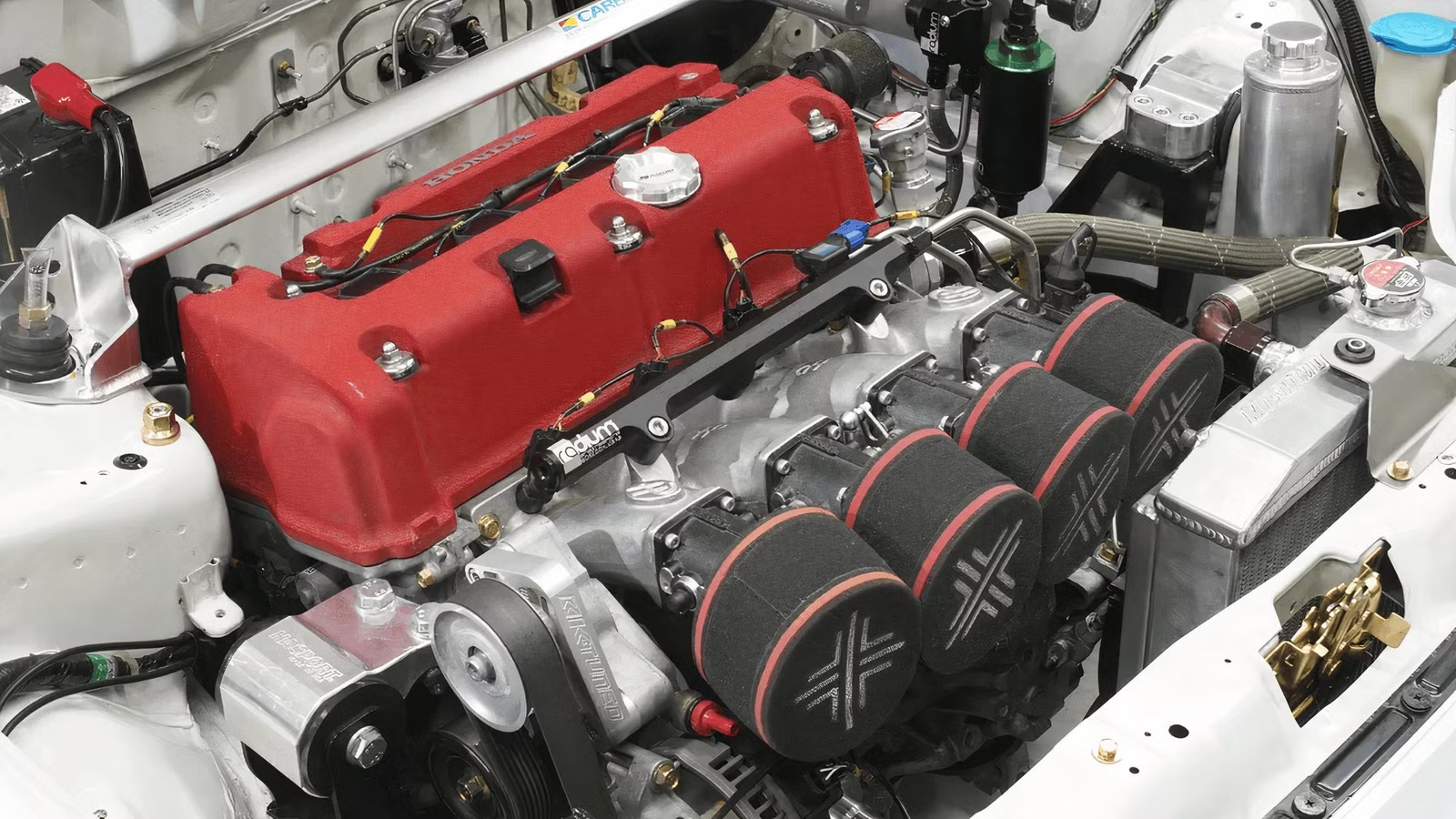
The world of tuning is a rich and complex subset of the automotive community. Ever since the very first cars were created, gearheads have been looking to upgrade their vehicles, making them faster and more powerful. The variety of modifications is nearly infinite. Whether you’re making minor upgrades to an otherwise stock vehicle, or creating an elaborate build with a new engine and several new parts, the only limit is your imagination (plus, of course, your budget and your willingness to spend weekends working on your dream car).
Although the evolution of automotive technology has made modern engines efficient and powerful, sometimes older is better. In this list, we have assembled a group of 10 inline-four engines that are not exactly recent, but are still highly popular among tuners. Some are naturally aspirated; some are turbocharged. However, what they all have in common is that, despite their age, they are firm favorites in the tuning community, even outperforming modern-day turbocharged engines. Let’s take a closer look at these engines and what they have to offer.
Items are listed in no particular order. Horsepower figures refer to each engine in its stock form.
Mitsubishi 4G63
1999 Mitsubishi Carisma GT Tommi Makinen Edition 4G63 Turbo I4 EngineMitsubishi
Years Produced
1980-2013
Horsepower
~135-200
Displacement
2.0 liters
Turbo / NA?
NA (turbocharged 4G63T version also available)
We start our list with the Mitsubishi 4G63 engine. This 2.0-liter engine is a member of Mitsubishi’s “Sirius” engine family. This engine has a strong connection with the world of motorsport because its turbocharged sibling (the 4G63T) could be found under the hood of several Mitsubishi cars competing in the World Rally Championship.
In the tuning community, the 4G63 is prized for its versatility and ability to handle major upgrades. While stock power outputs range between around 135 and 200 hp (for the NA version) and 190 and 280 hp (for the turbocharged version), tuners have been able to get up to 400-600 hp from this engine without sacrificing durability.
Honda F20C/F22C1
Honda F22C1 engineRich Niewiroski Jr/Wikimedia Commons
Years Produced
1999-2009
Horsepower
237-247 hp
Displacement
2.0L / 2.2L
Turbo / NA?
NA
The F20C and F22C1 were a pair of engines built to power Honda’s legendary S2000 sports car. The 2.0-liter F20C exclusively powered the model’s first generation, while the North American and Japanese versions of the second-gen model featured the 2.2-liter F22C1.
The F20C and F22C1 are famous for being thrilling, high-revving engines; the F20C’s redline is 8,800 rpm, while the F22C1’s is 8,000 rpm. The two engines are also highly reliable, in line with Honda’s reputation as a brand. These characteristics make them an excellent blank canvas for tuners bringing their dream build to life.
Toyota 4A-GE 20v
Toyota 4A-GE 20-valve engineEvansam-commonswiki
Years Produced
1991-2000
Horsepower
158-163 hp
Displacement
1.6 liters
Turbo / NA?
NA
The Toyota 4A-GE engine is part of Toyota’s “A series”, a large family of engines that traces its origins back to the late 1970s. One of its predecessors was famously used in the legendary AE86 of “Initial D” fame.
The 4A-GE comes in two different versions: a 16-valve one and a 20-valve one, with the latter being a popular choice for enthusiasts looking to perform an engine swap. There are plenty of characteristics that make this engine a favorite: its 20-valve setup allows for improved airflow, while its redline of 7,800 rpm (for the “Silver Top” version) or 8,400 rpm (for the “Black Top” version) produces a thrilling driving experience.
Nissan SR20DET
Press image of the Nissan SR20DET EngineNissan
Years Produced
1989-2002
Horsepower
201-247 hp
Displacement
2.0 liters
Turbo / NA?
Turbo
The Nissan SR20DET is a 2.0-liter turbocharged engine from Nissan’s SR series. It was used in a wide variety of Nissan models between the late 1980s and the early 2000s, including the S13 and S14 Silvia. The Silvia’s North American counterpart, the 240SX, did not get this engine, but today, the SR20DET is a common engine swap option for American 240SX owners.
The engine’s compact and lightweight architecture, as well as its responsiveness to upgrades, which results in large power boosts, make the SR20DET a popular engine in the tuning community. Its forged-steel crankshaft makes it highly resilient and durable, and the wide availability of aftermarket parts and resources makes it easy to upgrade.
BMW S14
BMW S14 engineSbscottw via Wikimedia Commons
Years Produced
1986-1991
Horsepower
189-235 hp
Displacement
2.0-2.5L
Turbo / NA?
NA
While the first part of our list has focused on Japanese engines, we now move to Germany with our next entry: the BMW S14. This engine has an important place in BMW’s history, as the last M-badged inline-four unit produced by the brand. Part of the S14’s strong reputation comes from its link to the racing world: it is based on the M10 engine block, which also served as the basis for the turbocharged M12 engine BMW used in Formula 1.
Thanks to its motorsport DNA, the S14 can handle extensive modifications; however, be aware that it also has a reputation for being slightly expensive to maintain, so saving up some extra cash might be a wise move.
Cosworth YB
Ford-Cosworth YB engineOSX/Wikimedia Commons
Years Produced
1985-1996
Horsepower
204-224
Displacement
2.0 liters
Turbo / NA?
Turbo
This 2.0-liter turbocharged engine, built by the legendary British automotive firm Cosworth, is based on Ford’s T88 engine. The YB was first introduced in 1986 with the legendary Ford Sierra RS Cosworth, a model produced for homologation purposes as part of Ford’s Group A racing program.
Its motorsport heritage is a major part of why the YB is popular with tuners. Built with the racetrack in mind, the engine is highly durable, endures severe stress with ease, and responds well to modification. The road-going Sierra RS Cosworth produced 201 hp, but with modifications such as an upgraded turbocharger or upgraded cooling, the YB engine can be pushed to produce over 500 hp.
Related
Honda S2000 to BAC Mono R: The Ultimate High-Revving Four-Cylinder Engines
Of the many cars that have debuted in the last two decades, these are some of the highest-revving four-cylinder cars.
Honda K-series (K20A/K20C)
Honda K20A engine top viewHonda
Years Produced
2001-2011 (K20A) / 2015-present (K20C)
Horsepower
150-221 hp (K20A) / 150-320 hp (K20C)
Displacement
2.0 liters
Turbo / NA?
NA (K20A) / NA or turbo (K20C)
Another Honda engine family: the famous K-series, which has made its way into countless weird and wonderful “K-swap” builds. The K family comprises several engines, but the K20A and K20C are among the most popular choices. The former produces up to 220 hp in stock form, while the latter goes up to 320 hp.
Both engines, however, can be tuned to produce much higher output without sacrificing Honda’s trademark reliability. Features such as the robust aluminum cylinder block make K-series engines resilient and durable. They are highly versatile for engine swaps, which is how K-swapping became so popular; they are also highly efficient thanks to VTEC technology.
Volkswagen 1.8T 20v
2001 Volkswagen Golf GTI 1.8T Mk 4 engineVW
Years Produced
1993-2010
Horsepower
~150-250 hp
Displacement
1.8 liters
Turbo / NA?
Turbo
This Volkswagen engine has a strong association with the tuning community thanks to its durability. Among other features, its cast-iron block and (in some examples) forged crankshaft contribute to the unit’s resilience. As this engine was produced in large numbers, it’s fairly easy to find one, and major power gains can be had with relatively small upgrades.
Its success led to a long production run: the engine was around for 15 years, from 1995 to 2010. Although it was used in a variety of models, one of its most famous applications was in the fourth-generation Golf GTI. This model was sold in the US between the 1999 and 2005 model years; it attracted controversy thanks to its design, however its engine was considered one of its strong points.
Related
Ranking Every Volkswagen Golf GTI Generation From Worst To Best
Like our recent Miata ranking piece, this is bound to hurt some feelings.
Mitsubishi 4B11
Mitsubishi 4B11 engineQurren/Wikimedia Commons
Years Produced
2006-2017
Horsepower
148-156 hp
Displacement
2.0 liters
Turbo / NA?
NA (turbocharged 4B11T version also available)
We go back to Mitsubishi with the 4B11, an engine that was first introduced in 2007 but is still used on some models today (in the US, you can find it in the Eclipse Cross). This engine is part of the 4B1 engine family, which also includes three other units (one of them being the 4B11T, a turbocharged version of the 4B11). All engines in this group have an aluminum cylinder block and head, which keeps weight down.
Tuners love the 4B11 for its resilience, low weight, and potential for large power gains. In stock form, the 4B11 produces around 150 hp; with a few upgrades, tuners can get more than twice that.
GM LK9
GM LK9 / Saab B207 engineMonza-2t/Wikimedia Commons
Years Produced
2003-2012
Horsepower
210 hp
Displacement
2.0 liters
Turbo / NA?
Turbo
The last engine on our list is General Motors LK9, a turbocharged engine in the Ecotec family. This engine is known by a few different names, as a variety of GM-owned brands used it. Saab called the unit the B207, while over in Europe it was used by Opel as the Z20NET. Fans of the Ariel Atom should also be familiar with the supercharged variant of the LK9 that powered the Atom 2. The LSJ, which is renowned for its performance and made it onto the Ward’s Best 10 Engines List in 2006.
Thanks to its performance DNA, the LK9 has a wide range of parts available for those who wish to upgrade. Although in stock form, the engine produces just over 200 hp, its sturdy architecture enables it to produce 300-350 hp without internal modifications.
Sources: Mitsubishi, Honda, Toyota, Nissan, BMW, Ford, Volkswagen, General Motors
